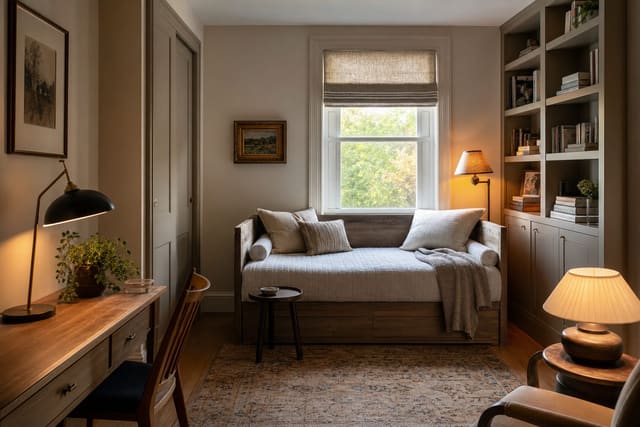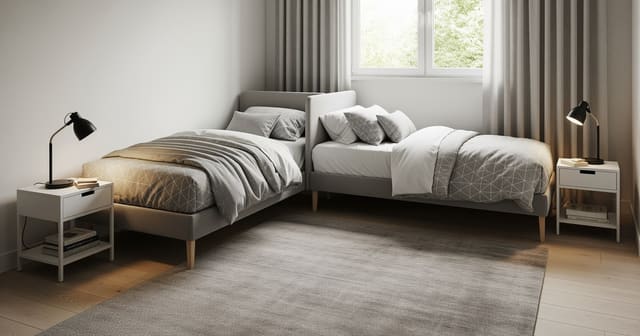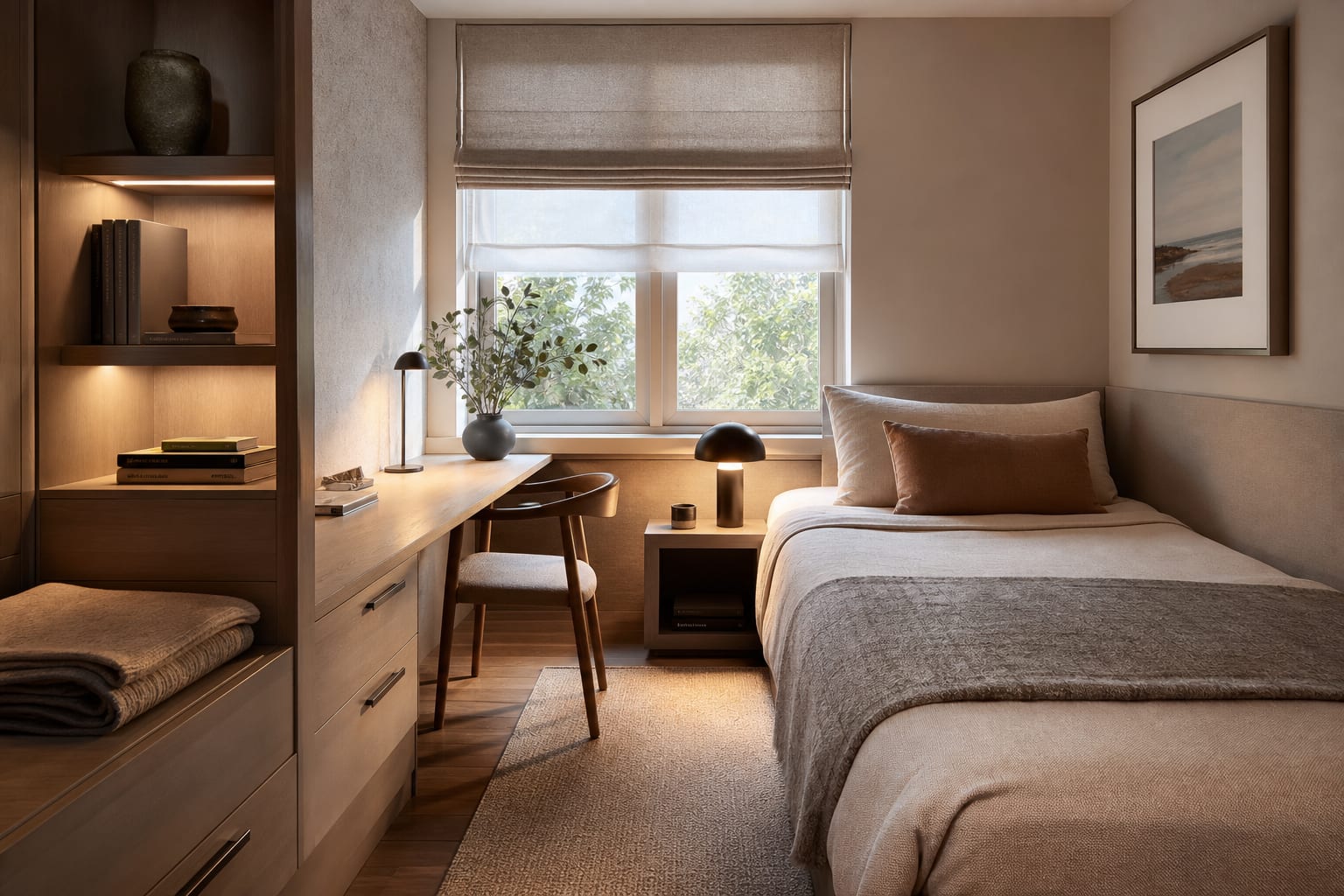
A guest room home office combo works best when the desk owns the daylight wall and gets the best chair, while a queen daybed or murphy bed absorbs the sleep function in minutes. You decide which use is daily, give that use the prime wall, and make the occasional use fold, shrink, or hide. These six layouts show how to make the combo feel deliberate, not apologetic.
What makes a guest room office combo actually work?
You combine a guest bedroom with a home office by giving the daily work zone the best light, choosing a guest bed that doesn't dominate the floor, and building enough closed storage that neither role leaves evidence everywhere. Most spare rooms fail because the desk sits in the darkest corner, the bed blocks the closet, and cables are visible from the pillow.
Rank the two functions honestly. If you work from home four days a week but host guests six weekends a year, the desk gets the window and the cleanest wall for calls. If guests stay for two weeks at a stretch, the bed needs 24 inches of clearance on one side so luggage isn't a trip hazard.
Even a 10-by-11-foot room needs three zones: a work surface at least 42 inches wide, a sleep surface sized for real visitors, and a landing spot for clothes or supplies. The same flexible-room thinking applies in flex room spare bedroom ideas — one room, one primary job, one secondary job, not six half-finished ones.
The bed decision that controls the whole layout
The bed is the bully in this room: a queen mattress alone is 60 by 80 inches before frame or nightstands, often leaving the office a leftover strip of wall.
- Murphy bed: the cleanest option if your wall and lease allow it. Place a full or queen wall bed on the longest uninterrupted wall, desk opposite or near the window, with at least 30 inches clear in front when folded down.
- Daybed: the better middle ground for renters. A twin daybed with a real mattress and tailored cover reads as a lounge seat on workdays. This overlaps with a twin bed bedroom layout, where fewer mattress inches often make a more adult room.
- Sleeper sofa: works only if comfortable in both modes; many need 84 to 90 inches of clear projection when open. Add a curtain or cabinet doors so the desk gear doesn't dominate the guest view.
Test this on your own room photo with ReDesign before committing — keep the daylight, ceiling line, and main path visible so the preview solves your actual room.
Six layouts that solve the room without pretending it's huge
- Window desk, daybed on the side wall. Desk under or perpendicular to the window; twin daybed along the longest side wall. Use a 22 to 24 inch deep writing desk unless the room is 10+ feet wide.
- Murphy bed wall, floating work wall opposite. A 15 inch deep cabinet across from the wall bed holds files, a printer, and guest linens without stealing floor space.
- Queen bed centered, desk as nightstand. Best for frequent guests, not daily calls. Use a 36 to 42 inch desk beside the bed with a plug-in sconce above it.
- Sleeper sofa facing a cabinet desk. Hide the office in a secretary desk or armoire with doors. Keep the walking path at 24 inches or more when the sofa is open.
- Two-zone room with a low divider. Desk near the window, bed at the far end, separated by a 30 to 42 inch bookcase that keeps daylight moving.
- Corner workstation, compact full bed. An L-shaped surface no deeper than 24 inches per side works for laptops but not dual monitors unless the room is 11 by 12 feet or larger.
Common guest room office combo mistakes
Buying a queen bed before checking the desk chair's pullout is the top mistake — a chair needs roughly 30 inches behind the desk, so tape both zones on the floor before ordering anything upholstered.
Treating storage as an afterthought is next. A narrow wardrobe, wall cabinet, or storage bench can replace a bulky dresser, echoing the strategy in dresser alternatives for small bedrooms.
Letting office lighting double as bedroom lighting also backfires. Use a focused 3000K task lamp at the desk and warmer 2700K bedside light with a shade, or put one dimmable fixture on both duties.
Finally, a messy video-call background undercuts the whole layout. Pick one calm camera wall — art, closed shelves, or a curtain — so guests don't sleep inside your work archive and coworkers don't see a pillow pile.
Use AI to preview your guest room office before you commit
This layout fools people on paper: a bed can fit mathematically and still trap the desk, or a Murphy panel can block the closet door once open. Preview it first.
Upload photos from the doorway and the opposite corner so the window, closet, and outlets are visible. Ask for versions with a Murphy bed, a twin daybed, a sleeper sofa, and a queen-bed-with-desk-nightstand plan, keeping wall color and flooring steady so you judge layout, not style.
Check for real conflicts: Does the chair clear the bed? Can a guest reach a lamp without moving your laptop? Is there a 24 to 30 inch path to the sleep surface? Does the desk get afternoon glare?
The winning version keeps the daily job easy and the guest job gracious: visible floor, controlled cables, a real reading light, and a work zone that can disappear for a weekend. For the broader upload workflow, see the AI design complete guide, then return here for room-specific scale and layout choices.
Frequently Asked Questions
Is a daybed or Murphy bed better for a guest-room office?
A queen daybed reads as seating most days and sleeps two adults on guest weekends. A Murphy bed disappears completely but needs an 84 inch clear wall and 60 inches of swing space, which most home offices don't have.
How do I share storage between guest and office uses?
Assign one closet shelf and the top half of one cabinet to guest linens and toiletries; the rest stays office gear. The room never needs a full "switch," only tidying between uses.
Where does the desk go if a daybed dominates the wall?
Place the desk perpendicular to the daybed against the window wall so video calls frame a clean background. Check chair pullout, walkway width, door swing, and glare before finalizing, since those matter more than a catalog-perfect angle.
Will a guest see my work paperwork?
Use one locked cabinet or rolling file for sensitive documents. Open bookcase contents are fine, but client files, pay stubs, and HR paperwork belong behind a closed door regardless of how often guests visit.
Is a sleeper sofa good enough for a guest-room office?
Only for 1 to 2 night stays. Pull-out mattresses run 4 to 5 inches thick and strain an adult's back past two nights, while a queen daybed mattress at 8 to 10 inches sleeps much closer to a real bed.
> Try this: Ready to see this on your own room? Open ReDesign and run the preview before you buy, paint, drill, or move furniture.
Three transformations to try
1. Queen daybed with perpendicular desk and shared closet shelf 2. Murphy bed wall with desk in front, swung up for guests 3. Sleeper sofa for occasional guests with full office wall