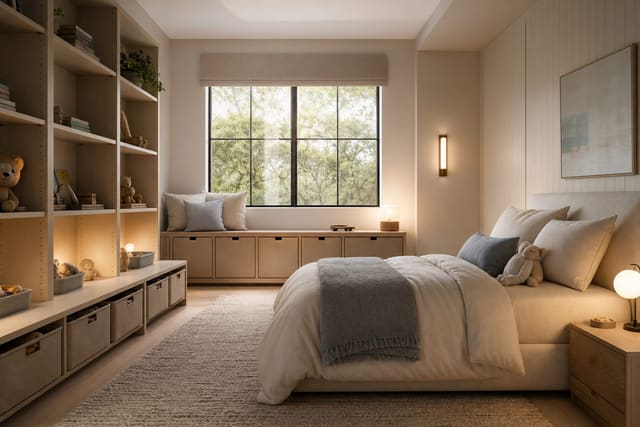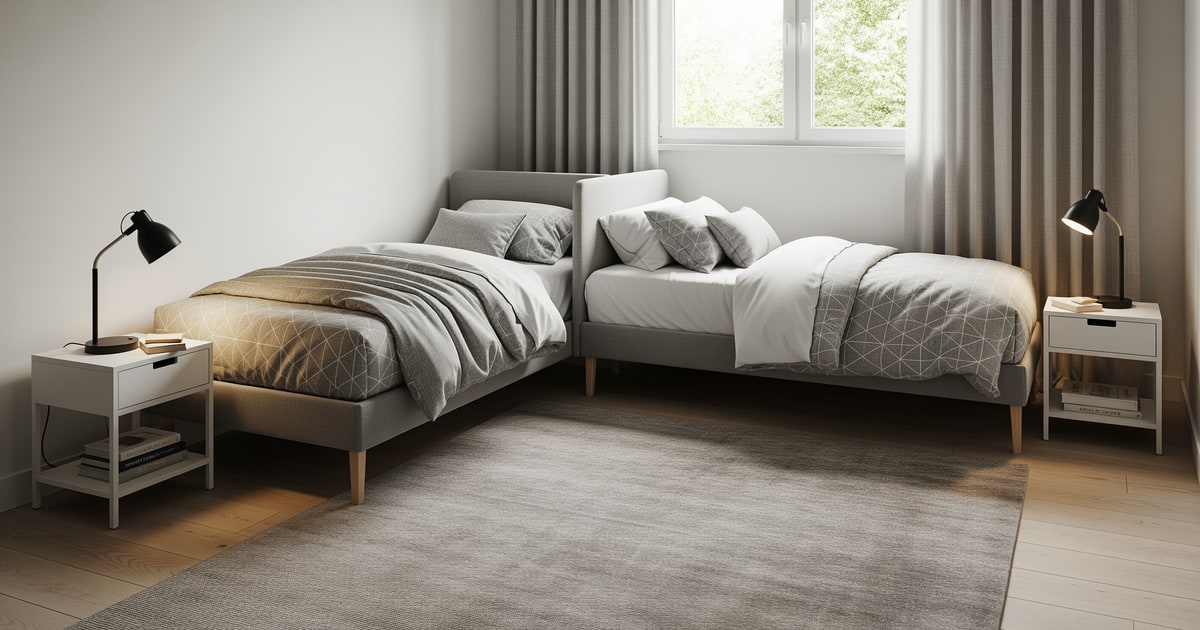
A twin-bed bedroom lays out best when one twin pushes lengthwise against the long wall (or two twins share the wall with a 18 to 24-inch shared bedside between), the dresser and closet take the opposite wall, the desk or play zone tucks under the window, and the rug spans 5 by 8 feet to anchor the bed zone separately from the play or work zone. Two twin beds in a single room is one of the oldest design challenges in residential architecture. Most rooms default to the obvious: both beds against the same wall, side by side, with a single nightstand between them. It works. It also leaves half the room unused, eliminates any sense of individual zones for the people sharing the space, and feels like every summer camp dormitory you've ever seen. Five other arrangements solve the same square footage problem with dramatically more personality and function.
How do you arrange two twin beds in a small bedroom?
Choose from six layouts based on the room's proportions and the relationship of the people sharing it: side-by-side, L-shaped corner, foot-to-foot, bunk stack, loft with desk below, or daybed-plus-trundle. The right layout depends on window placement, door swing, and whether each occupant needs a dedicated homework zone. A 10x12 room can support any of these if the beds are twin XL (38"x80") and the clearance between beds is at least 24".
Layout 1: Side-by-side, with a real gap
The default — but done well. Two twins against the same wall with 24"–36" between them and a nightstand in the gap. - Spec: Each bed against the wall with the headboard at 3"–6" from the wall. Nightstand between them at 16"–18" width, 26"–28" height. - What makes it not the default: A room-width headboard that spans both beds unifies the wall. IKEA and Pottery Barn both offer paneled headboards that run 100"–120" wide. The twin beds read as a single intentional composition. - Works in: Rooms 10' or wider. Ideal for siblings who want identical setups.
Test this on your own room photo with ReDesign before you choose the final direction; keep the doorway, walls, windows, main furniture, lighting, and awkward fixed features visible so the preview solves the room you actually have.
Layout 2: L-shaped corner
One bed against each wall, headboards sharing a corner. - Spec: Headboard on the long wall, second bed perpendicular on the short wall. Corner nightstand (triangular or wedge-shaped) fills the space where the two headboards meet. - Clearance: 36" from the foot of each bed to any obstacle. - Benefit: Each bed reads as its own zone. Occupants face different directions, which provides visual privacy even in one room. - Works in: Nearly square rooms. Especially good when each occupant needs their own wall for a desk or bookcase.
Layout 3: Foot-to-foot, centered in the room
Both beds pushed to opposite short walls, foot ends facing each other with a shared 36"–48" gap in the middle. - Spec: Headboards at opposite walls. The gap in the center serves as the shared floor space — a rug, a small table, or an open play zone. - Benefit: Maximizes wall space on the long walls for desks, dressers, and bookshelves. Each occupant has full use of their short wall. - Best in: Narrow rooms (9'–11' wide, 12'–16' long) where side-by-side doesn't fit and L-shaped wastes a wall.
Layout 4: Bunk stack
Two twin beds stacked vertically. Recovers the floor footprint of one twin entirely. - Spec: Standard bunk footprint 41"x80"; ceiling clearance for the top bunk: 36"–42" minimum from mattress top to ceiling. - What the floor plan gains: 33 square feet of open floor — enough for a desk, a reading chair, or a large dresser. - Caution: Children under 6 should not sleep on the top bunk. Safety rail required. Access ladder must not block the door swing. - Best in: Rooms under 120 sq ft where floor space matters more than separation.
Layout 5: Loft with desk below
One twin lofted at 5'–5.5' height; a full-width desk, bookcase, or wardrobe underneath. - Spec: Loft platform 42"–46" off the floor (sitting headroom below: 36"–42"). Twin mattress above. Desk or shelving built into the space below. - Benefit: The loft occupant gets a private raised sleeping zone; the desk occupant gets a defined work space. Two functions, one footprint. - Best in: Single-occupant rooms where one child wants both a private loft and a dedicated desk. Not ideal for shared rooms unless the second bed is freestanding on the opposite wall.
Layout 6: Daybed plus trundle
One daybed (functions as a sofa by day, twin by night) with a trundle that rolls out for the second sleeper. - Spec: Daybed is 38"x75"–80"; trundle rolls out to the same footprint on the floor. Combined sleeping: two twins. Combined daytime: one compact sofa. - Benefit: During the day, the room reads as a single-bed guest room or a sitting room. At night it becomes a two-person room. - Best in: Guest rooms or flex rooms where the two-bed function is occasional rather than nightly.
Clearance specs for twin bed rooms
| Clearance zone | Minimum | Comfortable |
|---|---|---|
| Between beds (side-by-side) | 24" | 36" |
| Foot of bed to wall/furniture | 30" | 36"–42" |
| Bed to door (door swing) | 24" | 36" |
| Bunk top rail to ceiling | 36" | 42" |
Twin rooms need shared symmetry without pretending both sleepers use the room the same way. A standard twin is 38 by 75 inches, so two beds plus a 24 inch center gap already consume 100 inches before any outer clearance. If the room is under 10 feet wide, consider a single shared table 30 to 36 inches wide instead of two nightstands. Wall sconces or clip lights keep the surface clear, and matching headboards create order even when bedding differs. If the room is for children, the long-game storage strategy in kids room design matters more than a themed quilt.
The second product pick is the frame. Low upholstered twins, simple wood spindle beds, or metal frames with open legs keep the room lighter than storage beds on both sides. Storage beds are useful only when the drawers can fully open; in many small rooms they create blocked drawers and bruised shins. For a guest room, use two extra-long twins only if the room can handle the extra 5 inches of length. Owners can add one centered sconce pair or a shared pendant; renters can use plug-in sconces and a flat-weave rug to unify the layout. If someone asks whether a larger bed would be simpler, compare the clearance math in small bedroom king bed layouts before deciding.
Common twin-bed-room mistakes
- Both beds against one wall with no clearance between them. No individual identity for either occupant.
- Matching everything. Matching bedspreads + matching lamps + matching nightstands = institutional. Differentiate the textile or the lamp silhouette between the two sides.
- A bunk in a room with 8' ceilings. Standard bunks need 9'+ for safe top-bunk clearance. Measure before ordering.
- Foot of the bed directly against the dresser. The occupant can't stand up fully before hitting furniture.
- No desk space. Every shared children's bedroom needs at least one desk surface even if it's wall-mounted.
- Making both sides symmetrical when the room is not. Symmetry looks calm, but forcing it into an off-center window or closet path can waste the best storage wall.
- Choosing storage beds without drawer clearance. A drawer that opens six inches is not storage; it is a daily reminder that the layout was forced.
Use AI design to preview each layout before buying beds
A layout that looks fine in a floor plan drawing may feel wrong in the actual room. AI design lets you photograph the empty room and preview the L-shaped layout, the foot-to-foot layout, and the bunk arrangement side by side — in the actual room, not a blank floor plan — before you buy anything. For a decision that usually costs $1,000–$3,000 in beds and furniture, the preview pays for itself.
Frequently Asked Questions
How do I arrange two twin beds in a small bedroom?
Place both twins against the long wall with an 18 to 24-inch shared nightstand between for the dual-twin look, or one twin on each opposing wall with a shared rug at center for sibling rooms. Use the room photo to compare the visible layout and fixed constraints before committing, because door swings, windows, outlets, storage reach, circulation, and existing furniture decide whether the idea survives daily use.
What is the best layout for a single twin bedroom?
Push the twin lengthwise against the long wall as a daybed (with throw pillows along the wall), leaving the rest of the room for a desk and storage; the daybed orientation reads more designed than the traditional headboard-out layout. Keep the preview honest by leaving the problem area visible in the frame, then compare one conservative version against one bolder version before you buy lighting, paint, furniture, or storage.
How much space between two twin beds for a kids room?
Aim for 18 to 24 inches between beds for a shared nightstand or simple gap; below 18 inches, no nightstand fits and the visual reads as a king with a seam. Check the result against ordinary movement first: drawer clearance, chair pullout, walkway width, glare, switch access, and sightlines matter more than a perfect catalog angle.
What rug size works in a twin-bed bedroom?
A 5 by 8 or 6 by 9 rug centered on the bed zone — front feet of the twin (or twins) on the rug — anchors the sleeping area separately from the play or desk zone. Use the image to narrow priorities and measurements before ordering anything custom; final purchases still need real dimensions, outlet locations, installation limits, and product clearances.
Should I put the twin bed under the window?
Avoid when possible — daylight wakes kids early, curtains overhead become a hazard, and headboards crowd the window casing; place the twin perpendicular to the window instead. If the preview invents architecture or hides the awkward feature you need solved, rerun it with stricter instructions so the result remains tied to your actual room.
> Try this: Ready to see this on your own room? Open ReDesign and run the preview.
Three transformations to try
1. Two twins with shared nightstand against long wall 2. Single twin pushed lengthwise as daybed 3. Sibling twins on opposite walls with shared rug