The right home bar is the one that matches how often you actually pour, not the one that looks best in a catalog. My honest take: most people overbuild, dropping money on a wet bar they use twice a year when a well-styled cart would have done the job and moved when they rearranged the room. Start by counting how many bottles and glasses you genuinely keep out, then pick the format that holds exactly that.
I think the format question, cart versus cabinet versus built-in, is really a commitment question. A cart asks for nothing but a square of floor. A built-in asks for plumbing, a budget, and a wall you will never want back. Match the ambition to the use and the bar earns its spot every evening.
Idea 1: The bar cart for renters and small rooms
A bar cart is the most flexible home bar there is, and for most apartments it is all you need. A typical cart runs about 24 by 18 inches and rolls, so you can park it beside the sofa for a party and tuck it into a corner the rest of the week. Because it claims so little floor, a cart fits rooms where a cabinet would crowd the walkway. If your living room is already short on storage, the cart keeps the bar from stealing a wall you need, much like the open-plan thinking in my living room without TV ideas.
Here is how I style a cart so it reads as designed, not cluttered:
- Top shelf: 6 to 8 bottles you actually reach for, tallest at the back.
- Bottom shelf: glassware, a bucket, and a small tray for tools.
- One vertical element: a bud vase, a short stack of cocktail books, or a small lamp.
- One bar tool set on display: a shaker and jigger earn their visual space.
- A repeated metal finish, brass or matte black, tying the cart to nearby hardware.
- A 12-inch buffer of clear floor so it can roll without scraping the sofa.
The discipline of a cart is that it cannot hold everything, which is the point. Edit to the bottles you pour weekly and the cart looks intentional instead of like a liquor stash on wheels. A common upgrade is to add a small tray on the top shelf, roughly 12 by 16 inches, so the working bottles sit on a defined surface and the cart stops feeling like loose objects rattling on metal.
Material choice does a lot of quiet work on a cart. A mirrored or glass shelf bounces light and makes a modest collection feel richer, while a warm wood or brass cart reads softer against a sofa. Whatever you pick, repeat that finish somewhere nearby, in a lamp base or a picture frame, so the cart belongs to the room rather than floating in it as an obvious add-on.
Idea 2: The cabinet bar that hides in plain sight
If you own the place and want more capacity without construction, repurpose a cabinet. A credenza, a vintage hutch, or a dedicated bar cabinet on a 36 to 48-inch footprint holds 20 to 30 bottles and a full glass set, and it closes up when guests are not over. I like this approach because it scales with a real collection while keeping the everyday room calm; a closed door hides the working clutter that an open cart cannot.
Look for a piece with one fixed shelf strong enough for bottles, which are heavy, and at least one drawer for tools, napkins, and a corkscrew. A pull-out shelf at counter height gives you a surface to mix on without buying counter space. The color of the cabinet matters as much as its storage; a deep cabinet can anchor a room, and the palette logic in my living room color ideas helps decide whether it should blend or stand out.
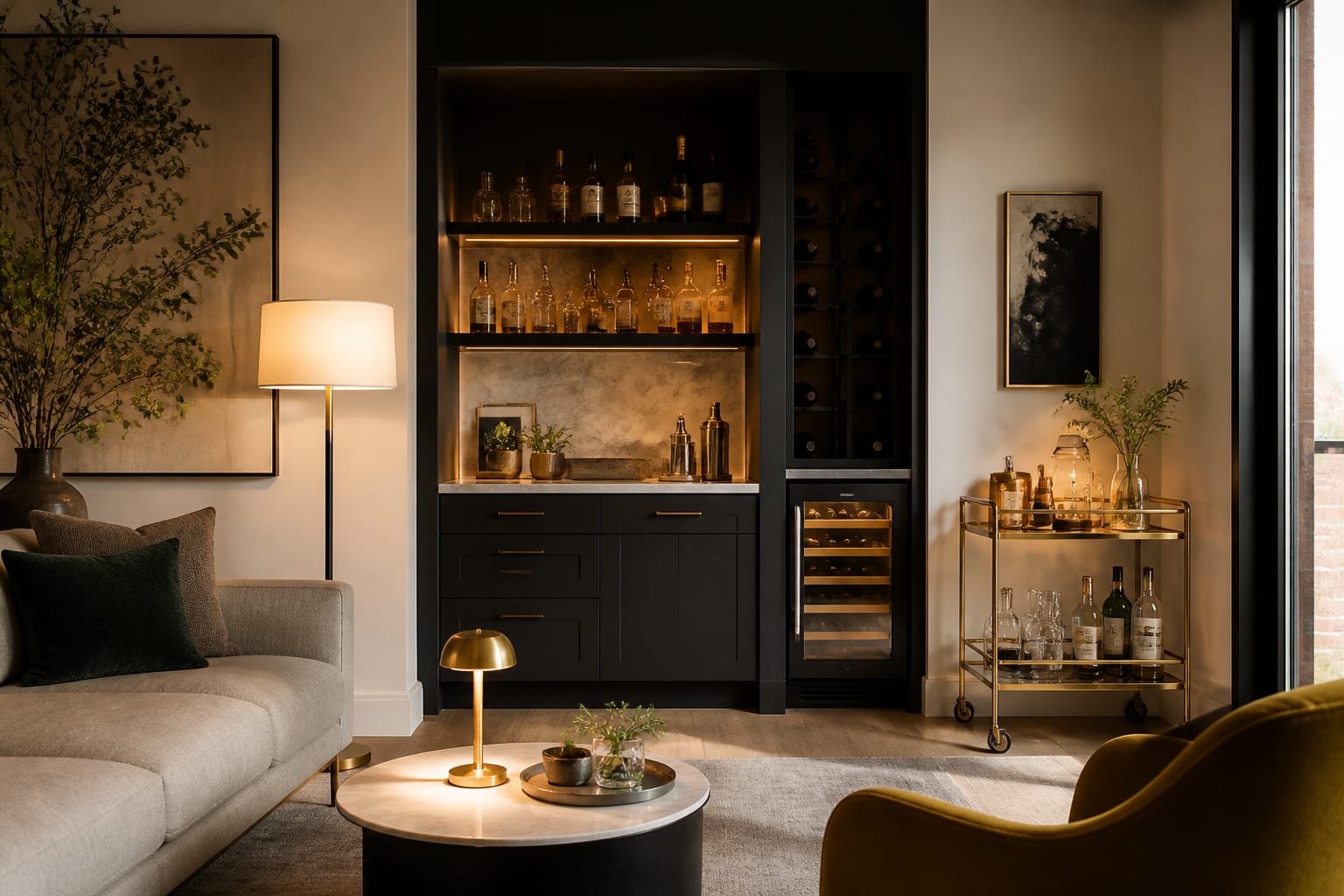
The one upgrade I always add to a cabinet bar is light. Bottles in a dark cabinet look like a pantry; the same bottles lit from behind look like a display. A stick-on 18-inch LED strip at 2700K, run along the inside top, makes the glass glow and turns a closed box into the best corner of the room when the doors open.
Idea 3: The built-in wet bar for serious entertainers
A built-in is the real commitment, and it is worth it only if you host often enough to use it. Plan for 24 inches of counter depth, a 15-inch undercounter fridge, and either a small sink or a deliberate choice to skip plumbing and keep it dry. Once water is involved, the budget starts around $3,000 and climbs with cabinetry and stone, so be honest about whether the frequency justifies the spend.
The payoff is that a built-in does everything at once: cold storage, prep surface, bottle display, and glass storage in one dedicated zone, so the rest of the room stops doing bar duty. Run the upper shelves with the same warm 2700K backlight a cabinet uses, keep the counter clear for mixing, and give bar stools 24 to 30 inches of width each plus 12 inches of knee clearance under the overhang. If you are blending a built-in into a pared-back palette, the restraint in my neutral living room ideas keeps a big cabinetry run from overwhelming the space. One small detail pays off daily: line the speed rail or top shelf with a wipeable surface, since a busy bar gets sticky fast and a sealed counter saves you weekend scrubbing.
Use AI design to preview your home bar before you build
The trouble with a home bar is scale: a cabinet that looks compact in a store can dominate your actual wall, and a built-in is impossible to picture from a sketch. Re-Design solves the guesswork. Upload a photo of the corner or wall you have in mind, and the AI design tool re-renders it with a cart, a cabinet, or a full built-in so you can see which format fits the room you actually live in.
Because you upload your real space, the previews keep your true wall length, window placement, and adjacent furniture in frame. Try a rolling cart, then swap in a tall cabinet, then a counter-height built-in, and compare how each one reads against your sofa and walkway before you spend a dollar or call a contractor.