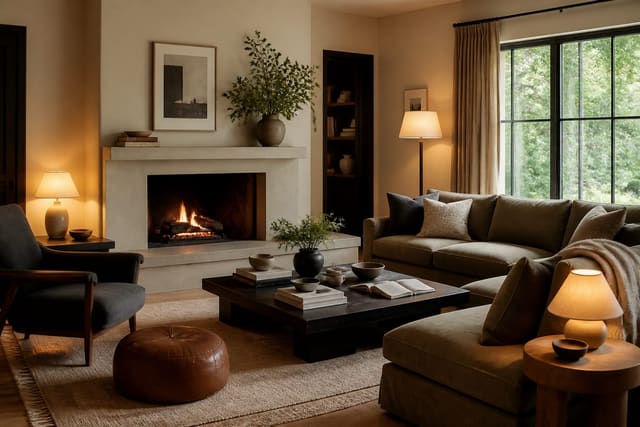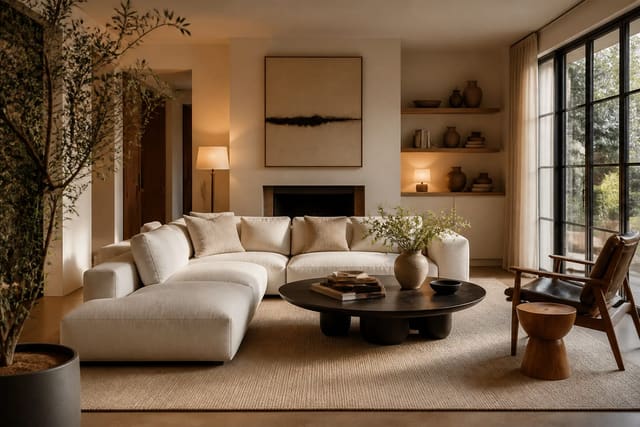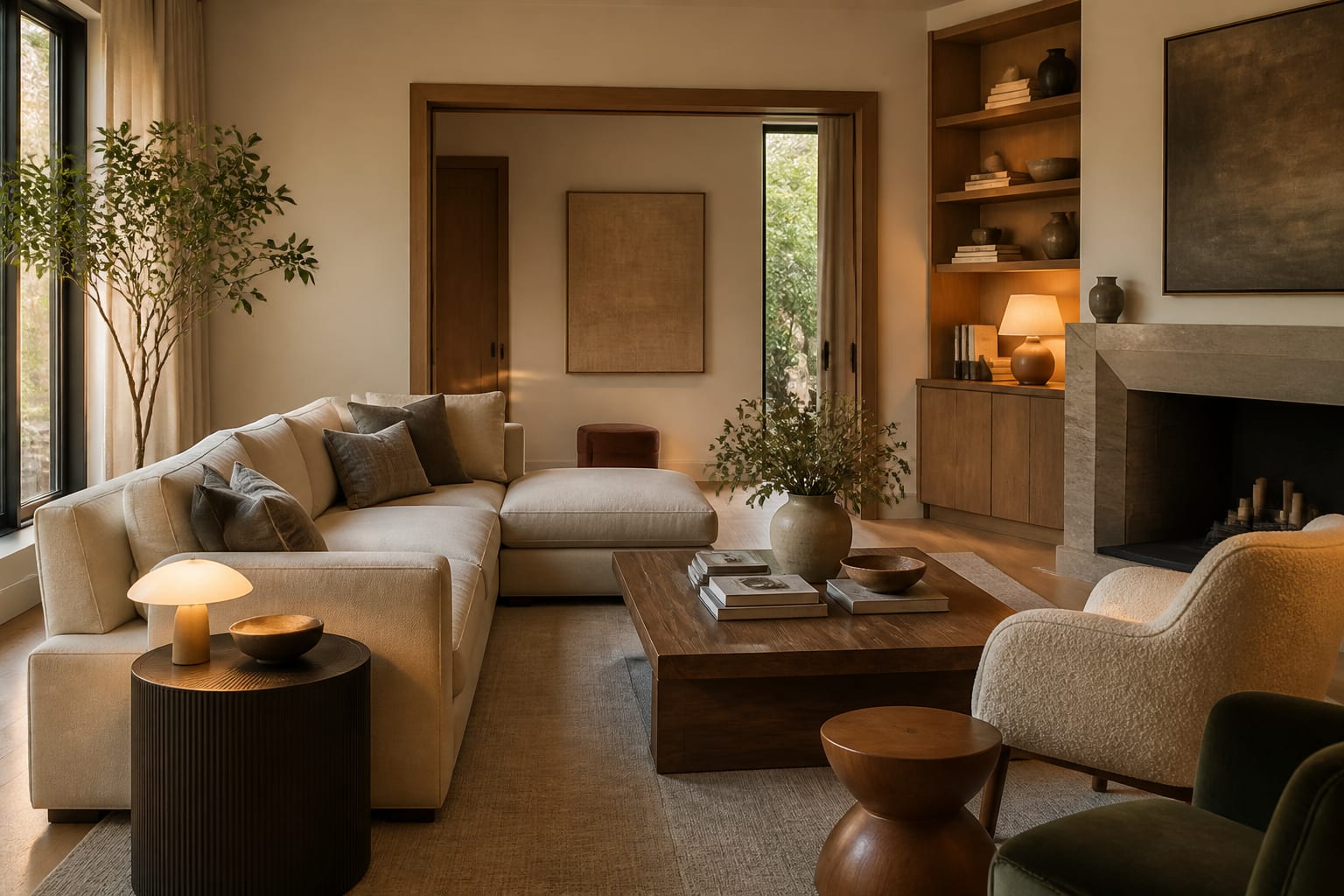
A living room without a TV is not a compromise — it is a deliberate choice that forces better design decisions. When there is no screen to anchor the room, every other element has to earn its place: the seating arrangement, the lighting, the art, the shelving.
The result is almost always a more human-centered space. Conversations happen more naturally, books actually get read, and guests stay longer because there is nothing competing for attention. These living room without TV ideas give you concrete direction so the space never feels incomplete or unfinished.
Choosing a New Focal Point
Every living room needs something for the eye to land on, and a television usually fills that role by default. Without it, you get to decide what deserves that prime position. A large-format painting, a gallery wall, or a sculptural mirror can command as much visual weight as any screen — and they hold that power around the clock, not just when powered on.
A floor-to-ceiling bookcase is another strong option. Style it with a mix of books, objects, and plants rather than packing every shelf, and it reads as architecture rather than storage. If your room has a fireplace, lean into it hard: a mantel styled with restraint and a good fire surround become the undeniable center of the space.
The key is committing to a single focal point rather than scattering interest across multiple walls. Decisiveness in placement is what separates a room that feels designed from one that feels like it is missing something.
See also our guide to Living Room Color Ideas for more on living room without tv ideas.
Seating Arrangements That Invite Conversation
Furniture in TV-centric rooms almost always faces the same wall. Without that constraint, you can arrange seating in configurations that actually suit how people interact. A U-shape — two sofas facing each other across a coffee table with a chair closing the end — creates an enclosed, intimate zone where no one is shouting across the room.
For smaller spaces, a pair of armchairs angled toward a sofa works just as well and uses less square footage. The critical rule is that every seat should have a sightline to every other seat, not to a blank wall. Coffee table placement matters here: position it so people can set down a drink without stretching awkwardly.
Round or oval coffee tables help conversation flow because they eliminate corners that block movement. If your room is long and narrow, consider two separate seating clusters rather than one large grouping — a reading nook at one end and a main conversation area at the other gives the room a narrative.
For a related angle on living room without tv ideas, read Neutral Living Room Ideas.
Lighting as Atmosphere
A television provides constant ambient light at night, and its absence is noticeable the first few evenings. The fix is intentional layering: ambient overhead light, task lighting near reading spots, and accent lighting that highlights the focal point. Together they produce a warmth that overhead-only schemes never achieve.
Floor lamps with dimmer switches are the workhorses of a screen-free living room. Position one next to each primary seating spot so anyone reading has usable light without flooding the whole room. Wall sconces on either side of your focal piece — a fireplace, art, or bookcase — frame it the way studio lighting frames a subject.
Candles and low-wattage table lamps add the last layer. They do not need to be functional; their job is to create points of warm light that the eye moves between naturally. This layered approach makes the room feel alive even on a quiet Tuesday night with no screen and no party.
Styling Details That Make It Feel Finished
A TV-free room can feel sparse if the styling is not thoughtful. The visual weight that a large black rectangle provided needs to be redistributed through texture, pattern, and objects. Start with a rug that is genuinely large enough — undersized rugs are the single most common reason living rooms feel unanchored.
Layer textiles on the sofa: two or three throw pillows in varying textures, a blanket draped over an arm. These are not decorative afterthoughts; they tell anyone entering the room that the sofa is for lingering. A coffee table tray with a candle, a small stack of books, and one object keeps the surface from looking bare.
Plants at different heights — a tall fiddle-leaf fig, a trailing pothos on a shelf, a small succulent on the table — add organic movement and fill vertical space that wall-mounted screens typically consume. The room should look considered from every angle, not just from the main doorway.
- Hang an oversized canvas painting at least 48 inches wide as the room's anchor.
- Build a floor-to-ceiling bookcase and style alternate shelves with objects instead of books.
- Position two sofas facing each other with a 16-inch-high coffee table between them.
- Install a dimmable wall sconce on each side of your focal wall for balanced accent lighting.
- Add a round coffee table to allow free movement and face-to-face seating from all sides.
- Place a tall floor lamp beside every primary seat so reading is comfortable without harsh overhead light.
- Use a large area rug that extends at least 18 inches beyond the sofa legs to anchor the grouping.
Bring the look home with Re-Design
Before you commit to rearranging furniture or investing in a large art piece, Re-Design lets you upload a photo of your current living room and preview a TV-free layout with AI. You can test different focal points, seating configurations, and lighting approaches in your actual space without moving a single piece of furniture. It is a direct way to see whether a bookcase wall or a gallery arrangement will feel right before you spend anything.
Frequently Asked Questions
What do you put on the wall where a TV used to be?
A large piece of art, a gallery wall, or a well-styled bookcase all work well. The replacement should be at least as wide as the TV was to avoid leaving the wall looking bare. A framed mirror is another option — it adds light and makes the room read larger.
How do you keep a living room without a TV from feeling empty?
Layered lighting, rich textiles, and a strong focal point do most of the work. The room should have vertical interest — tall plants, a floor lamp, shelving — so the eye has places to travel. A deliberate seating arrangement signals that the space is designed for use, not just display.
Can you still watch movies in a living room without a TV?
Yes. A short-throw projector paired with a pull-down or retractable screen gives you a large image that disappears completely when not in use. The screen tucks away and the room returns to its intended look. This approach works especially well when the focal wall is a light, neutral color.