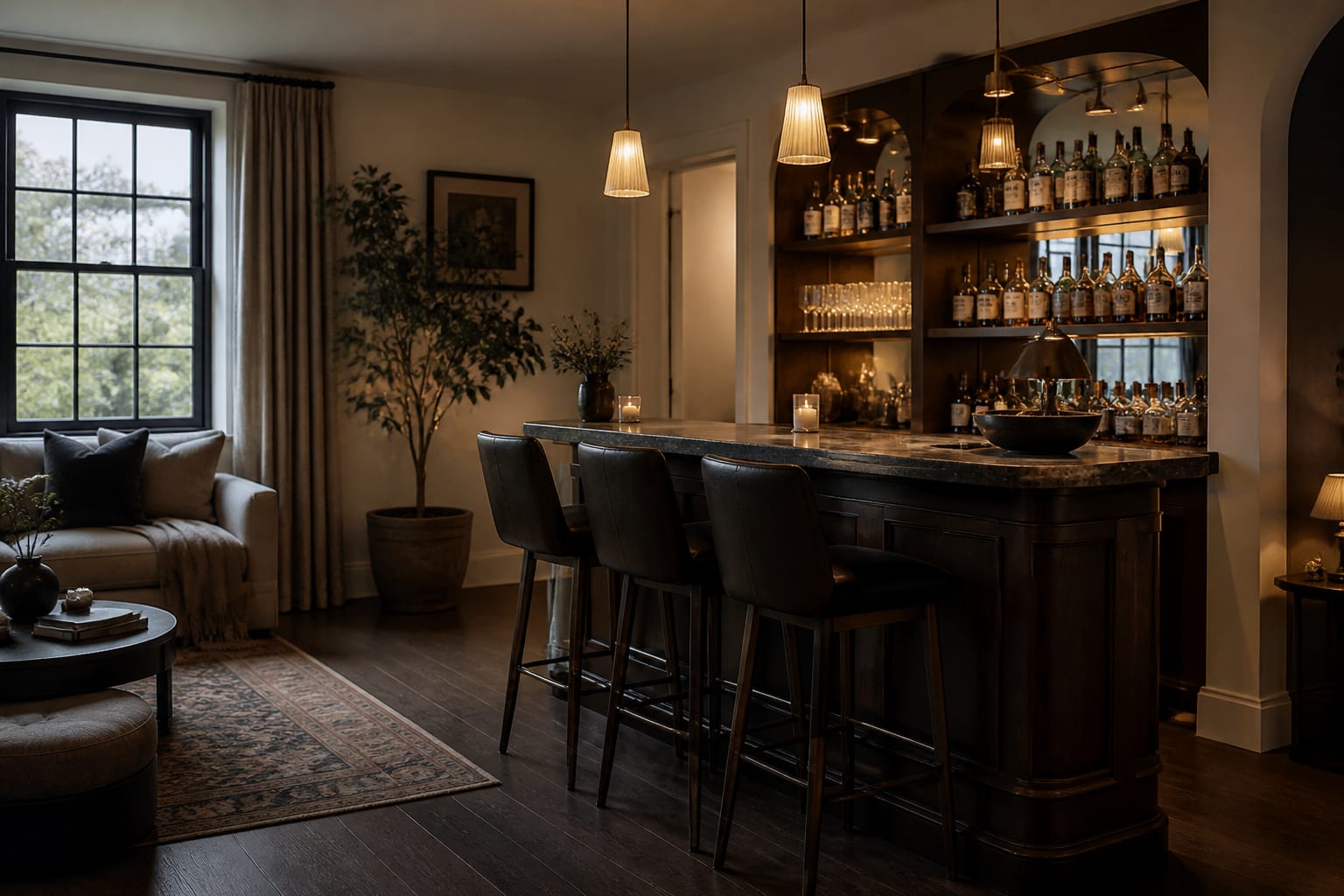
A home bar earns its square footage only when the counter height, storage, and seating are planned together rather than bolted on as an afterthought. The most successful setups treat the bar as a small hospitality station: bottles and glasses within arm's reach, a counter sized for either standing drinks or seated lingering, and lighting that flatters the back-bar display. You do not need a dedicated room. A 36-inch run of cabinetry in a living room corner, a basement nook, or the dead end of a dining area can hold everything a confident host actually uses on a given night.
How tall should a home bar counter be?
Counter height is the first decision because it dictates seating, clearance, and how the bar reads in the room. A true bar-height surface measures 42 inches from the floor, which is the tallest common option and pairs with 30-inch seat-height stools. A counter-height bar measures 36 inches and works with 24- to 26-inch stools, giving a more casual, kitchen-adjacent feel. The taller 42-inch bar creates a clear visual divide between the bar zone and the rest of the living room, which is useful when you are carving a bar out of an open-plan space.
Leave at least 12 inches of overhang where stools tuck under so knees do not bang the cabinetry. If your bar backs onto a walkway, keep a 36- to 44-inch clearance behind the stools so people can pass while someone is seated. For a standing-only setup against a wall, you can drop the depth to 12 to 15 inches and skip stools entirely, which suits a tight living room corner that still wants a proper pouring surface and a row of bottles.
See also our guide to Built In Shelving Ideas for more on home bar ideas.
Dry bar or wet bar: which is right for you?
A dry bar has no plumbing. It is a cabinet or console that stores bottles, glassware, a few tools, and maybe an ice bucket you fill from the kitchen. Dry bars are the easy win for renters and for living rooms where running water lines is impractical, and they cost a fraction of a plumbed installation. The trade-off is the walk to the kitchen sink for water and cleanup.
A wet bar adds a small sink, usually 15 to 18 inches wide, plus the supply and drain lines behind the cabinetry. Many wet bars also tuck in an under-counter fridge or a 15-inch beverage cooler for mixers, garnishes, and ice. If your bar lives in a basement near existing plumbing, a wet bar is far more reachable than it sounds, since you are tapping lines that already run through the space. For most living-room bars, start dry and upgrade only if you entertain often enough to resent the kitchen trips.
For a related angle on home bar ideas, read Wallpaper Ideas.
How do you store bottles and glassware on a bar?
Good storage keeps bottles visible and glasses safe, and those two goals pull in different directions. Bottles want open back-bar shelving where labels face out and tall spirits stand without crowding; a shelf depth of 6 to 8 inches holds most bottles while keeping them from tipping forward. Group bottles by use so the everyday gin and whiskey sit at eye level and the seldom-poured liqueurs go higher.
Glassware does better with protection. Stemware hangs upside down from an under-shelf rack so the bowls stay dust-free and chip-free, while rocks and highball glasses stack on a closed shelf or in a shallow drawer lined with felt. Keep at least an inch of air between glass rims so a quick grab does not knock two together. A pull-out drawer at 6 to 9 inches deep holds tools, coasters, and cocktail napkins, which clears the counter for actual mixing. Reserve the lowest cabinet for heavy backstock and mixers you buy by the case.
What lighting makes a home bar look good?
Bar lighting works in layers, and the back bar is where it counts most. A strip of warm LED tape, around 2700K, tucked under the front lip of each back-bar shelf washes light down over the bottles and makes glass and liquid glow. This is the single move that separates a styled bar from a shelf of bottles in a dim corner. Keep the strip dimmable so you can drop it low for evening drinks.
Over the counter, two or three pendants hung 30 to 36 inches above a 42-inch bar give task light for pouring and a clear visual anchor for the zone. Space pendants evenly along the run and center them on the counter depth, not the wall. Add a dimmer here too. If the bar shares a living room, put the bar lighting on its own switch so you can light the bar while keeping the seating area soft, which lets the bar read as a distinct destination after dark.
- Float a 42-inch bar-height counter with three stools to divide an open living room from the lounge zone.
- Build floating back-bar shelves in front of a mirror so the bottle display doubles in apparent depth.
- Convert a basement alcove into a wet bar with a 15-inch beverage cooler and a compact bar sink.
- Use a tall bar cabinet as a dry bar in a small apartment, with a drop-front for mixing and storage below.
- Run warm 2700K LED tape under each back-bar shelf to make bottles and stemware glow at night.
- Hang stemware upside down on an under-shelf rack to free counter space and protect the glass bowls.
- Wrap the bar front in fluted wood or stacked tile to give the counter a finished, furniture-grade face.
- Add a rolling bar cart beside a fixed bar for overflow garnishes and to carry drinks to the seating area.
Bring the look home with Re-Design
Before you commit to a counter height or a wall of back-bar shelving, you can preview the whole bar in Re-Design. Upload a photo of the living-room corner or basement wall you have in mind, then re-design it with a 42-inch bar, pendant lighting, and a lit back-bar display to see how the zone reads against your existing furniture. Trying a dry bar console versus a built-in wet bar takes seconds, so you can judge proportion and stool spacing before you buy cabinetry or call a plumber for the supply lines.
Frequently Asked Questions
How much space do I need for a home bar?
A standing dry bar fits in as little as a 36-inch wall run with a 12- to 15-inch deep counter. For seated stools, add 24 to 30 inches per stool plus a 36-inch clearance behind them for passing. A basement bar with a sink and cooler usually wants a 5- to 8-foot run to feel comfortable for one person to work behind.
What is the difference between bar height and counter height?
Bar height refers to a 42-inch counter paired with 30-inch seat-height stools, the tallest standard setup. Counter height refers to a 36-inch surface paired with 24- to 26-inch stools, matching a typical kitchen counter. The taller bar height creates a sharper visual break between the bar and the surrounding room, which many people prefer in open-plan living spaces.
Do I need a sink for a home bar?
No. A dry bar with no plumbing handles most home entertaining as long as you keep an ice bucket and pitcher stocked. A sink helps if you mix frequently or host large groups, since it spares the trips to the kitchen for water and cleanup. Wet bars make the most sense in basements near existing plumbing lines.
How far apart should bar stools be?
Space stools 24 to 30 inches apart measured center to center so adjacent guests have elbow room and can pull seats out without colliding. Wider stools or chairs with arms need the full 30 inches. For a three-stool bar, plan on roughly 6 to 7 feet of counter run so nobody feels crowded during a busy evening.