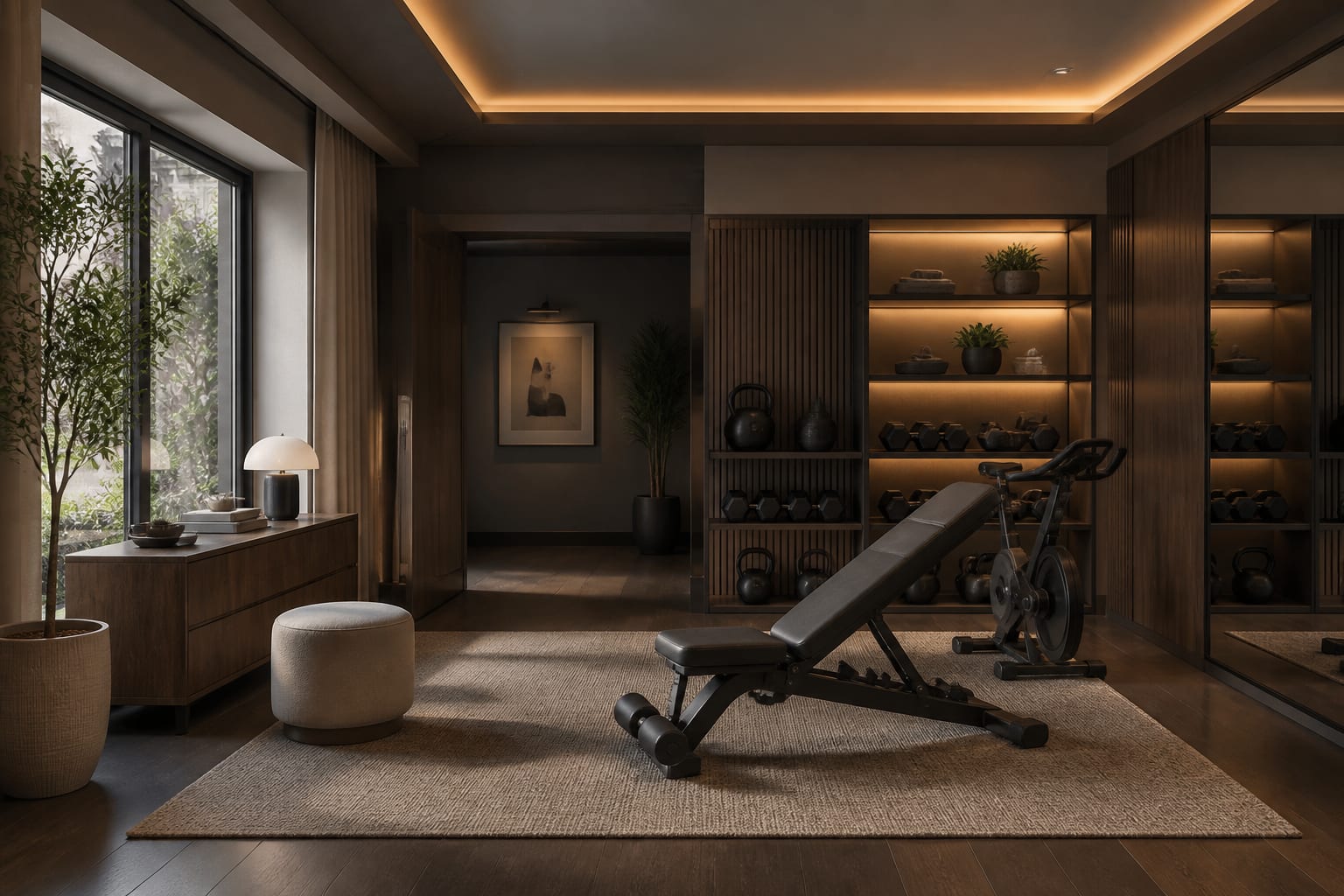
A home gym fails when it looks like a storage room with a treadmill in it. The single best decision you can make is committing a defined zone, even a 6 by 8 foot corner, to nothing but training. Equipment scattered between a guest bed and holiday boxes never gets used. Give the space proper flooring, honest lighting, and a mirror, and you remove the friction that keeps people from walking down to work out. The room should feel intentional the moment you step in, with everything within two steps of where you stand.
How much space does a home gym really need?
People wildly overestimate this. A functional strength setup fits in roughly 80 to 100 square feet, about the footprint of a single-car garage bay or a spare bedroom. The non-negotiable measurement is not floor area but ceiling height: standing barbell presses and pull-ups need at least eight feet, and ten is comfortable for taller lifters reaching overhead with a plate. If you only have a 6 by 8 foot pocket, you can still run a complete program with adjustable dumbbells, a folding bench, and a wall-mounted pull-up bar. The trick is planning vertical and folding storage so the working floor stays clear. A power rack with a 4 by 4 foot footprint plus a 7-foot barbell needs about a 9 by 7 foot clearance zone around it so loaded plates do not clip walls. For cardio, a treadmill wants a 3-foot runoff behind it for safety, and a rower needs roughly 9 feet of length when the seat is at full slide. Measure your actual ceiling at the lowest point, including any ductwork or light fixtures, before you buy a rack. Many basement gyms get derailed by a single low joist. If clearance is tight, lean toward a half rack, landmine attachments, and dumbbell work rather than tall cable towers, and you will fit a real training space into a surprisingly small room without feeling cramped during any lift.
See also our guide to Kitchen Backsplash Ideas for more on home gym ideas.
Flooring, walls, and protecting the structure
Flooring is where most home gyms either succeed or quietly destroy a house. Over a concrete slab, three-eighths-inch rubber mats or rolled rubber work fine for general training. The moment you deadlift or drop loaded barbells, step up to three-quarter-inch rubber tiles, or build a dedicated lifting platform from two layers of plywood topped with horse-stall mats. On an upper floor or over a finished basement, the impact and noise change everything: add a layer of high-density foam or stall mats under the rubber to spare the joists and the rooms below. Stack rubber under just the rack and platform rather than wall to wall to control cost, since each 4 by 6 foot stall mat covers 24 square feet for very little money. Walls take more abuse than people expect from racked bars and swinging cables, so mounting plywood backing behind the rack lets you anchor a pull-up bar or band pegs anywhere. Paint walls a clean light gray or white to bounce light and make the room feel larger. If you wall-mount a folding rack, lag it into studs, never just drywall anchors. A good floor and solid wall anchoring quietly carry the whole gym, and skimping here is what produces cracked tiles, dented slabs, and the dull thud that wakes the rest of the house at 6 a.m.
For a related angle on home gym ideas, read Bathroom Tile Ideas.
Lighting and mirrors that change how you train
Lighting is the most underrated upgrade in a home gym. Garages and basements usually ship with one dim warm bulb, and training under it feels like working in a cave. Swap to LED shop lights or flush panels at 4000K to 5000K, aiming for a bright, daylight-neutral field that keeps you alert through the last set. Plan for around 50 to 75 lumens per square foot, which for a 100-square-foot room means roughly 6,000 to 7,500 total lumens spread across at least two fixtures so nothing casts you in shadow. Mirrors do double duty: they let you check form on squats and hinges, and they visually double the size of a small room. A mirror at least 48 inches wide and running floor to about 6 feet tall covers a full standing lift. Mount it on the wall you face during most movements, set roughly 6 inches off the floor so dropped plates do not crack the glass. Gym-grade mirrors come in safety-backed sheets, but framed acrylic panels are lighter and shatter-resistant if you have low ceilings or active kids nearby. Add a small clock with a second hand or a wall-mounted timer in your sight line for interval work. Finish with one accent: a bold wall color behind the rack, a flag, or a single piece of art. That visual anchor gives the room identity and makes the whole space feel like a destination rather than a leftover corner.
Equipment layout and a setup that flows
Arrange equipment by the order you actually move through a workout, not by how it looks lined against a wall. Put the rack and platform as the anchor, ideally against the most solid wall and facing the mirror. Keep dumbbells and kettlebells on a vertical rack within two steps so supersets do not send you walking back and forth. Cardio belongs near a window or fan, since treadmills and rowers throw heat and you will want airflow. Leave a clear 6 by 6 foot open patch of rubber for floor work, mobility, and bodyweight circuits, because that empty zone is what separates a usable gym from a cluttered one. Storage should be vertical and labeled: a wall rack for resistance bands, a pegboard for jump ropes and straps, and a small shelf for chalk and a phone. Plug a fan and a sound system in before you start, because a stuffy, silent room kills consistency faster than any missing barbell. If the space doubles as a garage, mount fold-down components so cars still fit. Budget about 30 inches of walking clearance between any two stations so you never squeeze past a bench mid-set. The goal is a loop you can run blindfolded, where every piece of gear sits exactly where the next movement needs it, and nothing breaks your focus between the warm-up and the final cooldown stretch on the floor.
- Build a lifting platform from two plywood sheets topped with horse-stall mats for quiet, safe deadlifts.
- Wall-mount a folding squat rack lagged into studs to reclaim floor space in a shared garage.
- Add a 48-inch-wide floor-to-shoulder mirror on the wall you face during most lifts.
- Hang LED shop lights at 4000K to keep energy high through the final set.
- Use a pegboard for bands, ropes, and straps so the working floor stays clear.
- Install a wall-mounted interval timer or clock directly in your line of sight.
- Reserve a 6 by 6 foot open rubber zone for mobility and bodyweight circuits.
- Mount a quiet high-velocity fan near the cardio station for airflow during long sessions.
Bring the look home with Re-Design
Seeing the room before you commit to a rack saves expensive mistakes. With Re-Design you upload a photo of your spare bedroom, garage bay, or basement corner, then preview rubber flooring, a mounted mirror, brighter lighting, and a rack laid out against the wall. You can test whether a power rack actually fits the ceiling and footprint or whether dumbbells and a folding bench suit the space better, all before spending a dollar on equipment or paint.
Frequently Asked Questions
What is the minimum ceiling height for a home gym?
Aim for at least eight feet of clear height for standing barbell presses and pull-ups, and check the lowest point including ducts, beams, and light fixtures. If you only have seven feet, focus on dumbbells, landmine work, and seated presses, and choose a half rack instead of a tall cable tower.
What flooring works best for a home gym?
Over concrete, three-eighths-inch rubber suits general training, but step up to three-quarter-inch tiles or a plywood and stall-mat platform for deadlifts. On upper floors, add high-density foam or extra mats beneath the rubber to protect the joists and quiet impact for rooms below the gym.
Can I fit a real gym in a spare bedroom?
Yes. A 10 by 12 foot bedroom comfortably holds a rack, a bench, and dumbbells with room for floor work. Use a vertical dumbbell rack and wall storage to keep the floor open, add a mirror to expand the space visually, and upgrade the lighting since most bedrooms run too dim for training.