Most furniture returns I hear about start the same way: someone fell for a sofa online, eyeballed the wall, and ordered it. The honest answer is that almost nobody measures wrong because they lack a tape measure. They measure wrong because they skip the boring numbers, like the 36 inches a walkway needs or the arc a door swings through. Those are the numbers that decide whether a room feels generous or jammed, and they take ten minutes to collect.
Reading a room is a skill, not a talent. Once you know which dimensions matter and which ones to write down, you can plan a layout that fits on paper before a single box arrives at your door. This guide walks through the exact measurements to take, how to translate them into a scale plan you can trust, and the clearances designers leave around every major piece of furniture.
The measurements that actually decide your layout
Start with the perimeter. Measure each wall at floor level and again at about 30 inches up, because baseboards, bowed plaster, and built-ins can change the usable width along a single run. Write down every wall length in inches rather than feet, so you never fumble a conversion mid-plan. A 12-foot wall is 144 inches, and that single number governs whether a 96-inch sofa leaves breathing room at each end or crowds the corners until the space feels stuffed.
Next, capture the openings. Doorways, the direction each door swings, window sills and their height off the floor, closet openings, and the path from the entry to the rest of the house all shape where furniture can realistically live. A door that swings inward eats roughly a 32-inch quarter-circle of floor that nothing else can occupy without getting clipped. Windows matter too, because a sofa back rising above an 18-inch sill blocks light and looks wrong from the curb outside.
Then take the verticals. Ceiling height tells you whether a 7-foot bookshelf clears an 8-foot ceiling with the usual 12 inches to spare, or whether you need a lower profile entirely. If your space struggles with light, those height numbers feed directly into fixture planning, which I get into further in ai-design-dark-room-solutions. Measure to the bottom of any crown molding, not the ceiling itself, since that trim becomes your real ceiling for anything tall.
Turning numbers into a scale plan
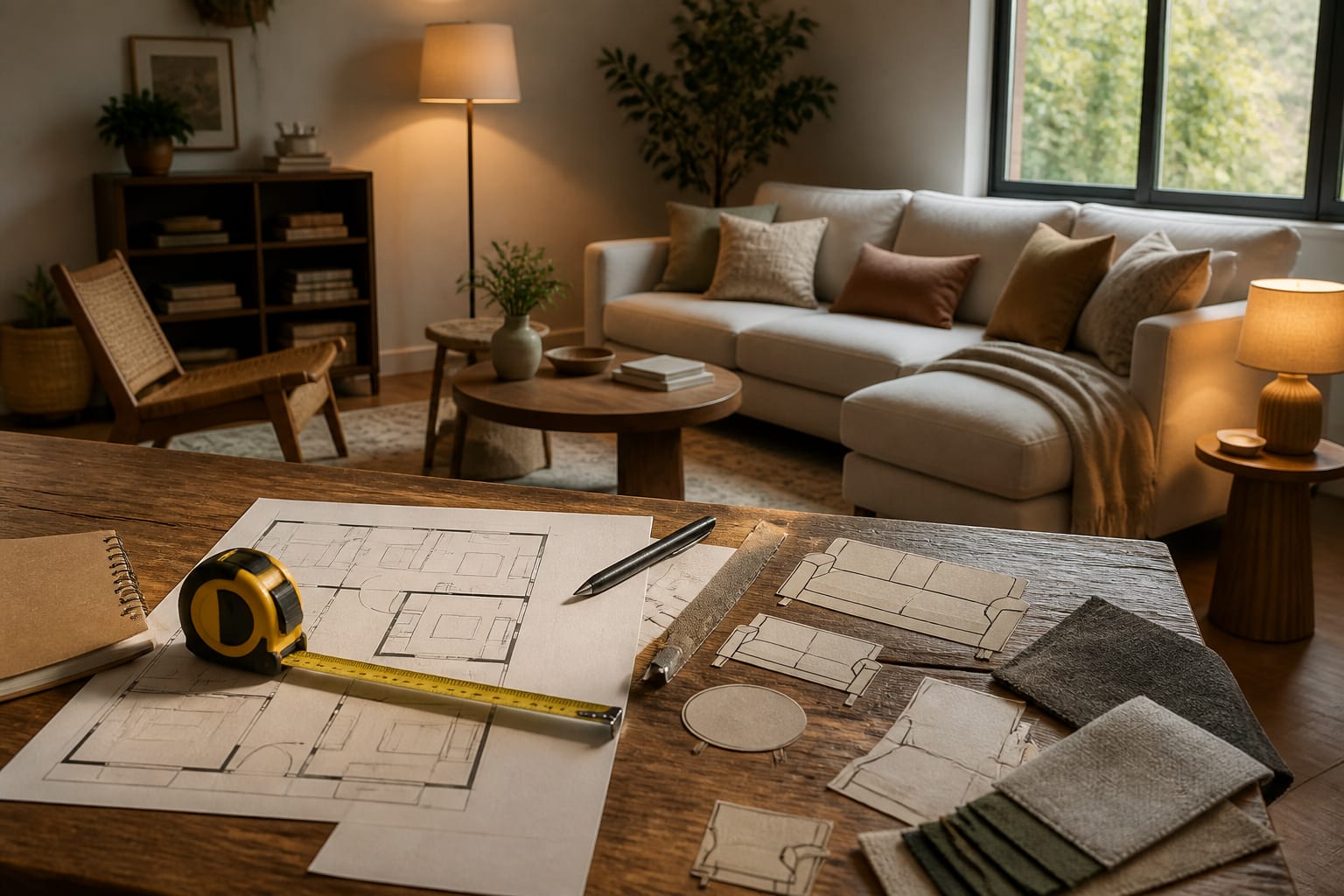
Graph paper is still the fastest tool for this. Use a scale of 1/4 inch equals 1 foot, so a 12-by-15-foot room becomes a tidy 3-by-3.75-inch rectangle you can sketch in seconds. Plot the walls first, then mark every door swing, window, vent, radiator, and outlet on the drawing. Outlets matter more than people expect, because a lamp placed 8 feet from the nearest plug means a cord stretched across a walkway, which is both ugly and a genuine trip hazard.
Cut paper rectangles for each furniture piece at the same scale and slide them around the plan. This is where mistakes surface for free, on paper, instead of after delivery. A sectional that looked reasonable in the showroom suddenly blocks the only clear path to the window. When you start combining functions inside one footprint, this paper test gets even more useful, and it pairs well with the planning ideas in dual-purpose-room-ideas. I redo this step three or four times before I trust a layout enough to start spending.
Keep a clearance list taped beside your plan as you work:
- 30 to 36 inches for primary walkways through a room
- 18 inches between a sofa and the front edge of a coffee table
- 36 to 48 inches behind dining chairs so people can push back and stand
- 24 to 36 inches of clearance in front of a dresser or wardrobe with drawers
- 14 to 18 inches of seat overhang for a kitchen or island bar stool
Buying furniture that matches the math
Every product page lists width, depth, and height, but the number people forget is the diagonal. A 36-inch-wide sofa might measure 84 inches across the diagonal, and that is the dimension that has to clear your doorway and any stairwell turns on the way in. Measure your tightest entry point before you fall in love with anything online. I have watched a perfect armchair sit stranded in a hallway for a week because nobody checked the 31-inch door against the 34-inch armrest.
Scale is also about proportion, not just whether something fits. A massive 40-inch-deep sectional in a 10-by-11-foot room technically fits but reads as oversized, while a leggy 32-inch-deep sofa lets the floor show and the room breathe. Mixing the heavy with the light is partly an eye-training exercise, and if you want to blend looks without it feeling random, how-to-mix-design-styles gets into how scale and style play off each other. Aim for one visual anchor per zone and let everything else stay lighter.
There is one more number worth recording before you shop: the height of the seat itself. A dining chair seat sits around 18 inches off the floor and wants a table surface roughly 28 to 30 inches high, which leaves the 10 to 12 inches of lap clearance people expect. A sofa seat at 17 to 19 inches pairs with a coffee table whose top lands within a couple of inches of that height, so reaching a mug never feels like a stretch. Get the relationship between heights right and a room feels effortless to use; get it wrong and every piece fights the next one even when each fits the floor plan perfectly.
Common mistakes to avoid
The most common mistake is measuring the wall and ignoring the trim. Baseboards stick out 1/2 to 3/4 of an inch, and window casings can project a full inch, so a piece that fits the drywall width may not sit flush against it. Always subtract trim depth from any fit that looks tight on paper.
Another mistake is forgetting the third dimension entirely. People obsess over footprint and never check whether a 30-inch table lamp leaves headroom under an 80-inch shelf, or whether a tall headboard ends up covering half a window. Measure height for anything over 4 feet tall before it goes in the cart.
The last one is treating clearances as optional. Skipping the 36-inch walkway to squeeze in one more chair makes the entire room feel hostile to walk through. If the math says it does not fit, it does not fit, and forcing it never gets better with time.
Use AI design to preview how to measure room for interior design before you commit
Measuring tells you what fits, but it does not tell you how the room will feel once everything is in place. That gap is exactly where Re-Design earns its keep. After you have your wall lengths and a rough layout, upload a photo of the actual room and let the AI re-render it with furniture placed to scale, so you can judge whether your 96-inch sofa reads as cozy or cramped against that 144-inch wall.
The workflow I lean on is simple: measure first, sketch the plan, then upload the empty or half-furnished space and test a couple of arrangements on screen. Seeing a proposed layout rendered into your real room catches proportion problems the tape measure quietly misses, like a coffee table that technically clears 18 inches yet still dominates the seating area. You confirm the numbers, then confirm the feeling, before you spend a single dollar.