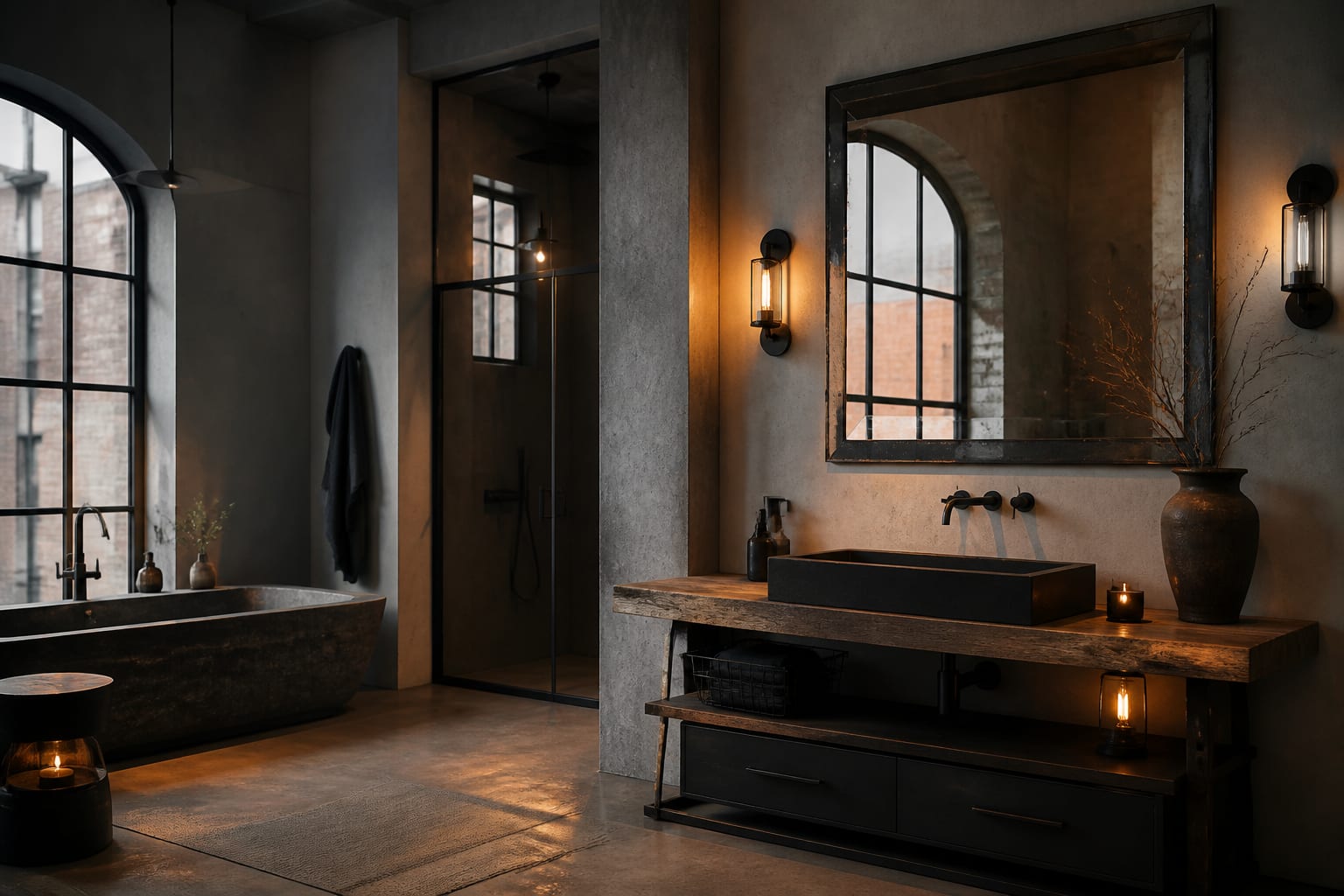
An industrial bathroom only works when the raw materials feel honest rather than staged. The strongest versions treat concrete, black metal, and exposed plumbing as the actual structure, not a costume bolted onto a builder-grade room. Lean into microcement walls, a black-framed shower screen, brushed brass or matte black taps, and one warm wood vanity to keep the hard surfaces from turning clinical. The goal is a space that reads like a thoughtfully converted warehouse, durable and a little moody, where every fixture looks like it earns its place. The ideas below cover the surfaces that set the tone, the plumbing and hardware that define the style, and the lighting moves that warm up all that stone and steel.
Set the Tone With Concrete and Microcement
Surfaces decide whether an industrial bathroom reads authentic or like a theme, so start with the walls and floor before choosing a single fixture. Microcement is the workhorse finish here because it goes on in thin seamless coats over existing tile or board, giving you the raw, slightly mottled look of poured concrete without the structural weight or grout lines. Applied at roughly two to three millimeters and sealed properly, it handles a wet room beautifully and wraps walls, floors, and even a shower in one continuous skin. That seamless quality is what separates a convincing industrial space from a room that simply owns a few gray tiles.
If full microcement feels like too much commitment, you can fake the effect convincingly with large-format porcelain tiles in a concrete look. Choose sheets around sixty by sixty centimeters or larger, set with a tight color-matched grout so the joints nearly disappear, and the eye reads a continuous surface from a few steps back. Polished concrete floors work well in ground-level bathrooms where the slab can carry the weight, and they pair naturally with underfloor heating to counter the inherent coolness of stone underfoot. Sealing matters on every concrete surface, since unsealed cement stains and dusts in a humid room.
Keep the palette tight and let texture carry the interest. Industrial bathrooms live in a narrow band of greys, charcoal, and warm taupe, so resist introducing bright color and instead vary the finish: a matte microcement wall against a honed stone basin against a brushed metal frame. A single feature, such as a raw plaster wall left deliberately uneven, can add the handmade imperfection the style celebrates. The restraint reads as confidence, and it gives the metal fixtures and warm wood vanity room to register as deliberate accents rather than competing with a busy backdrop.
See also our guide to Powder Room Design Tiny for more on industrial bathroom ideas.
Make Exposed Pipes and Plumbing the Feature
Visible plumbing is the signature move of the style, and treating pipes as deliberate fixtures rather than something to hide is what gives an industrial bathroom its character. An exposed shower system with a thick riser, a fixed rain head, and a hand shower on a visible run of pipe instantly signals the look, especially in brushed brass, gunmetal, or matte black. Wall-mounted taps that emerge straight from the wall over a basin reinforce the same honest, mechanical feeling. The trick is to make the exposed runs look intentional and neatly aligned, since sloppy plumbing reads as unfinished rather than styled.
Fittings carry a surprising amount of the aesthetic, so choose them with the same care you would give furniture. Industrial-style taps often borrow from old factory and lab fixtures, with chunky cross-handles or lever handles, knurled grips, and unlacquered finishes that develop a living patina over time. Unlacquered brass in particular darkens and mellows with use, which suits a style built on materials that age rather than stay pristine. Pair these with an exposed bottle trap under a wall-hung basin so even the waste pipe becomes part of the composition instead of being boxed away.
Consistency in metal finish ties the plumbing together across the room. Pick one dominant tone, matte black or aged brass are the safest, and repeat it on the taps, shower, towel rail, robe hooks, and any visible pipe so the eye reads a coherent system. A black-framed shower screen extends that metal line into the architecture and is one of the clearest industrial signals you can add. If you mix metals, keep it to two and use the second sparingly as an accent, because too many competing finishes dissolve the deliberate, engineered quality that makes the look convincing in the first place.
For a related angle on industrial bathroom ideas, read Cottagecore Bathroom Ideas.
Add Warmth With Wood, Leather, and Brick
Concrete and steel alone tip an industrial bathroom toward cold and unwelcoming, so warm natural materials are what make the room livable rather than severe. A raw or lightly oiled wood vanity is the single most effective counterweight: a slab of oak, walnut, or reclaimed timber with visible grain brings organic warmth that immediately softens all the surrounding hard surfaces. Floating the vanity off the floor keeps the room feeling open and shows off the wall finish beneath, while a vessel basin in stone or matte ceramic sitting on top reinforces the handcrafted, assembled-over-time quality the style is reaching for.
Exposed brick is another classic warming element where the architecture allows it. A genuine brick wall, or a convincing brick-slip cladding on one feature wall, adds russet and terracotta tones that flatter the surrounding greys and introduce a handmade texture concrete cannot match. Seal brick carefully in a wet area so it resists moisture, and keep it to a single wall so it stays an accent rather than overwhelming the room. Reclaimed brick with worn edges and varied color reads far more authentically than a too-perfect new equivalent, since the style prizes evidence of age and use.
Smaller touches of leather, woven texture, and greenery complete the warmth without crowding the space. A leather or canvas strap on a wood-framed mirror, a tan leather valet tray for grooming bits, and a couple of rolled towels in oatmeal or charcoal soften the palette at eye level. A trailing plant such as pothos or a hardy fern thrives in the humidity and breaks up the hard lines with living movement. The principle throughout is contrast: every cold, smooth, manufactured surface deserves a warm, tactile, natural counterpart nearby so the room feels grounded rather than clinical.
Light It With Edison Bulbs and Black Fixtures
Lighting carries an industrial bathroom from a hard daytime box to a warm, atmospheric retreat, and warm-toned fixtures are essential to that shift. Exposed Edison-style bulbs are the defining choice, their visible glowing filaments echoing early factory lighting and adding a soft amber wash that flatters concrete and wood alike. Choose warm bulbs around 2400K to 2700K rather than cool blue-white, since the amber tone makes microcement glow and stops the metal fixtures from feeling sterile. Caged or open black metal pendants, sconces, and a bare-bulb fixture over the mirror all reinforce the look while keeping the hardware language consistent.
Layering light matters as much as the fixtures themselves, because a single ceiling source leaves an industrial bathroom flat and shadowy. Combine an ambient source overhead with task lighting at the mirror and a low accent or two for mood. Wall sconces flanking the mirror at roughly eye level cast even, shadow-free light for grooming, while a pendant or two on a dimmer lets you drop the room into a softer evening setting. Always confirm any fixture in a wet zone carries the correct moisture rating, since open-bulb pieces near a shower need to be properly sealed for safety.
- Wrap walls and floor in seamless microcement for a poured-concrete look.
- Fit an exposed shower riser and rain head in matte black or brass.
- Mount a vessel basin on a floating raw oak or reclaimed wood vanity.
- Add a black-framed shower screen to extend the metal line architecturally.
- Clad one feature wall in sealed reclaimed brick for warm contrast.
- Hang caged Edison-bulb sconces at eye level beside a slim black mirror.
- Choose unlacquered brass taps with cross-handles that patina over time.
- Soften the room with a leather strap mirror and a trailing pothos.
Bring the look home with Re-Design
Committing to microcement walls and an exposed brass shower is a big leap from a tile sample, so see the whole scheme in your own bathroom first. Upload a photo of your bathroom to Re-Design, choose an industrial style, and preview how concrete surfaces, a black-framed screen, Edison bulbs, and a raw wood vanity come together in your exact space. You can compare matte black against aged brass and test warmer or cooler lighting in seconds, which makes scale and mood easy to judge. Preview the finished look first, then buy the fixtures and finishes knowing they fit.
Frequently Asked Questions
How do I stop an industrial bathroom from feeling cold?
Counter every hard surface with a warm, tactile one. A raw oak or reclaimed wood vanity, a single sealed brick wall, leather accents, and warm 2400K to 2700K Edison bulbs all soften concrete and steel. Add a trailing plant and oatmeal towels at eye level, and the room reads grounded and inviting rather than clinical or severe.
Is microcement a good choice for a wet bathroom?
Yes, when it is applied and sealed correctly. Microcement goes on in thin seamless coats over existing tile or board, handling showers and wet rooms without grout lines once a proper waterproofing system sits underneath. Quality sealing is essential, since unsealed cement stains and dusts in humidity. Hire an experienced applicator for wet zones to guarantee the finish lasts.
What metal finish suits an industrial bathroom best?
Matte black and unlacquered aged brass are the two strongest choices. Pick one as the dominant tone and repeat it across taps, shower, towel rail, hooks, and the shower screen frame so the room reads as one engineered system. If you mix metals, limit it to two and use the second sparingly so the look stays deliberate, not busy.