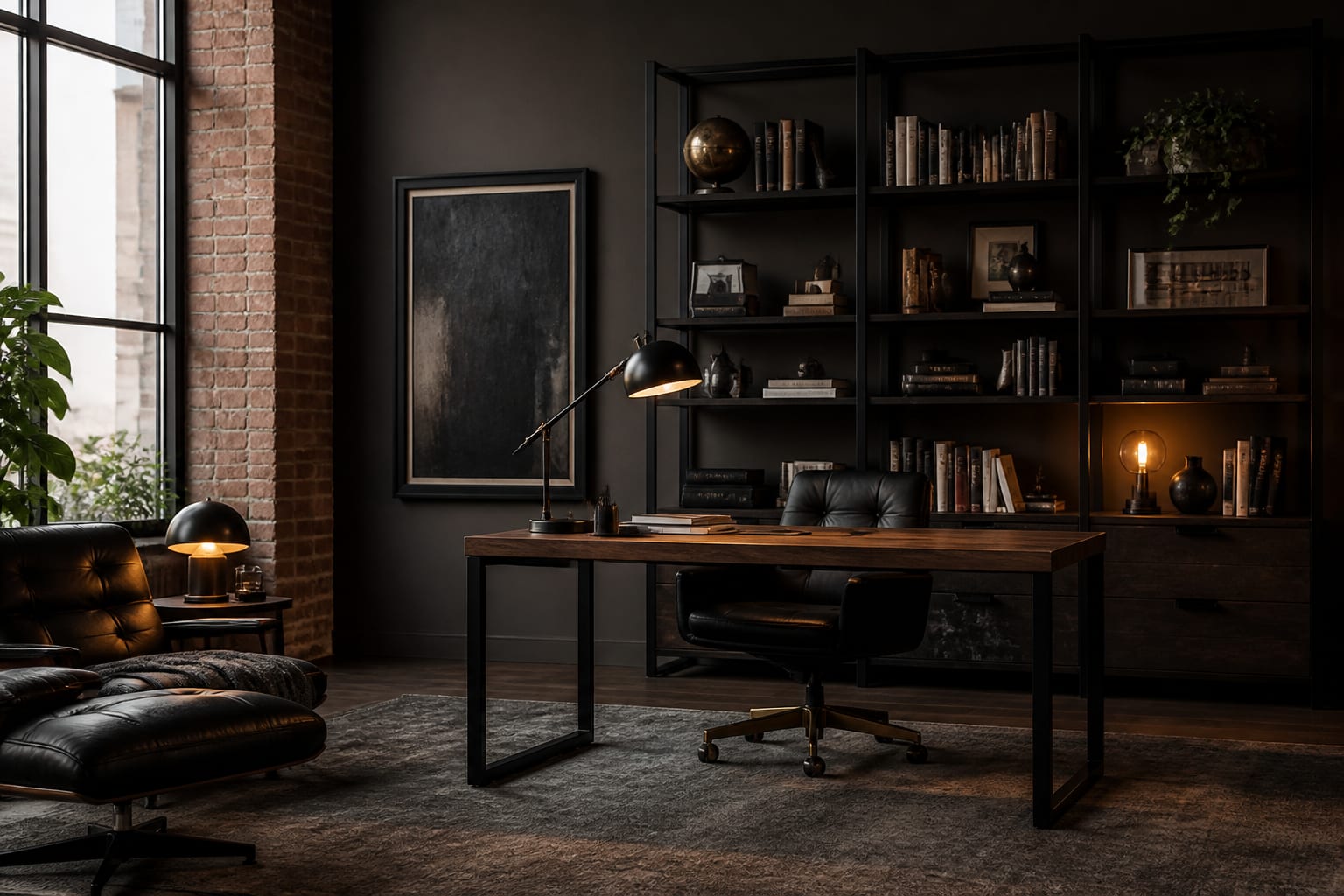
An industrial home office works when dark metal, warm wood, exposed texture, and purposeful lighting build a high-contrast space that still feels comfortable to sit in all day. The failure mode is a fake warehouse corner with a laptop in it. Get the desk, storage, and lighting right and you get sharper focus without the gloom.
What does an industrial home office look like?
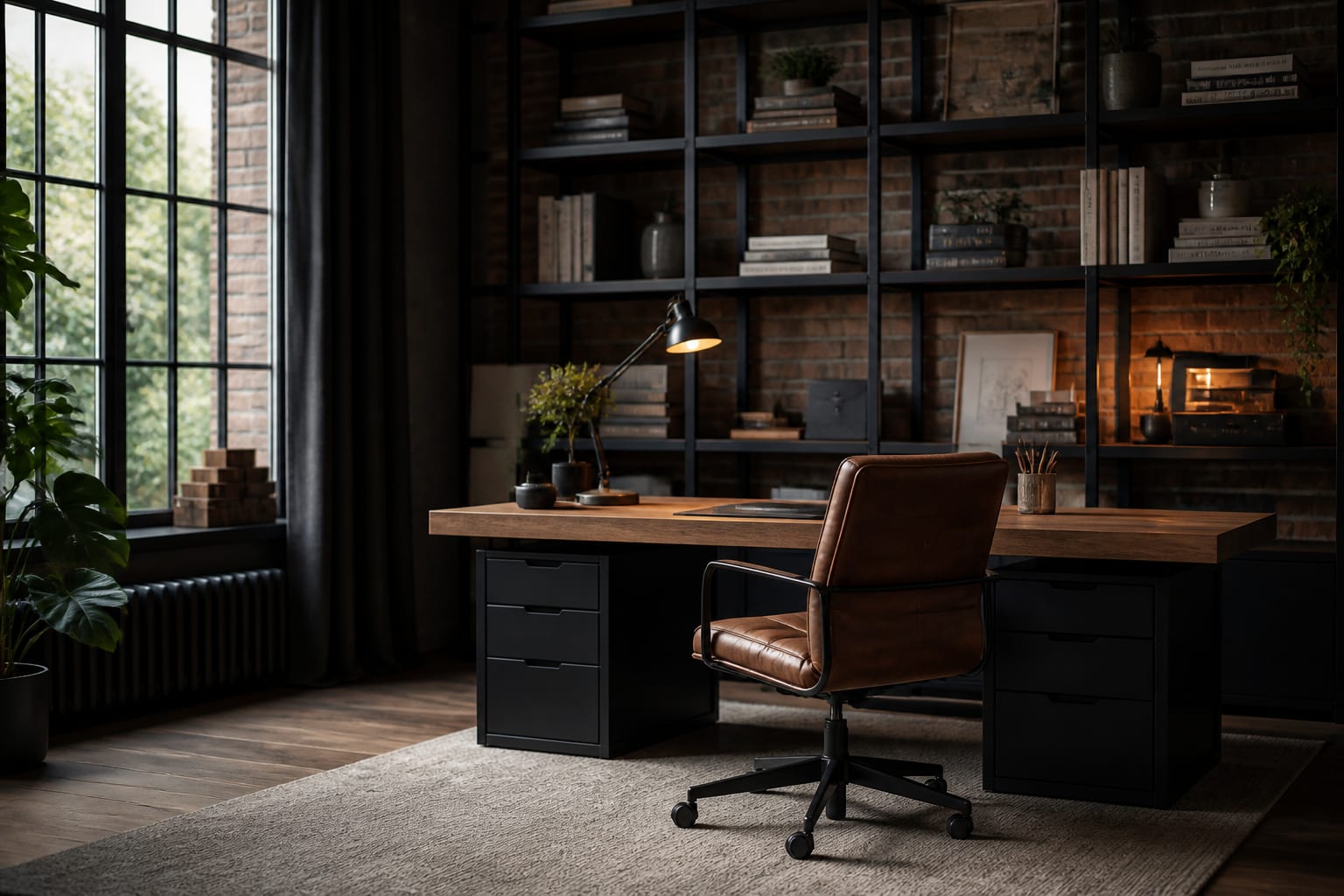
It's a high-contrast work zone where structure is visible: metal frames, wood grain, leather, brick or concrete tones, matte black details, and utilitarian lighting. A steel-legged desk beside a walnut cabinet, a black library sconce, a low-pile rug, and one large piece of graphic art say more than a wall full of faux factory objects.
Start with the desk wall since it controls the room's first impression. Place the desk perpendicular to the window so daylight reaches the surface without turning your monitor into a mirror by noon. Keep the palette dark but not dead: charcoal, warm black, tobacco, oxblood, concrete gray, walnut, camel leather, aged brass, olive, and bone all work. With an 8 ft ceiling, confine the darkest color to the desk, shelves, rug, or one wall; a loft-like ceiling or exposed brick can carry heavier paint and taller storage.
Which ideas actually sharpen the desk setup?
Solve your actual workday problems, screen glare, paper piles, weak lighting, a flat video background, before adding style for its own sake.
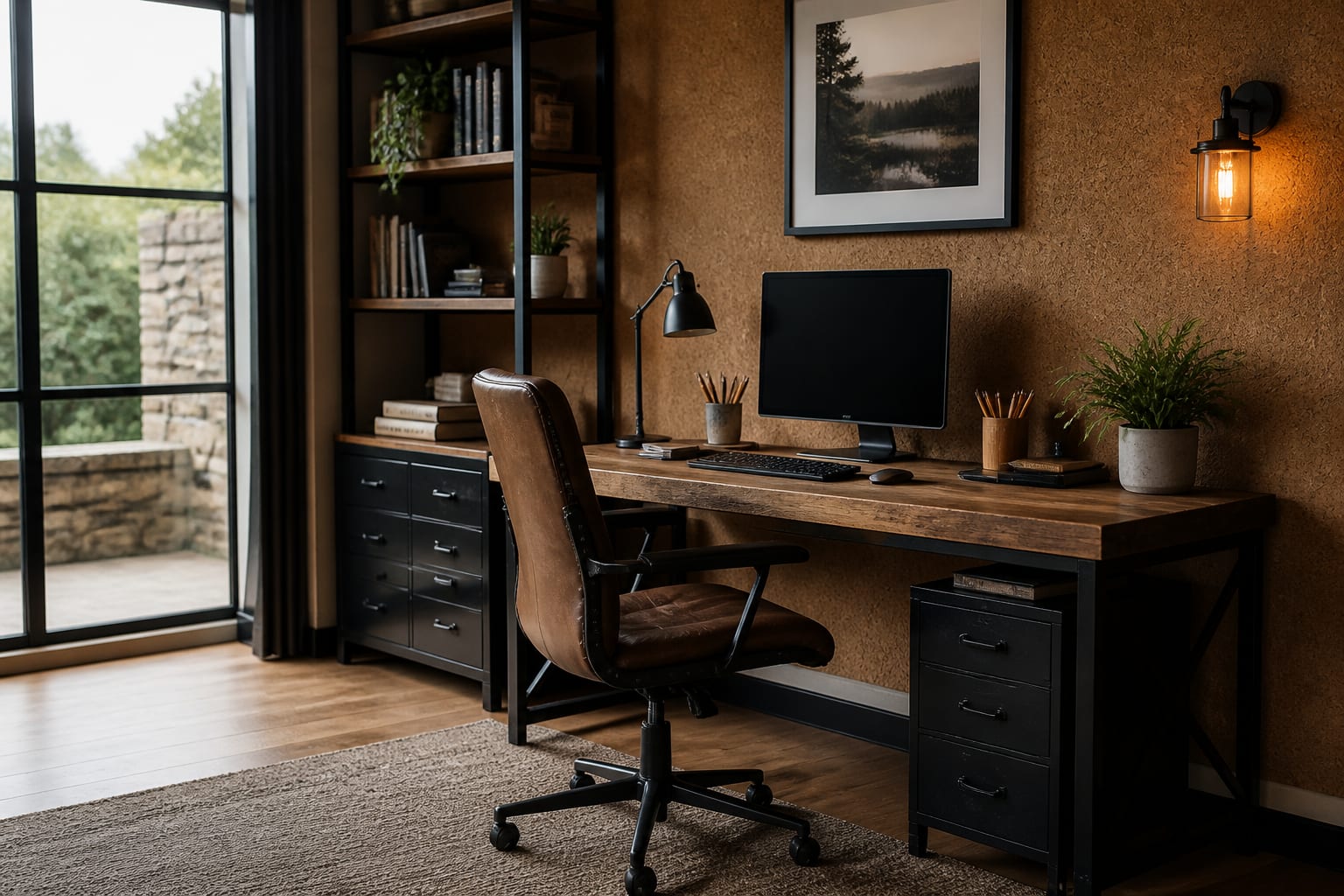
- Desk: 48 in–60 in wide if you use a monitor; black metal legs with a wood or leather top give the workstation authority.
- Shelving: keep depths around 10 in–14 in and stay disciplined about what goes on them, or they become shadowy storage ledges.
- Task lamp: 20 in–28 in tall in metal, glass, or fabric, positioned to light the work surface, not glow beside the keyboard.
- Rug: low-pile, extending at least 24 in behind the pulled-out chair for acoustic softness without dragging on casters.
- Metal accents: repeat black metal in three controlled spots (desk frame, shelf brackets, frames) so it reads as architecture, not scattered theme.
- Wood storage: one lateral file, sideboard, or shallow cabinet (16 in–20 in deep) to break up the black-metal grid.
- Art: one large piece, roughly 24 in x 36 in or bigger, above the desk beats several small objects competing with your webcam view.
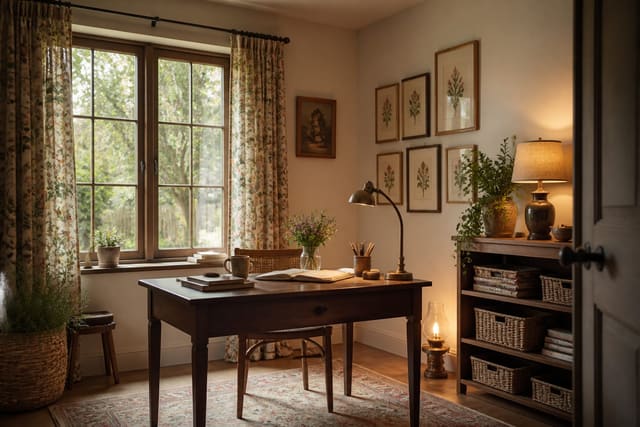
- For a softer version, borrow the comfort layer, fabric shade, wood drawer unit, warmer curtain, from cottagecore home office ideas.
How should dark color, metal, and storage work together?
Dark color creates focus, metal creates outline, and storage removes clutter from view. Push all three too hard at once and the office starts to feel like a storage room with better branding.
Use dark paint where it aids concentration or the camera background, ideally with a pale floor, warm desk, and enough lamplight to keep it from going flat. In north-facing rooms, black-blue paint can read cold, so test warmer charcoal, deep olive, mushroom brown, or tobacco on 8 in x 10 in samples across morning, afternoon, and evening light.
Storage makes the style credible. Open shelves suit books, records, bins, and ceramics; cables, paper, and chargers belong in drawers or boxes. Keep the desktop to daily equipment only, laptop, keyboard, one lamp, one notebook, one tray, and file everything else out of sight.
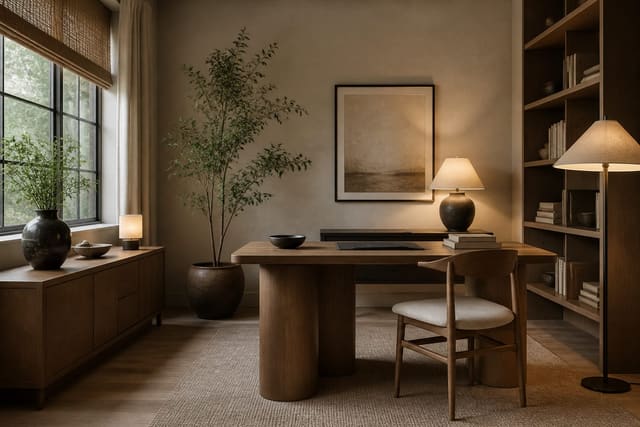
For a quieter counterpoint, Japandi home office ideas use less contrast and more negative space, but its discipline around storage and empty surfaces can sharpen an industrial room too. Either way, the desk should look ready for work, not buried under personality.
Lighting decides whether the room feels cinematic or depressing. Use warm 2700K bulbs for lamps and sconces, and add light beside or behind the monitor so the screen isn't the only bright rectangle in the room. A lamp placed slightly in front of your face and to one side flatters video calls better than an overhead fixture.
Common industrial home office mistakes
These rooms go wrong when people copy loft symbols without respecting how the space actually gets used for work.
- Desk too narrow: a 42 in writing desk feels cramped with a monitor, keyboard, notebook, and lamp; go 54 in or wider.
- Exposed bulbs at eye level: swap for shaded sconces, dome lamps, or library lights so glow lands on the desk, not your eyes.
- Tiny industrial props everywhere: use larger books, lidded boxes, framed work, and a few heavy objects instead of a theme-restaurant shelf.
- No cord control: mount a cable tray under the desktop, use fabric sleeves, and keep the power strip off the floor.
- A hard chair for the look: choose a supportive task chair first, then bring in style through leather, black arms, or a wood shell.
The quiet mistake is ignoring sound. Concrete-look floors, metal shelves, bare windows, and a hollow desk make calls echo, so add curtains, a rug, a fabric pinboard, and upholstered seating to absorb noise without softening the mood.
Use AI to preview your industrial home office before you commit
Every major material in this style changes how the next one reads: a black desk can look crisp against plaster and oppressive against espresso floors, and brick can add character in one room while crowding another. Upload a photo of your actual office to Re-Design and test the full composition from the same angle before buying the heavy pieces.
Try a black metal and walnut desk, a darker feature wall with lighter shelves, and a version where the mood comes mainly from lighting, leather, and art. Keep real window size, outlets, chair clearance, door swing, monitor size, and floor color visible so you see which dark move your room can actually absorb.
This is especially useful in a shared space like a guest room or dining area, where you need to check whether the desk background reads focused on calls or the shelves crowd the chair path. If greenery matters, biophilic home office ideas show how to add plants without tipping the room into a wellness studio.
What finishing details make the workspace feel intentional?
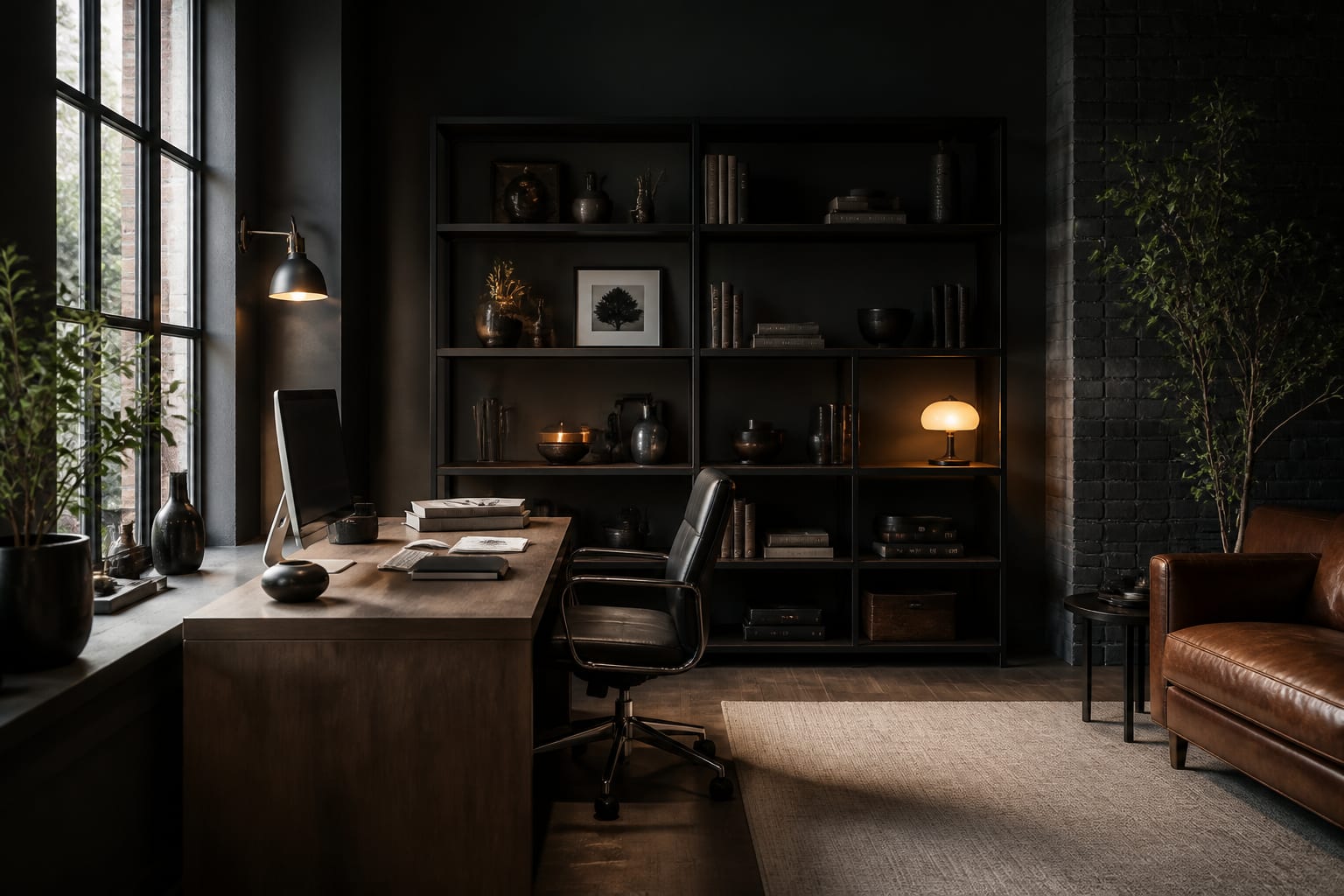
Add objects with weight and purpose: a ceramic pencil cup, leather tray, black metal letter sorter, cork board, stone bookend, or framed architectural print. Keep the surface edited enough to open a laptop, write in a notebook, and set down coffee without rearranging anything.
Give art scale, hang a single piece around 57 in–60 in on center when it stands alone, or leave 6 in–10 in of breathing room above the desk. Black-and-white photography, line work, maps, and large typography all support the palette without adding random color.
Add plants only where light supports them. A rubber plant, snake plant, pothos, or ZZ plant in a 6 in–10 in pot softens a corner; in a dim office, use branches or a textured lamp shade instead.
Stand in the doorway and name the strongest element in three seconds. If you only register dark objects, add warmth where your hands and eyes spend time.
Frequently Asked Questions
What colors work best in an industrial home office?
Charcoal, warm black, tobacco, oxblood, concrete gray, walnut, camel leather, aged brass, olive, and bone all suit the style. Confine the darkest tones to the desk, shelves, rug, or a single wall in lower-ceiling rooms, and test paint samples in real morning, afternoon, and evening light before committing.
How do I keep an industrial office from feeling cold?
Add warmth at every point you touch: wood grain, leather, wool, linen, or cork. Use warm 2700K bulbs, a wood storage piece, and a low-pile rug so the black metal has something soft to sit against.
What size desk works for an industrial home office?
Aim for 48 in–60 in wide if you use a monitor, with at least 20 in–24 in of usable depth. A desk under 42 in feels cramped once a keyboard, notebook, and lamp are on it.
How much metal is too much in this style?
Repeat black metal in about three spots, such as the desk frame, shelf brackets, and picture frames. Covering every object in black steel turns the room into a themed set instead of a working office.
Can I preview my industrial office design before buying furniture?
Yes. Upload a photo of your actual room to Re-Design and test different desk, wall color, and lighting combinations from the same angle. This shows which dark, heavy choices your specific room can handle before you commit to paint or furniture.