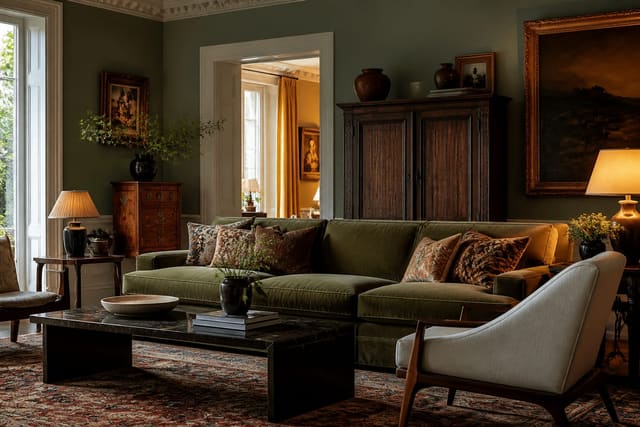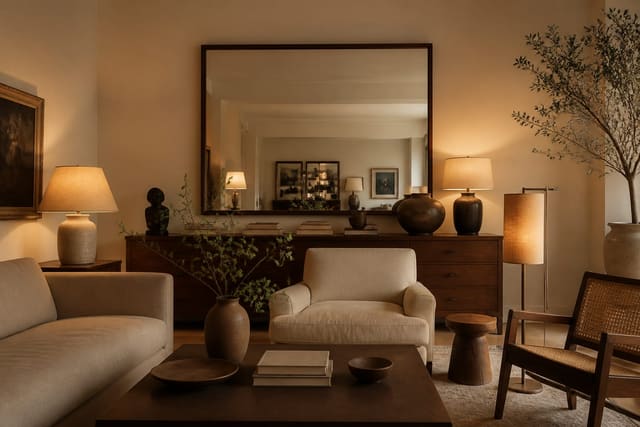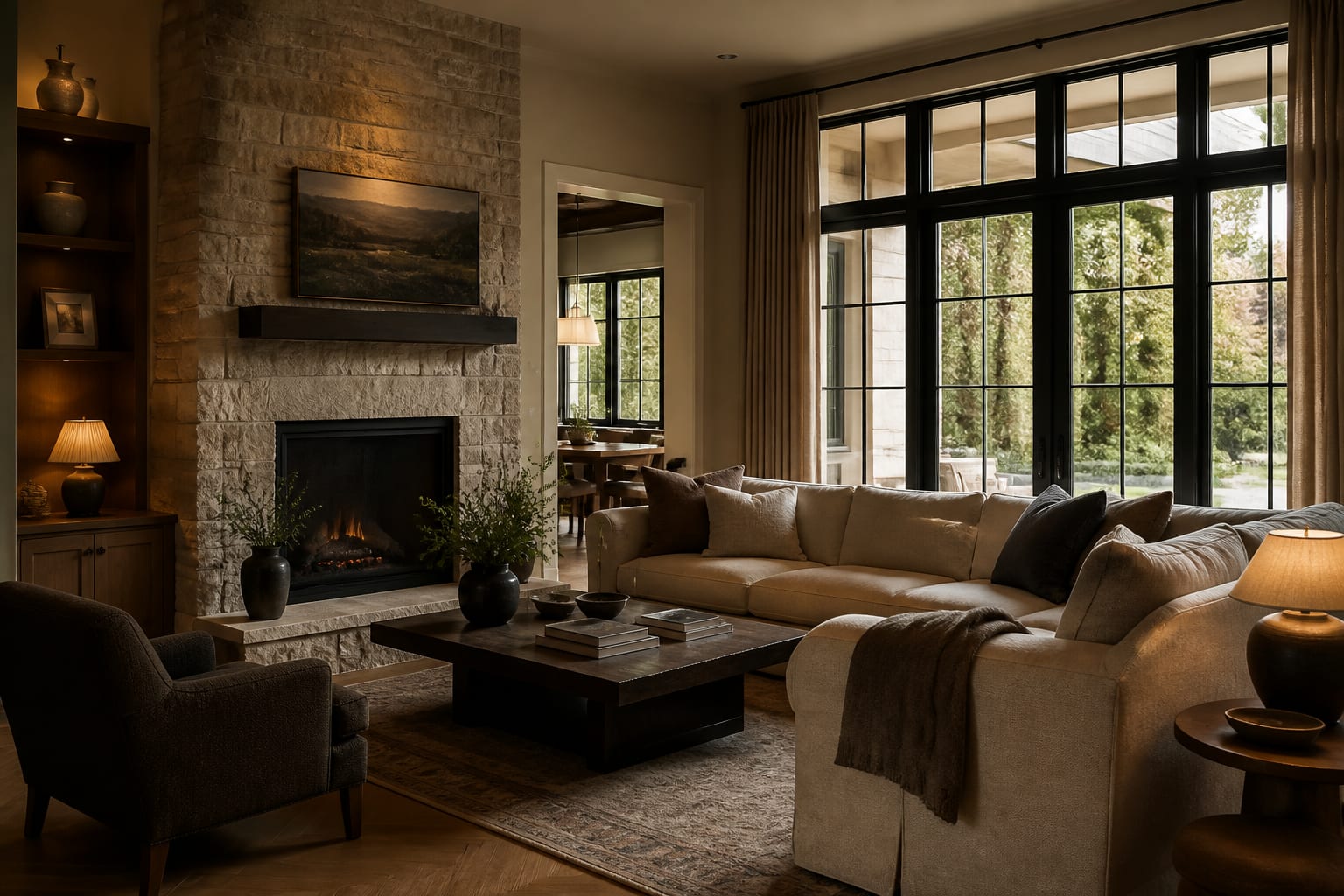
A new build home feels warm when you fight its biggest weakness on purpose: it has no age, no patina, and no character baked in, so you have to layer all of that yourself through texture, color, mixed eras, and better lighting. The blank white box is a blessing and a curse. My read is that new builds get a bad rap not because they are poorly made, but because people decorate them in the same crisp, matchy, builder-grade palette they came with, which doubles down on the generic feeling instead of fixing it.
Older homes hand you character for free: crown molding, original floors, quirky nooks, the marks of decades. A new build hands you flat drywall, beige carpet or gray LVP, and recessed cans. That is not a flaw to hide; it is a clean canvas. But a canvas needs paint. The whole job is adding the soul the builder left out.
Layer in the texture and age the builder skipped
The number one reason a new build feels soulless is that every surface is smooth, new, and the same age. There is no patina, no wear, nothing that says time has passed here. You fix that with texture and with a deliberate mix of old and new. Bring in materials that carry history or roughness: a vintage rug with some wear, a reclaimed-wood console, a leather chair that will only look better as it ages, a stone or ceramic piece with an irregular surface.
Mixing eras is the fastest cheat code for character. One or two genuinely old pieces per room, a flea-market mirror, an antique side table, a piece of art with age, instantly counter the everything-is-new flatness. The contrast between a crisp new sofa and a worn vintage rug is exactly what makes a room feel collected over time rather than bought in one trip. The same logic of combining different looks and ages runs through my mixing design styles guide, and the headline rule carries over: aim for at least 3 contrasting surfaces in every view.
Keep a balance of soft and hard so the room does not tip cold. New builds often have hard floors and hard walls, so weight your additions toward soft, warm materials: wool, linen, leather, and wood against all that drywall and LVP. A large area rug, 8 by 10 feet or bigger in a living room, does double duty here, warming the hard floor underfoot while quieting the echo that empty new rooms always have.
Window treatments are an underrated warmth move in a new build, because builders rarely include them and bare windows keep the room feeling like a listing photo. Mount curtain rods 4 to 6 inches above the frame and run floor-length panels in a textured fabric like linen; that single change softens the hard window rectangle and adds the height new builds with 9-foot ceilings can really show off. Layering in a woven shade behind the panels adds another natural texture and lets you control the light.
Break the builder palette and the flat walls
Builder-grade interiors are designed to offend no one, which means greige walls, white trim, and the safest possible finishes. Decorating in that same palette keeps the model-unit feeling alive. The fix is real color and real contrast. Commit to a proper scheme, a clear dominant color, a supporting tone, and a bold accent, rather than fifteen shades of the same beige.
Flat drywall is the other culprit. Older homes have architectural detail; new builds usually do not. You can add it back without a contractor:
- Paint a feature wall or the whole room a saturated color to give the eye somewhere to land.
- Add picture-frame molding or board-and-batten to a wall for instant architecture.
- Hang large-scale art or a big mirror to break up empty drywall expanses.
- Install a peel-and-stick or grasscloth wallpaper on one wall for texture and depth.
- Swap builder-grade flush ceiling lights for fixtures with actual presence.
Lighting deserves its own push, because builders default to recessed cans that flatten everything. Add the three layers that make a room feel designed: overhead, mid-level lamps or sconces, and a low floor source, all warm at 2700K to 3000K. Put the overhead cans on a dimmer if they are not already, and let the lamps do the evening work, since a wall of bright 4000K downlights is one of the strongest tells of a builder interior. If parts of your new build feel dark or cavernous, the layered-light tactics in my dark room solutions guide translate straight over.
Hardware is the last quick win. Builder packages lean on the cheapest cabinet pulls, faucets, and switch plates, and swapping even a few of them for a finish with some weight, aged brass, matte black, brushed nickel, signals that someone made choices here. Pick one metal finish and repeat it across a room so the upgrades read as intentional rather than scattered.
Common mistakes to avoid
The most common mistake is decorating a new build in the same neutral, matchy palette it was built in, which preserves the exact blandness you are trying to escape. Add color, age, and contrast on purpose.
A second frequent mistake is buying everything new and from one store at once, so the whole room shares a single style, finish, and age, the textbook recipe for a model-unit look. Mix sources, eras, and price points. A third is leaving the builder lighting untouched and wondering why the rooms feel flat, when recessed cans alone never create warmth. People also leave the big drywall walls completely bare, which makes the space echo and feel temporary. And many skip texture entirely, assuming new and clean equals finished, when new and clean is exactly what reads as cold. Layer in rough, soft, and aged materials and the new build finally feels like a home rather than a showroom.
Use AI design to picture the warmed-up version
The hard part of warming up a new build is imagination: standing in an empty white box, it is genuinely difficult to picture color on the walls, a feature wall of paneling, or how a vintage rug would read against new floors. Re-Design takes the guesswork out. Upload a photo of your new build room and the AI design re-renders it with richer colors, layered textures, mixed-era furniture, and better lighting so you can see the warmed-up version before you commit.
Because you upload your real space, the preview respects your actual layout, window placement, and those crisp new finishes you are working with. Test a deep accent wall against your builder-white, try board-and-batten on a flat wall, and see how a warmer, layered scheme transforms the box before you buy paint, furniture, or fixtures.