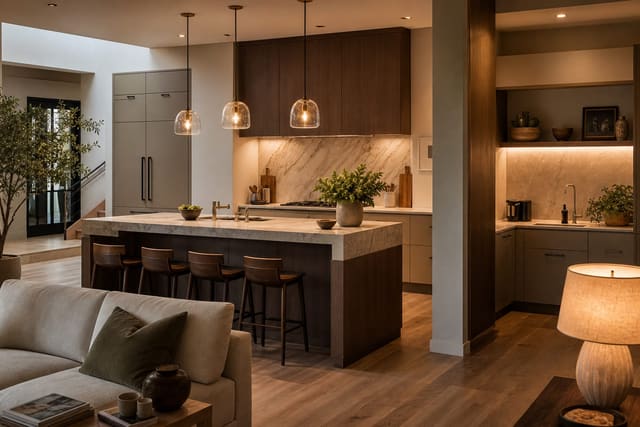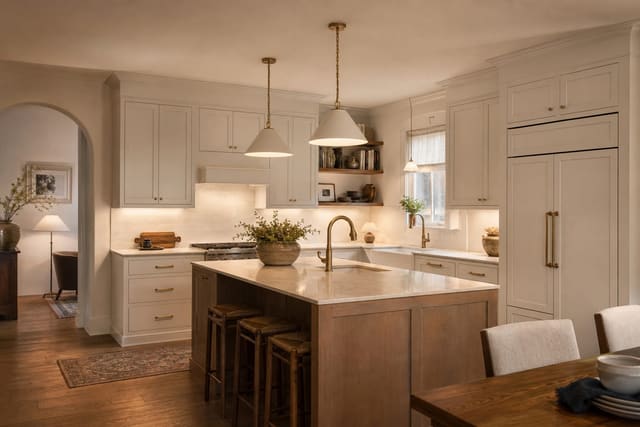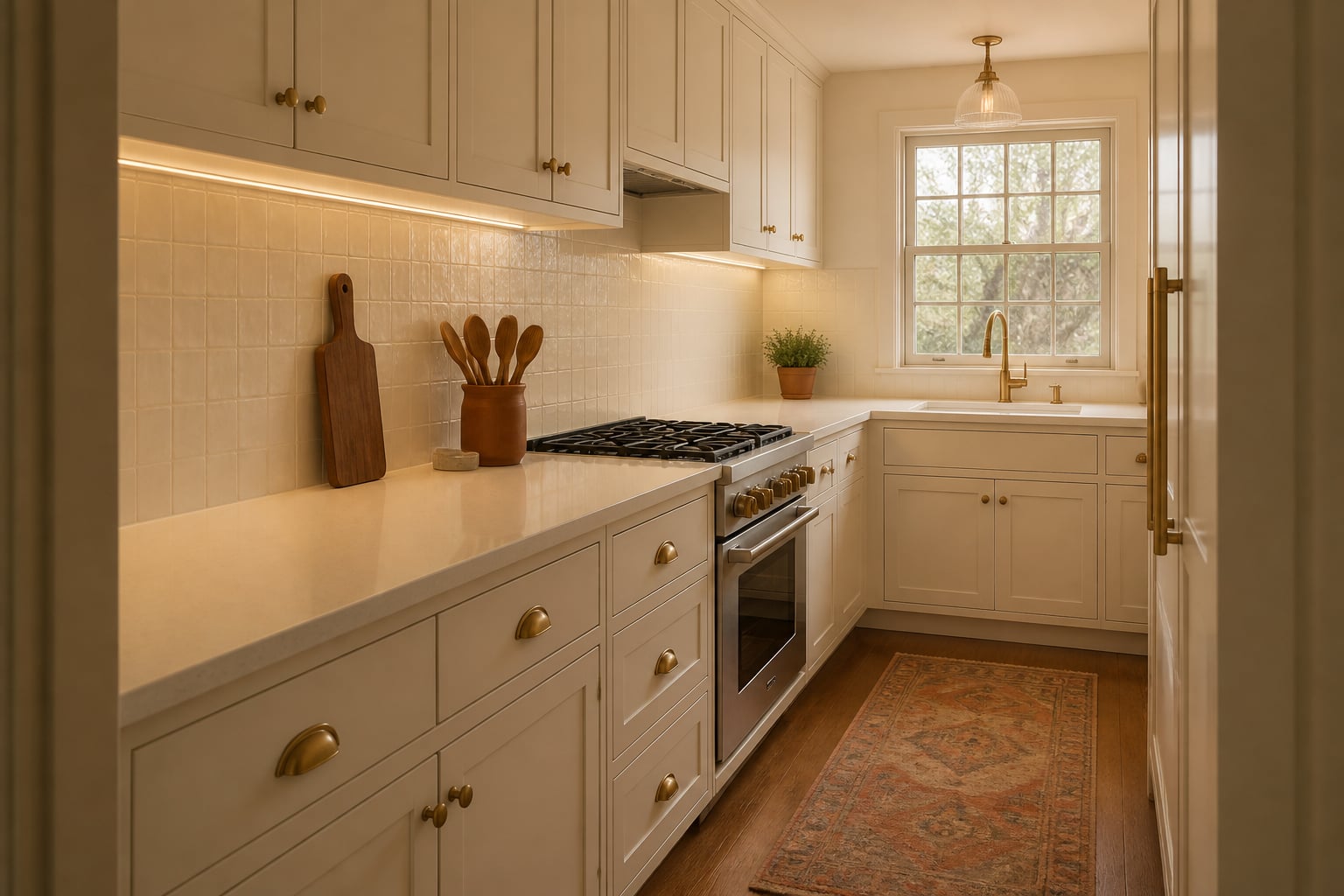
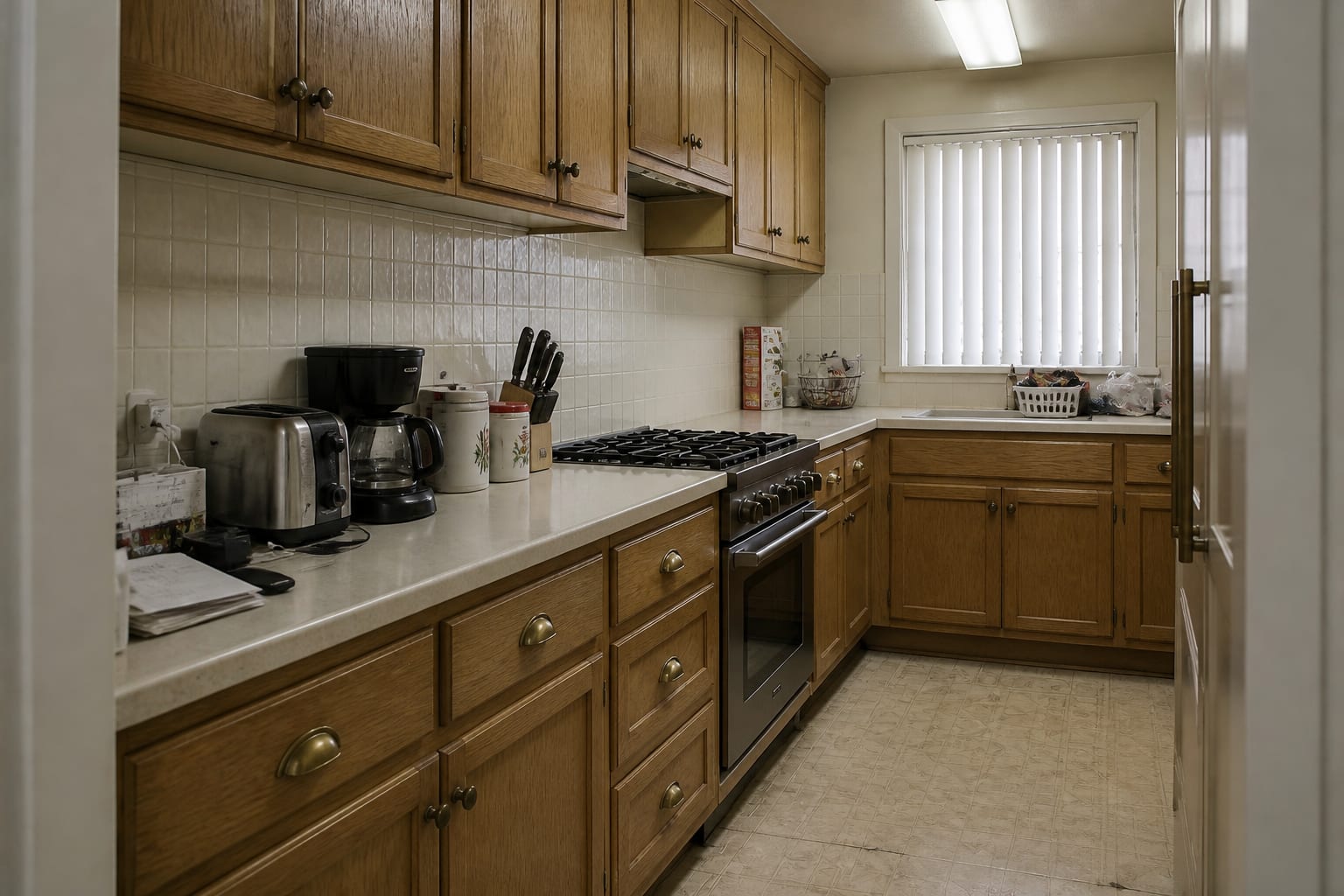
Kitchen counters stay clear permanently when every appliance and tool has a closed home within arm's reach, the daily-use zone holds only a few essentials (coffee setup, knife block, salt), and one drawer is dedicated to the mail and key drift that always lands on the counter. The fix is deciding what the counter is allowed to do, then making the wrong behavior inconvenient.
"The counter stays calm when only the tools that earn the surface are allowed to live there."
How do you permanently fix kitchen counter clutter?
Remove every non-daily item from the counter, assign each daily item a reachable home, and protect at least one clear prep zone that stays empty after every meal. A kitchen usually needs one uninterrupted prep run at least 24" wide, ideally 30"–36" for two cooks. If that space is occupied by mail, vitamins, an occasional-use blender, and decorative jars, the room will look cluttered even after you wipe it down.
Use a 30-second reset rule: if an object can't return to its home within 30 seconds while standing in the kitchen, its home is wrong. Mugs across the room from the coffee maker or spices buried behind mixing bowls create piles because the kitchen resists how you actually move.
Don't start by buying organizers. Fire the counter from jobs it shouldn't have first. Mail belongs near the entry, charging belongs in a drawer, and rarely used appliances belong behind a door. If pantry overflow is pushing things outward, fix the storage source with this guide to small pantry organization that creates real capacity.
Which items deserve counter space?
Keep only what you use daily, what's too heavy to move safely, or what supports a specific zone: the coffee maker, maybe a toaster, hand soap, and a small tray for salt or oil.
- Appliances: A stand mixer can stay if you bake weekly or it's too heavy to lift. Blenders, air fryers, and waffle makers don't earn permanent space just because they have cords — store them on a 12"–16" deep shelf at waist height.
- Sink zone: Keep soap, a brush, and one sponge in a holder no wider than 6"–8". Use a roll-up or folding drying rack that disappears once dishes are dry.
- Cooking zone: Keep only the 2–3 seasonings used constantly within reach; move the rest to a drawer insert or a 3"–5" spice riser. Twenty bottles beside heat and grease reads as clutter.
- Kids' and pet items: Put lunch boxes in a 12"–15" high drawer, not on the counter because the shelf is too high. Keep leashes, medication, and grooming tools out of the kitchen entirely.
Test this on your own room photo with ReDesign before choosing a direction; keep the doorway, walls, windows, and fixed features visible so the preview solves the room you actually have.
What storage zones keep counters clear?
A clear counter depends on zones that match the work, not coordinated containers.
| Zone | What belongs there | Fix if it's overflowing |
|---|---|---|
| Prep | Knives, boards, daily spices | One 15"–18" drawer reserved for prep tools only |
| Beverage | Coffee maker, kettle, mugs, tea | Compress into one footprint, not a 4-foot spread |
| Cleanup | Soap, tablets, cloths | Two under-sink pull-out bins: wet cleaning, refills |
| Pantry overflow | Bulk snacks, extra bakeware | Closed 30"–36" cabinet or door-mounted racks |
| Drop zone | Mail, keys, chargers | Wall pocket or drawer near the entry, not the stove |
If the kitchen is open to the living room, see hiding open-plan kitchen mess before letting a full drink station face the sofa. Add a battery puck light (2700K–3000K) inside dark under-sink cabinets so items actually get put back.
Common kitchen counter clutter mistakes
- Trusting a tray to fix mixed categories. A tray can corral oil and a pepper mill; it can't make mail, vitamins, and a charger belong together. If it holds more than one category, it's a junk drawer without sides.
- Keeping appliances out because cabinets are annoying. That's a storage design problem. Add a slide-out tray or remove duplicate bakeware so the cabinet can do its job.
- Using clear containers for everything. Clear jars work for pasta or coffee; multicolor snack packets and supplement bottles look louder in plastic. Use opaque bins for visually noisy items.
- Ignoring vertical space. A short 18"–24" rail under an upper cabinet can hold a towel or utensil cup without stealing prep space — don't turn it into a hardware aisle.
- Blaming clutter alone for a crowded look. Shadows collect under cabinets and around small appliances in dim kitchens. Improve task light using ideas from this guide to making a dark kitchen feel bright before buying more bins.
How does AI design help find the permanent fix?
Upload a straight-on photo of the counter wall and another from the doorway so the sink, stove, cabinets, and everyday appliances are all visible. Leave the coffee maker, dish rack, and mail pile in the shot if they normally appear there.
Preview one behavioral change at a time: a counter with only the coffee zone removed, then a version with an appliance garage, then one with a wall rail or a closed pantry cabinet added. If the kitchen only looks calm when every useful object is stripped out, the concept is too fragile for real life.
Use the image to test proportions before shopping — whether a 30" cabinet crowds the doorway, whether a 12" rolling cart looks intentional, whether under-cabinet lighting makes the same clutter feel calmer. Then turn the best version into a maintenance rule: one tray for the coffee zone, an empty prep zone, one small caddy at the sink. That's how kitchen counter clutter solutions become permanent.
Frequently Asked Questions
Why does my kitchen counter clutter come back even after I declutter?
Counters refill because items have no closed home. Every appliance, tool, and paper needs a named drawer, cabinet, or basket within five feet of where you use it, or it returns within a week.
How many things should be on a kitchen counter?
Aim for three to five visible items in the daily-use zone: coffee setup, knife block, salt and pepper, and an optional fruit bowl. Everything else belongs behind a door.
Where should small appliances live if not on the counter?
Build an appliance garage in a deep cabinet next to the outlet, or dedicate a lower cabinet shelf with a pull-out tray so the toaster, blender, and mixer slide out instead of sitting out permanently.
What about the mail and keys that always end up on the counter?
Dedicate a shallow drawer or wall pocket near the entry to catch the daily drift. Clear it every Sunday evening so it never accumulates past one week.
How do I keep counters clear in a small kitchen with no pantry?
Convert the cabinet under the sink, one upper cabinet, and the shelf above the fridge into a virtual pantry. Counters stay clear once even pantry goods have a closed, dedicated home.
> Try this: Ready to see this on your own room? Open ReDesign and run the preview.
Three transformations to try
1. Three-item daily-use zone with closed appliance garage 2. Under-counter pull-out tray for small appliances 3. Single drawer for mail/keys/paper drift