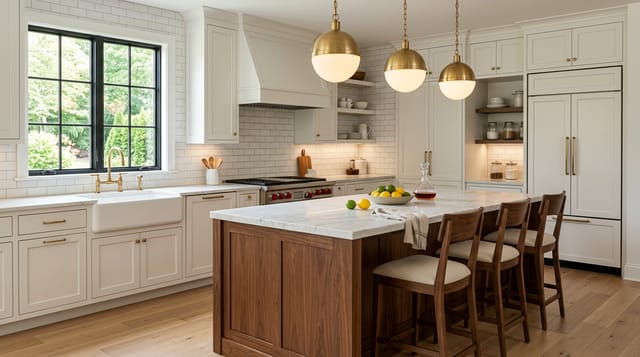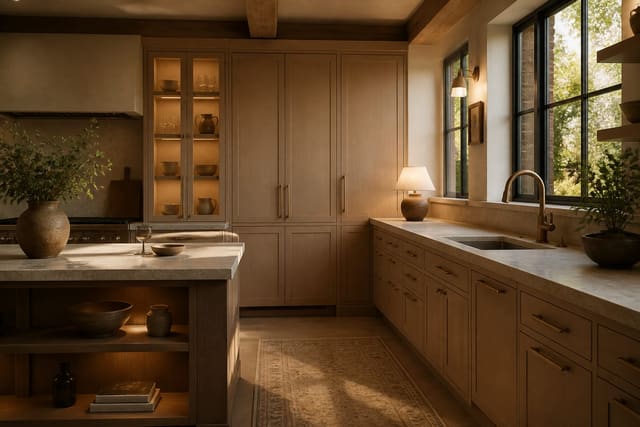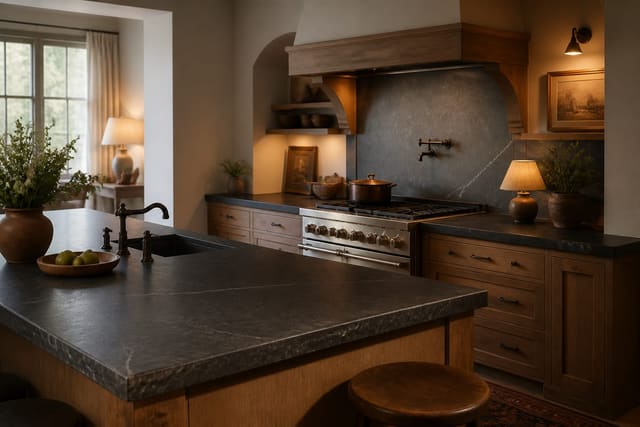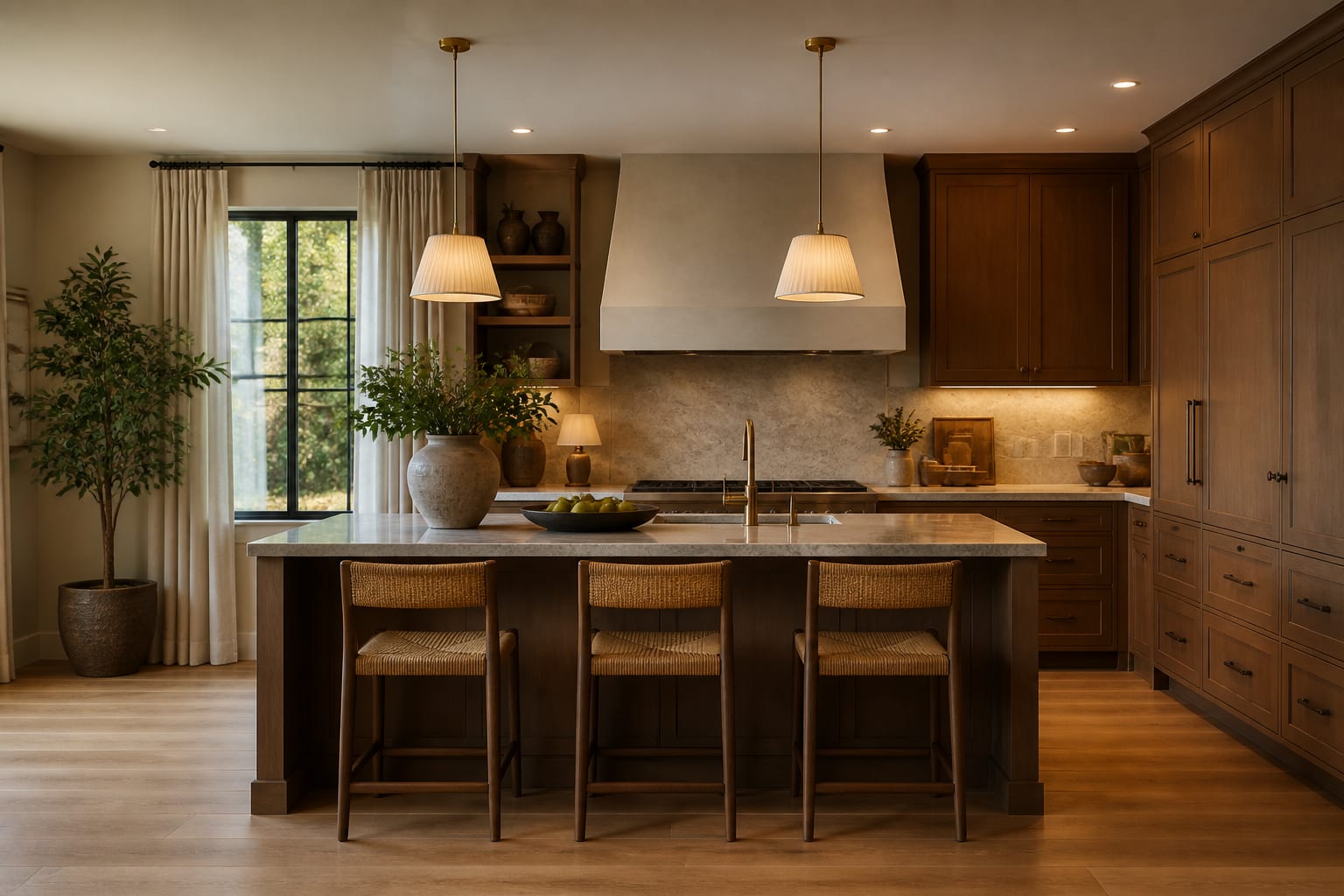
A peninsula is the smarter choice in more kitchens than people admit, and chasing an island anyway is how layouts end up cramped and awkward. An island needs roughly 42 to 48 inches of walkway on every side, which most rooms under about 150 square feet cannot give. A peninsula borrows one wall or run of cabinets and extends into the room, so it only needs clearance on the open sides. You still get the prep surface, the seating, and the storage, but the footprint fits a real house. The trick is treating the connected end as an asset rather than a compromise.
When does a peninsula beat an island?
The honest answer is whenever your room cannot give an island a full 42-inch path on all four sides without choking the main traffic lane. In a galley or an L-shaped kitchen, a peninsula closes the open end of the L and creates a U, which is one of the most efficient working shapes there is. You keep the cook inside the triangle of sink, range, and refrigerator while the peninsula adds landing space exactly where an L-kitchen usually runs short. That added run of counter, often 5 to 7 feet of it, is frequently more usable than a small island marooned in the middle.
A peninsula also earns its keep as a soft divider between a kitchen and an adjacent dining or living area in an open plan. Rather than a wall, you get a counter that defines the cooking zone while keeping sightlines and conversation open. If you are weighing the broader layout, our AI kitchen design ideas walk through how peninsulas, islands, and galley runs each change the flow of a room. The point is that a peninsula is not the consolation prize; in tight or open-concept floor plans it often outperforms the island people think they want.
How do you size a peninsula for seating?
Get the dimensions right and a peninsula seats people as comfortably as any island. Allow 24 inches of linear counter per stool so elbows do not collide, which means a 6-foot run comfortably seats three. For knee room, the standard counter-height overhang is 12 inches, but bump it to 15 inches if you want people to actually tuck in and linger rather than perch. Counter-height seating at 36 inches pairs with 24-inch stools; a raised 42-inch bar pairs with 30-inch stools and has the bonus of hiding prep mess from anyone seated on the far side.
Think hard about which side the seating faces. Stools on the room side keep traffic out of the cook's path, while stools tucked under the cooking side put guests too close to the range and hot pans. Leave at least 36 inches, and ideally 44 inches, of clearance behind pulled-out stools so someone can still walk past a seated diner. The pulls and knobs you pick for the base set the tone too; our kitchen cabinet hardware guide covers sizing drawer pulls so the seating-side cabinets stay easy to open without snagging a passing knee.
What can the peninsula base actually hold?
The base of a peninsula is prime, often wasted, storage. Because it is accessible from two or even three sides, you can plan deep drawers on the cook side for pots and a shallow run of cubbies or open shelves on the seating side for cookbooks and serving pieces. A peninsula 24 inches deep gives you standard cabinet depth on the working face; push the box to 27 or 30 inches and you create a knee-pocket plus a band of storage behind the seated diners. Corner access where the peninsula meets the wall run is the trap, so specify a lazy Susan or a diagonal cabinet there rather than a dead blind corner.
Decide early whether the peninsula carries a sink or cooktop. A prep sink needs plumbing run through the connected wall, which is far cheaper than trenching to a freestanding island, one more quiet advantage of the connected end. If you put the main sink on the peninsula facing the room, you get the social cook-and-chat setup people love, but plan a tall 4-inch backsplash lip or a raised bar behind it so splashes do not reach the seated side.
What finishes make a peninsula look intentional?
The difference between a peninsula that looks built-in and one that looks like a chopped-off cabinet run comes down to the exposed end. Never leave a bare cabinet side facing the room. Wrap it in a decorative panel, a run of beadboard, applied molding, or carry the countertop down the side as a waterfall slab. A waterfall edge in a stone like soapstone reads as a single sculptural block and instantly makes the peninsula feel like furniture; our soapstone material guide covers how that dense, matte stone wears and why it suits a high-traffic peninsula.
Color is a lever too. Painting the peninsula a contrasting tone from the perimeter, a deep navy base under a white counter, for instance, signals on purpose rather than left over. Add a row of two or three pendants centered over the seating, hung so the bottoms land 30 to 36 inches above the counter, and the peninsula reads as a designed focal point. Skip the toe-kick on the seating side and add a furniture-style baseboard if you want it to feel even less like a kitchen cabinet and more like a built-in table.
Here are the common mistakes to avoid when planning a peninsula: - Forcing a 15-inch overhang on a 12-inch deep base so the stools have no real knee room and feel like an afterthought. - Leaving less than 36 inches of clearance behind the stools, which blocks the only walkway through the kitchen. - Aiming seating into the cook's work zone so guests sit inches from the hot range and open oven door. - Leaving the exposed end as a raw cabinet side instead of finishing it with a panel or waterfall slab. - Skipping an electrical outlet on the peninsula, so it cannot serve as a homework desk or buffet with a warming tray. - Building a dead blind corner where the peninsula meets the wall run instead of a lazy Susan or diagonal cabinet.
Preview your peninsula in Re-Design
A peninsula is hard to picture from a tape measure, because the same run of cabinets can feel generous or cramped depending on the overhang, the stool height, and the finish on the end. Take a photo of your kitchen and upload it to Re-Design, then preview a peninsula in the spot you are considering: try a 36-inch flat counter against a raised 42-inch bar, swap a painted contrasting base for a wood-wrapped end, and add pendants over the seating to judge the scale. Seeing the peninsula in your own room, with your real walkways and sightlines, tells you in seconds whether three stools fit or only two, long before a cabinet is ordered or a wall is opened up.
Frequently Asked Questions
How much clearance does a kitchen peninsula need?
Leave 36 to 44 inches of walkway on the open sides of the peninsula, measured from the counter edge to the nearest wall or appliance. Behind seating, plan toward the 44-inch end so a person can walk past a pulled-out stool. Because a peninsula connects on one end, you only need this clearance on its exposed sides, not all the way around as an island demands.
How many stools fit at a peninsula?
Allow 24 inches of counter length per stool. A 6-foot peninsula seats three comfortably, a 4-foot run seats two, and an 8-foot peninsula can take four. Crowding stools closer than 24 inches leaves no elbow room, so it is better to seat fewer people well than to wedge in an extra stool that nobody wants to use.
What is the right overhang for a peninsula counter?
For counter-height seating at 36 inches, a 12-inch overhang is the minimum and 15 inches is more comfortable for tucking in. A raised 42-inch bar needs only about 12 inches because the higher perch changes the knee angle. Always support an overhang past 12 inches with brackets or steel rods so the stone or countertop does not crack.
Can a peninsula have a sink or cooktop?
Yes, and it is often cheaper than putting one in an island because the plumbing or wiring can run through the connected wall rather than under the floor. A prep sink or main sink on a peninsula creates a sociable cook-and-chat layout. If you add a sink facing seating, include a raised back lip or bar so water and food scraps do not reach the diners.