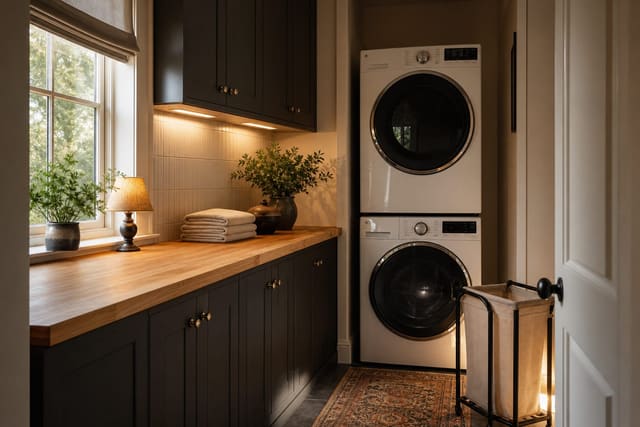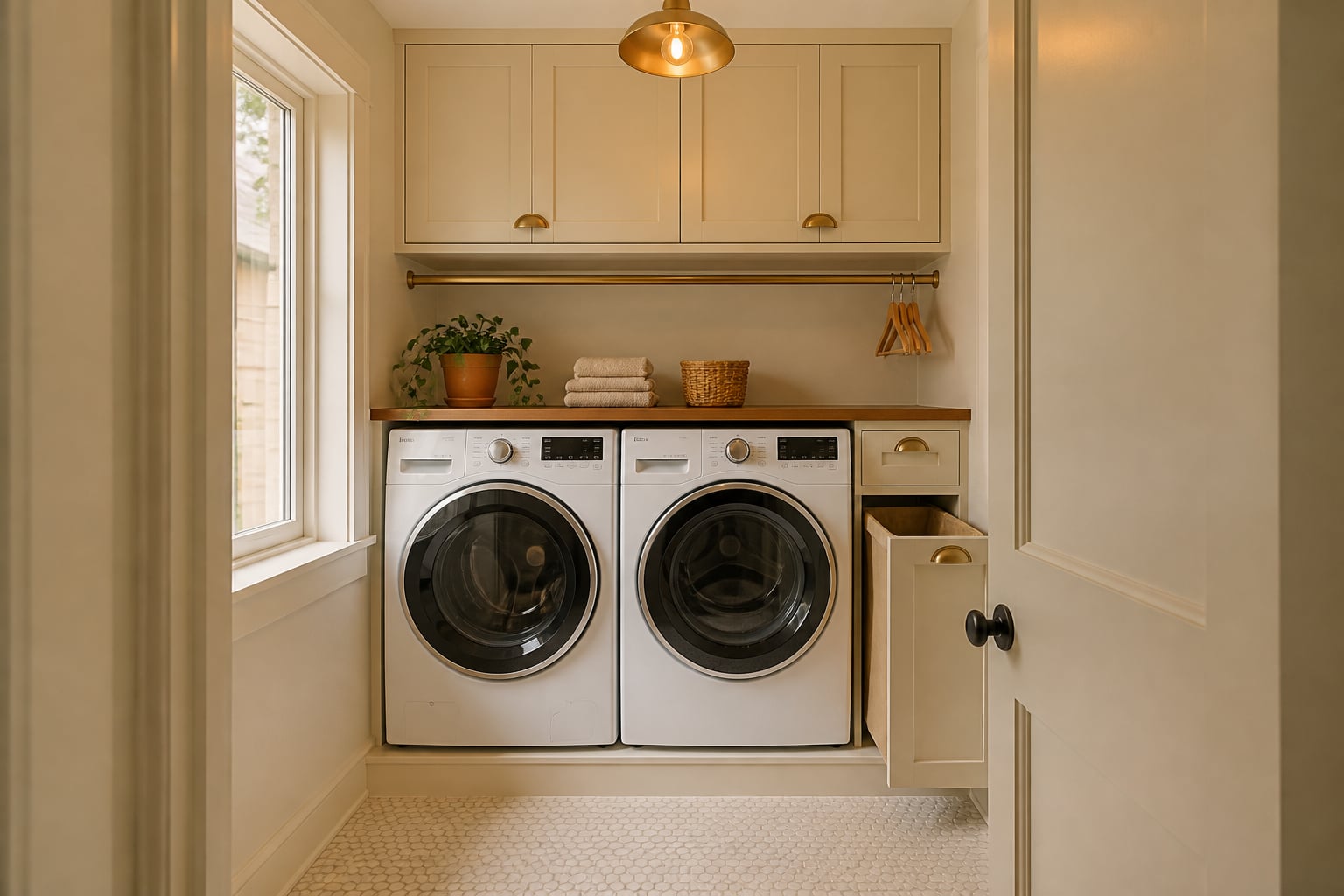
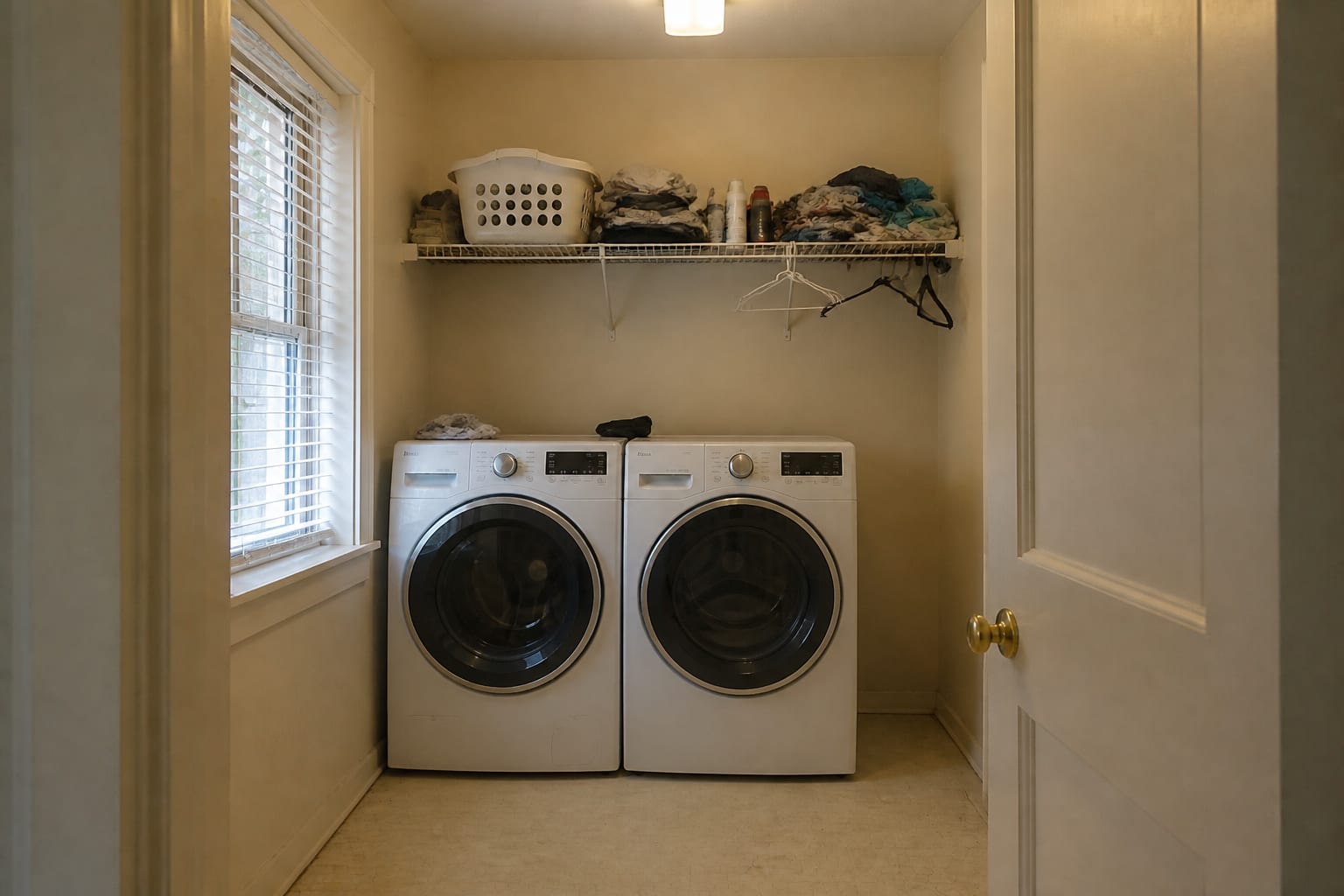
The best laundry room storage ideas treat the wall above the machines as a 12-16 inch cabinet run, use the gap beside the washer for a slim roll-out, and dedicate one wall to a folding counter or rod. Layer closed cabinets, open shelves, hampers, and wall rails so every wet, bulky, or ugly item gets its own spot instead of piling onto one wire shelf.
What storage works best in a laundry room?
The best combination is closed cabinets, adjustable shelves, a hanging rod, sorted hampers, and shallow wall storage, so every category has a specific place. Detergent, stain spray, dryer sheets, bleach, rags, and single socks should not all live in one open pile.
Start above the machines. Replace a shallow 12" shelf with a 12"-15" deep cabinet for visual calm, or add a second shelf 10"-12" above the first if closed storage isn't in the budget. Keep heavy liquids below shoulder height; lifting a full jug from above 60" gets old fast.
Mount a rod under the upper cabinet, not floating across the room. Leave 18"-24" of drop below it and keep it clear of a top-loader's lid. A front-load pair can often support a 36"-39" high counter, which doubles as a folding surface.
In a narrow room, borrow layout logic from a small laundry room layout that actually functions before buying containers. Protect door swing, machine doors, and the walkway first; a great cabinet that blocks the dryer door isn't a solution.
Which vertical storage decisions matter most?
Using the wall in bands makes a laundry room feel bigger without adding square footage.
| Band | Height | What goes there |
|---|---|---|
| Low | 0"-30" | Hampers (14"-18" wide, straight-sided) sorted by darks/lights/delicates |
| Middle | Counter to eye height | Weekly items: detergent, stain remover, dryer balls, mesh bags, lint bin |
| High | Above eye height | Backup supplies, bulk refills, empty bins — nothing needed mid-cycle |
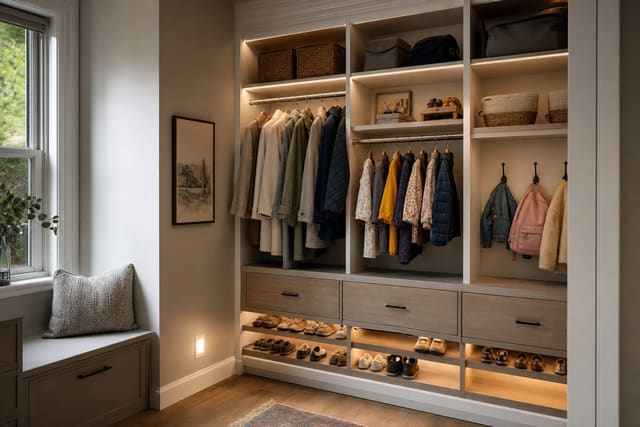
If the room doubles as a family entrance, plan the hamper zone with the discipline of a mudroom laundry combo layout so shoes and coats don't crowd the sort step. A 24"-30" wide wall cabinet above each machine usually reads more intentional than one long open shelf of mismatched bottles. If the top shelf needs a step stool, it shouldn't hold anything used during a normal wash.
Test this on your own room photo with ReDesign — keep the doorway, walls, windows, and fixed features visible so the preview solves the room you actually have.
How do you organize small laundry room storage without making it feel packed?
Small laundry rooms need fewer visible categories, not more tiny organizers. Appliance doors, hoses, vents, and labels already create noise, so an all-open wall reads as a utility closet even when tidy.
Pick one closed-storage move first: upper cabinets, a tall broom cabinet, or a narrow 10"-12" deep wall cabinet near the door. Send the ugly items there — bleach, concentrates, pet shampoo, rags, batteries.
Allow one open zone for daily rhythm: a 24"-36" wide shelf for jars, an orphan-sock basket, and the detergent you reach for constantly. A 10" deep shelf beats an 18" shelf here, since deep shelves hide forgotten duplicates.
Use the door only if it won't fight the machines — an over-door rack for stain spray and dryer sheets needs top and side clearance or it will bang and cheapen the room. Wall rails work better for slim tools like a drying rack, broom, or ironing board hung 48"-60" up. At a utility sink, keep a tray no wider than 8"-10" for daily soap and brushes, and put bulk product behind a door.
Common laundry room storage mistakes
- Buying baskets before sorting by behavior. A basket for dryer balls works; one basket for detergent, socks, batteries, and dog shampoo is just clutter with handles.
- Storing heavy liquids too high. Keep jugs between 30" and 54" from the floor, especially with kids or anyone doing laundry one-handed.
- Ignoring machine type. Top-loaders need lid clearance for any low shelf or rod; front-loaders need counter airflow and reachable shutoff valves.
- Turning the room into whole-house overflow. Vacuum parts, paint cans, and bulk toilet paper need permission before they take space meant for laundry and cleaning.
- Skipping task lighting. One cold ceiling bulb makes shelves look harsh; use 2700K-3000K bulbs and an under-cabinet strip over the folding counter so labels and stains are easy to see.
Use AI to preview your laundry room before you buy storage
Storage mistakes here are rarely about style — wrong cabinet depth crowds the walkway, wrong hamper blocks the door, wrong shelf height traps the washer lid.
Upload a straight-on photo from the doorway, plus a second angle from the machine side if the room is narrow. Keep the washer, dryer, hookups, sink, and current clutter visible; don't stage a fantasy version.
Preview three practical directions: closed upper cabinets with a hanging rod, open shelves with labeled bins, and a tall narrow cabinet plus sorted hampers. Compare against broader laundry room ideas for storage and style if the room also needs to look more finished.
Check the dull details in each preview: Does the rod clear the washer lid? Can the dryer door open? Is there 30" of standing space? Turn the best option into a buying brief — cabinet width, shelf depth, rod height, hamper count, counter height, and lighting location.
Frequently Asked Questions
How do I add storage above a washer and dryer?
Install 12 to 16-inch deep cabinets or open shelving starting 18 inches above the machine tops. Deeper than 16 inches blocks lid access on a top-loader and can hang over your face when you're reaching in.
What is the best storage for a small laundry room?
Use a stacked machine pair with a slim cabinet column on one side, a hanging rod above, a folding counter on the opposite wall, and one slim roll-out cart wedged between the machine and the wall.
Where should detergent and supplies go?
Detergent, fabric softener, and bleach belong in a closed cabinet above the machines or a slim pull-out beside them. Open shelves look messy within a week because bottle packaging rarely matches.
How wide should a folding counter be?
Aim for 24 to 30 inches deep and at least 36 inches wide. Less than 36 inches won't hold a queen sheet flat, and more than 30 inches deep wastes space in a tight room.
What storage makes a laundry room look designed instead of utilitarian?
Closed cabinet fronts with matte hardware, one wood counter top, a single woven sorting basket, and warm 2700K under-cabinet light turn a utility space into a room that looks intentionally designed.
> Try this: Ready to see this on your own room? Open ReDesign and run the preview.
Three transformations to try
1. Cabinet run above washer-dryer with folding counter opposite 2. Stacked pair with slim column and hanging rod 3. Slim roll-out between washer and wall for supplies