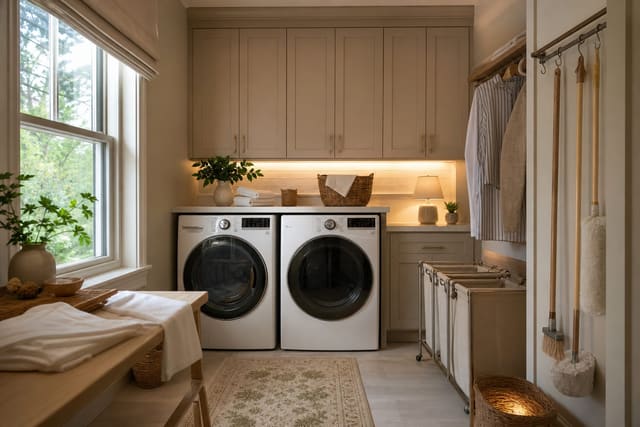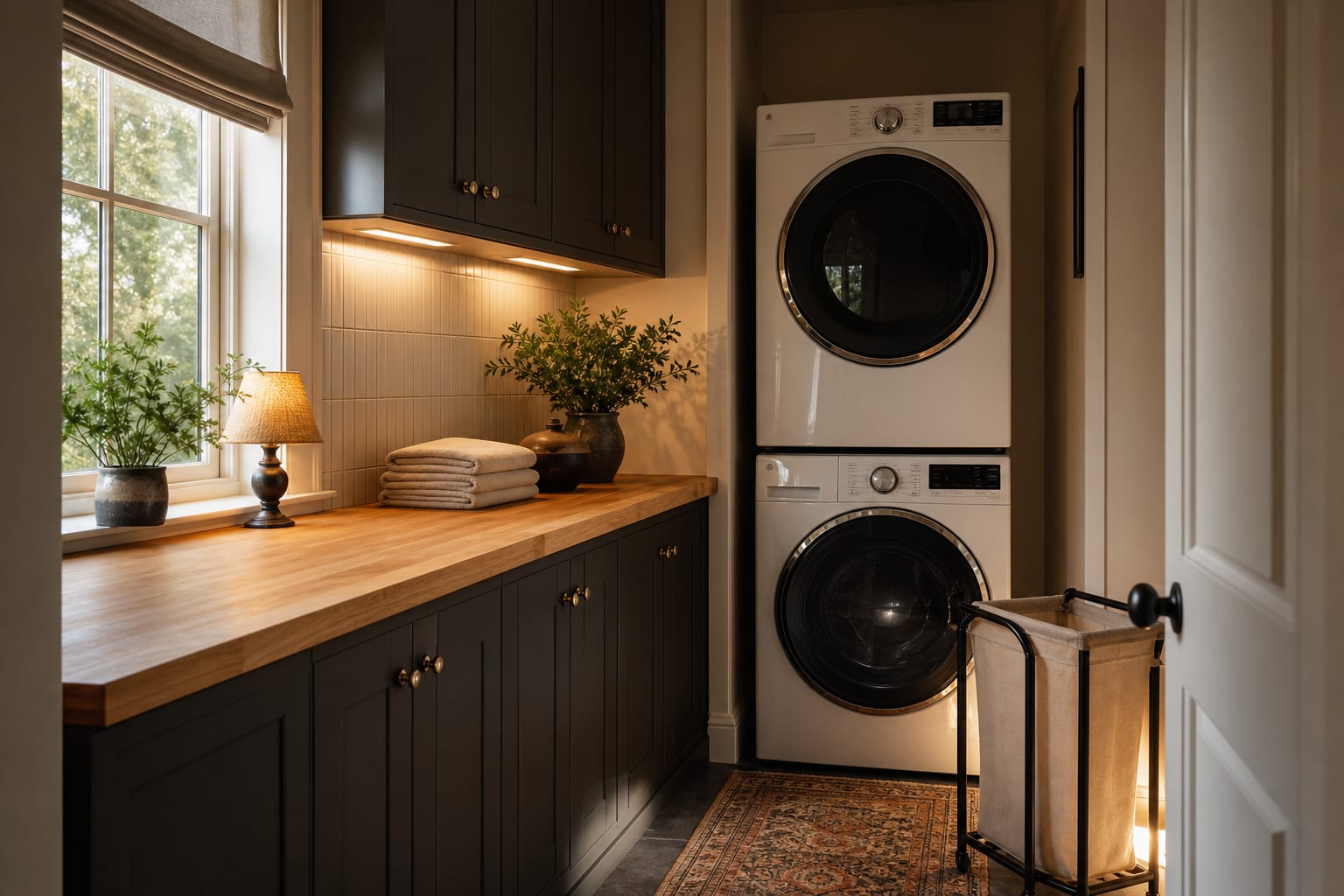
A small laundry room earns its layout when the pair stacks on one wall (saving 30 inches of floor width), the opposite wall carries a 24 to 30-inch folding counter with a rod above, and a 6 to 9-inch roll-out handles detergent and sorting - the whole room fits in 30 to 50 square feet. Small laundry rooms fail when treated like leftover closets; door swings, landing zones, and vertical inches decide the layout before baskets and finishes do.
What makes a small laundry room actually work?
A small laundry room works when the layout protects three things: a clear door swing, at least one landing surface, and storage you can reach without moving the hamper. Matching bins and trendy tile matter far less.
Check the machine doors first. Front-loaders usually need about 48 inches of clear space to open the door and crouch without hitting a wall. If the room can't spare that depth, a top-load washer with a side-by-side dryer is less photogenic but more workable.
Give yourself a landing surface within arm's reach of the dryer - a 24-inch counter over side-by-side front-loaders, or even a 12 to 15-inch wall shelf beside a stacked unit. Without it, every load migrates to the bed or dining table.
Use the wall above the machines. Wall cabinets should start 18 to 24 inches above a counter so you can open lids and still see what's stored. Over a top-loader, skip a fixed counter and set shelves high enough to clear the open lid. Pair this with laundry room storage ideas that use the full wall instead of solving everything with one cabinet.
The stacking decision that controls the layout
Stacking wins when the room needs floor space more than counter space - a closet laundry, a pass-through, or a zone that also holds a broom or utility sink. A stacked pair typically needs about 27 inches wide by 30 to 34 inches deep, plus manufacturer clearance behind for hoses and venting. Never squeeze the vent into a bent, crushed path.
Stacking shifts storage to the side wall: add a 10 to 12-inch shelf or narrow cabinet there instead of above the dryer, where shorter adults can't reach safely. Keep daily detergent between waist and shoulder height, and save the top shelf for backup supplies.
Side-by-side wins when folding is the real pain point. A continuous counter over front-loaders, around 36 inches high, turns the room into a work surface. In rooms 60 inches wide or more, side-by-side with a counter and one storage tower often beats a stack with awkward gaps.
One exception: if the laundry room doubles as the entry, stacking frees floor for shoes and a bench. Check a mudroom laundry combo layout with real traffic space before locking in appliance position, so machines don't block backpacks or the path from the garage.
Test this on your own room photo with ReDesign before choosing a direction - keep the doorway, walls, windows, and fixed features visible so the preview solves the room you actually have.
Which tiny laundry room ideas earn their inches?
Good ideas reduce bending, reduce clutter, or keep clean and dirty laundry from colliding. If an idea only looks styled while stealing reach or clearance, skip it.
- Counter over front-loaders: a 24-inch-deep counter, kept clear of vent lines, gives room to fold and stage baskets without balancing them on the dryer lid.
- Pull-out hamper: only worth it at 16 to 20 inches wide; narrower ones overflow onto the floor.
- Short hanging rod: a 24 to 36-inch rod above a counter beats a wall-to-wall rod, which blocks cabinets and lowers the ceiling feel.
- Slim ledge shelves: a 6-inch-deep shelf behind the door or beside a stacked unit holds stain spray and cloths without invading the walking aisle.
- Brighter task lighting: swap the builder-grade dome for a flush mount or under-cabinet strip in the 3000K to 3500K range so stains and dark socks are easier to judge.
Color matters less than expected. In a windowless closet, a warm white or pale putty wall reads cleaner than cool white. If the floor is busy, keep cabinets quiet; if machines and walls are plain, one darker cabinet or a patterned runner gives the room a focal point.
Common small laundry room mistakes
The biggest mistake is treating the hamper as an accessory instead of a layout requirement - if its only spot blocks the dryer door, the room never stays functional.
Another is building storage too deep. A 24-inch cabinet above a washer swallows detergent but also pushes the door swing and your head into the same zone. Shallow 12 to 15-inch storage lets you see and grab every bottle without a step stool.
Check appliance door direction: if the washer opens left and dryer opens right, clothes move easily between drums. If the doors fight each other, you twist with heavy laundry in a cramped aisle - reversible doors are worth checking before you buy.
Don't overfill the wall. Shelves, hooks, rods, art, and baskets on one 6-foot wall create noise. Pick two functions - storage and hanging, or counter and cabinets - and let the rest go.
Renters should avoid freestanding pieces that are too deep since built-in cabinetry isn't an option. A rolling cart should stay slim enough to clear the machine door, often 6 to 10 inches wide; tension shelves and peel-and-stick hooks help as long as they don't block service access.
Use AI to preview your laundry room before you commit
Small laundry rooms suit AI design because the choices are spatial. Upload photos of the washer wall, the opposite wall, and the doorway, then preview stacked machines, side-by-side counters, upper cabinets, and finish options before spending money.
Judge the preview on clearance, not polish: does the hamper still have a home, does the counter clear a top-load lid, does the room feel pinched with cabinets to the ceiling? AI can't verify installation codes, but it shows tradeoffs fast enough to prevent a bad first purchase.
Name the real constraint in your prompt - "small laundry closet with stacked washer dryer, 12-inch side shelves, warm white walls, no sink" - instead of asking for something generic. For finish direction once the layout is solved, compare results with laundry room ideas for finishes and storage.
Before ordering cabinets, tape the proposed counter, shelf, or hamper footprint on the floor and wall: 36 inches high for a counter, 18 inches above for cabinet bottoms, 24 inches deep for folding space. In a room this small, a 3-inch mistake is not minor.
Frequently Asked Questions
Should I stack the washer and dryer in a small laundry room?
Stack whenever the room is under 50 square feet - it frees roughly 30 inches of floor width for a folding counter or hanging rod. Side-by-side only earns its space when the room is 6 to 7 feet wide.
How wide does a small laundry room need to be?
Plan for 36 to 42 inches for a stacked pair plus circulation, or 60 to 72 inches for side-by-side plus a folding counter opposite. Below 36 inches, no laundry layout works comfortably.
Where does the hanging rod go in a small laundry room?
Mount it above the folding counter on the wall opposite the appliances, or above the stacked pair if there's no opposite wall. Set rod height to clear the tallest shirt plus 4 inches for the hanger.
How do I store ironing equipment in a small laundry room?
A wall-mounted slide-out ironing board, a cabinet-door iron hook, and a wall-hung steamer handle most ironing needs without using floor space. Freestanding boards take 4 to 6 square feet that small rooms can't spare.
Can a small laundry room have a utility sink?
Yes, if the room is at least 50 square feet. An 18 to 24-inch utility sink in a small cabinet fits beside the appliances on the same plumbing wall; below 50 square feet, use the kitchen sink for pre-soak instead.
> Try this: Ready to see this on your own room? Open ReDesign and run the preview.
Three transformations to try
1. Stacked pair with folding counter and rod opposite 2. Side-by-side with cabinet column and roll-out 3. Slide-out ironing board and wall-mounted iron hook