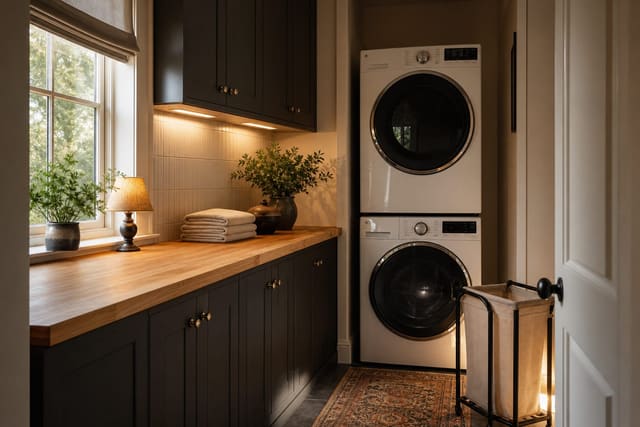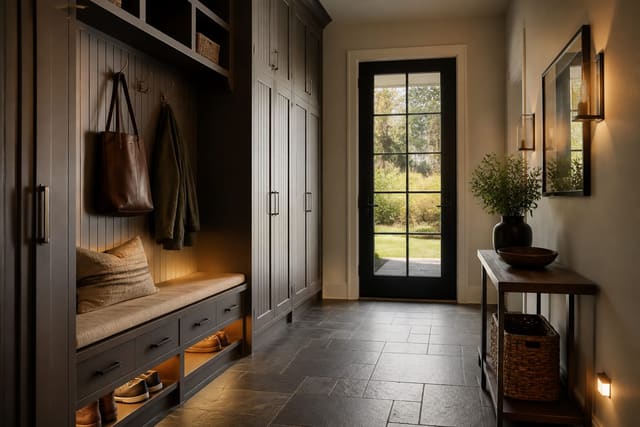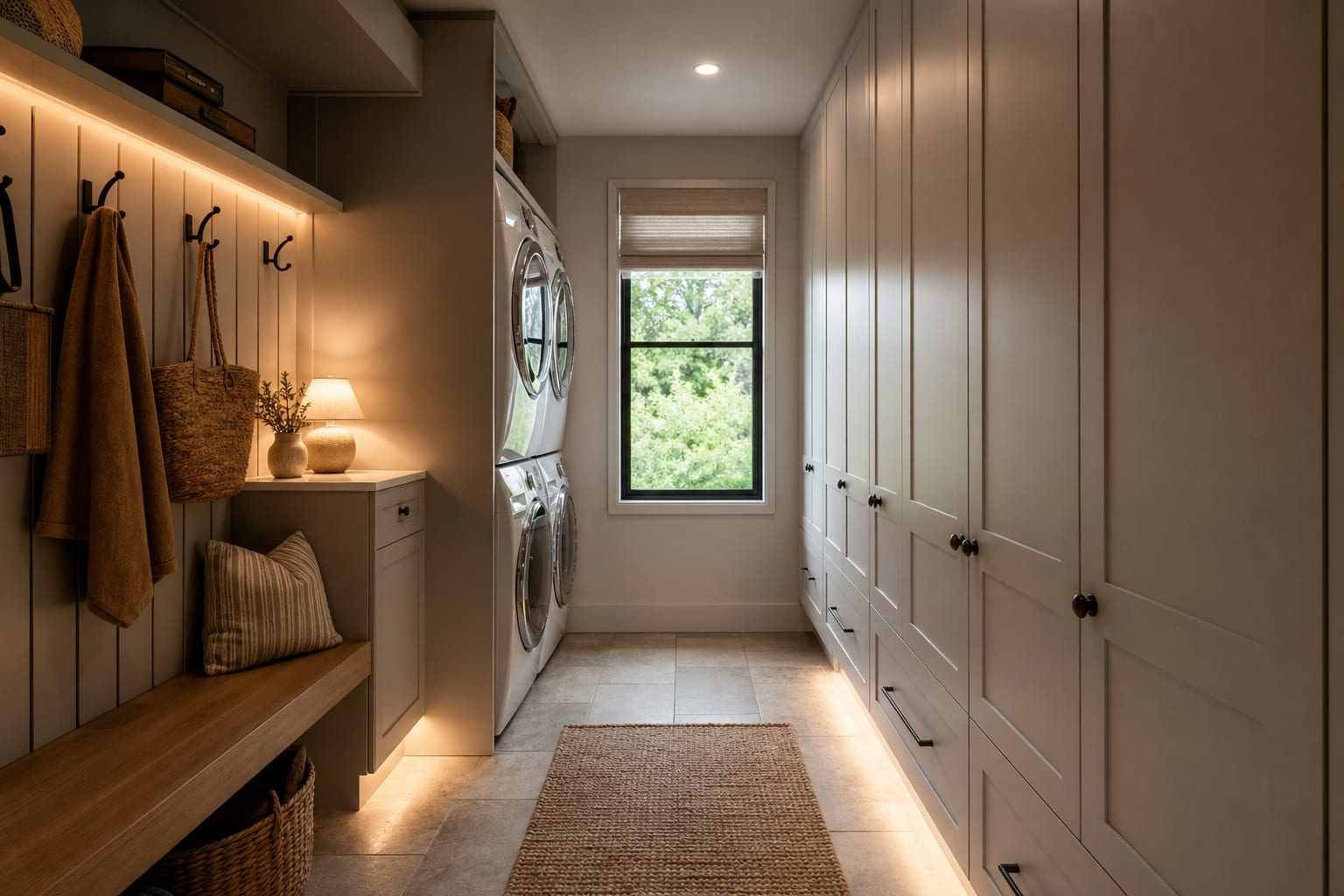
A mudroom laundry room combo works when the entry side (bench, hooks, shoe storage) sits within the first 36 inches of the door, the laundry side (washer, dryer, folding counter) sits against the plumbing wall, and a 36-inch walking path keeps the two from colliding. Skip that split and wet coats end up on clean laundry every weekend.
What makes a mudroom-laundry combo actually work?
Separate the dirtiest entry functions from the clean laundry functions, then connect both with one short, durable path. Shoes, hooks, and a landing bench go closest to the exterior door; the washer, dryer, folding surface, and hampers sit farther in so clean laundry isn't staged under wet outerwear.
Design the path before the appliances. Keep the main walkway at least 36 inches wide with washer and dryer doors closed, and never let it shrink below 30 inches where someone carries a basket. If the room is a pass-through to a garage or yard, lock in that straight route before adding a bench or sink.
Think in three zones:
- Drop zone: shoes, bags, umbrellas, leashes, outerwear near the door.
- Wash zone: sorting, detergent, drying, and folding near the plumbing wall.
- Buffer zone: a washable rug, floor drain, or hamper pullout between the two.
Use height, not just floor space. A 12- to 15-inch-deep wall cabinet above the washer holds detergent without stealing elbow room. Mount kid hooks around 48 inches and adult hooks around 66 inches. A bench needs only 15 to 18 inches of depth for shoes — deeper starts eating the walkway.
If the laundry side is the harder puzzle, start with appliance clearances using the small laundry room layout guide before placing mudroom pieces; plumbing and vent locations are far less flexible than hooks and baskets.
Which layout fits your room: one-wall, L-shape, or galley?
Choose by door swings, appliance doors, and where wet feet enter — not by style.
| Layout | Best for | Key rule |
|---|---|---|
| One-wall | Narrow pass-through, under 6 ft wide | Stack machines to free 24-30 in. for folding/landing tray |
| L-shape | Door on a short wall, appliances on the long wall | Bench near the entry corner; sink near laundry, not in the path |
| Galley | Wider rooms with room for two runs | Leave 42 in. between opposing fronts if both sides have doors/drawers |
A one-wall combo puts the washer and dryer on one side and a shallow bench or 10- to 12-inch shoe cabinet opposite. An L-shape keeps the bench at the entry corner and turns the laundry counter around the bend so no one stands in front of the washer to remove muddy shoes; an 18- to 24-inch utility sink works here if it stays out of the main path. A galley needs discipline — one side stays laundry, the other stays entry storage, or open doors and a loaded basket will collide.
Renters can zone with a freestanding bench with closed drawers, removable wall hooks where allowed, a rolling hamper that fits under a counter, and a washable runner. Owners should plan blocking for hooks, moisture-resistant cabinetry, a vented dryer route, and an outlet near the counter.
Test this on your own room photo with ReDesign before finalizing — keep the room structure, daylight, and main path visible so the preview solves the space you actually have.
How should storage, surfaces, and finishes handle real mess?
Start with what arrives dirty: shoes need air, coats need drip space, bags need sturdy hooks, and laundry needs a clean surface that isn't the mail pile.
Use closed storage low, open storage high. Shoes and gear look chaotic in the open, so use drawers, tilt-outs, or lidded bins near the floor. Coats and bags stay on hooks for speed. Size cubbies at 10-12 inches wide per person — wider becomes a junk shelf.
Give laundry one clean horizontal surface: at least 24 inches deep over front-load machines, and 48 inches wide minimum to actually fold on. If stacked machines remove that option, add a wall-mounted drop-leaf counter or a pullout shelf above the washer.
Choose finishes that expect water to win occasionally — porcelain tile, sealed concrete, or wet-rated luxury vinyl, not wood. Match grout color to the tile body so mud doesn't outline every joint. Satin or semi-gloss cabinet finishes wipe clean more easily than flat paint, and simple shaker or slab fronts catch less lint than ornate profiles.
Light for function first: even overhead light around 3000K for sorting and spotting stains, plus under-cabinet lighting over the folding surface if wall cabinets cast shadows.
If the "mudroom" is really an entry closet, apply the same order at a smaller scale using turning a small closet into a mudroom: hooks first, bench second, closed shoe storage third, decorative baskets last.
What mistakes wreck a mudroom-laundry combo?
- Folding counter next to the exterior door. It looks efficient on paper but becomes a landing zone for wet gloves and packages. Push folding space deeper into the room or block it with a tall cabinet end panel.
- Open cubbies for everything. They photograph well empty and collect mismatched boots and damp towels in real life. Keep hooks open for wet items, hide the rest behind doors.
- Ignoring appliance door swings. Tape every swing on the floor before ordering machines — many dryer doors reverse, many washer doors do not.
- Underestimating wet gear. Add a boot tray at least 24 inches wide, hooks over washable paneling, and a dedicated hamper for dirty entry textiles so it doesn't all land on the washer.
- Choosing pretty over durable. Pale rugs and delicate hooks fail fast under a wet winter coat. Use hooks rated for real weight and washable low-pile runners.
How can AI help preview the layout before you commit?
Upload a clear photo from the doorway, and a second from the opposite corner if possible, so the washer, dryer, both doors, and window are all visible. Leave real objects in frame — hampers, shoes, detergent, coats — since a staged, empty room produces a staged, unhelpful answer.
Test three controlled versions with the same flooring and wall color: stacked machines with a side bench, side-by-side machines with a counter over them, and a galley with storage opposite the laundry wall. Ask for specifics in the prompt: 36-inch traffic path, 15-inch-deep bench, hooks at kid and adult heights, closed shoe storage, washable flooring, and a door swing that clears the appliances.
Compare results against AI mudroom design ideas and pick the version that makes the daily motions easier, not just the prettiest render. For the broader workflow, the AI design complete guide is the parent checklist for uploads, then return here for room-specific scale and layout calls.
The right plan feels calm, not clever: enter with wet shoes, drop a bag, start a load, fold towels, and leave without moving three unrelated objects first.
Frequently Asked Questions
How much square footage do I need for a mudroom-laundry combo?
Plan for 50 to 80 square feet: a 36-inch entry-bench zone, a 30-inch laundry run, and a 36-inch path. Below 50 square feet, the room tends to function as either-or rather than both at once.
Should the laundry be stacked or side-by-side in a combo?
Stacking saves about 30 inches of wall run for hooks and bench but loses a folding surface on top of the dryer. Choose side-by-side only when at least 60 inches of run is free and a separate folding counter fits.
Where do wet boots and clean laundry stay separated?
Put the boot tray within 18 inches of the door with hooks and bench above it, then keep the folding counter and clean baskets on the far side of the walking path. That gap is what keeps dripping outerwear away from folded clothes.
Do I need a sink in a mudroom-laundry combo?
A 24-inch utility sink handles muddy boots, hand-washing, and washer overflow, and is worth the plumbing if space allows. Skip it only when the room is under 50 square feet or the kitchen sink is within about 12 feet.
What about ventilation in a combined mudroom-laundry?
Add a 50 cfm exhaust fan or an operable window to manage humidity from drying loads. A closed combo room without ventilation can grow mildew on hooks and baseboards within a year.
> Try this: Ready to see this on your own room? Open ReDesign and run the preview before you buy, paint, drill, or move furniture.
Three transformations to try
1. Stacked laundry against plumbing wall with 48-inch bench and hooks 2. Side-by-side laundry with folding counter and tucked utility sink 3. Closet-style stacked laundry behind a barn door with full mudroom front