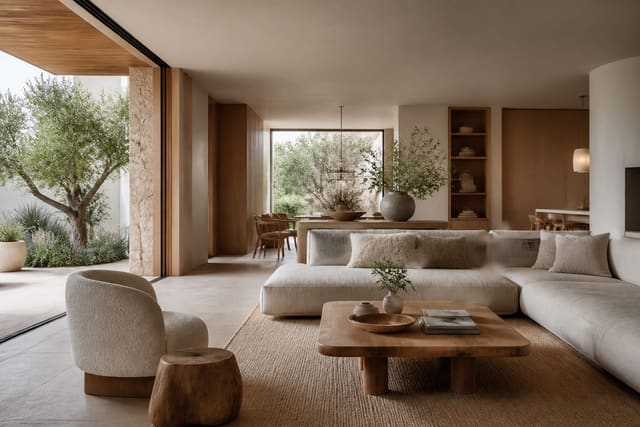
Limewash walls use a mineral coating of aged slaked lime, water, and pigment to create a soft, mottled, light-catching finish that standard paint can't match. This limewash walls guide covers how it differs from Roman clay, where it works best, the surface prep it demands, and how to style it in an organic modern room.
What Are Limewash Walls?
Limewash walls are finished with a mineral coating made from aged slaked lime, water, and pigment. The result is cloudy, layered, matte, and softly irregular, closer in feel to stone or plaster than paint.
The difference from conventional paint is how it bonds. Latex forms a film on top of the wall; limewash penetrates mineral surfaces like plaster, brick, stucco, and masonry. Instead of a flat sheet of colour, it catches light in subtle tonal shifts, producing low-contrast mottling, mineral softness, and a sense of age without distressing.
That quality makes limewash a defining finish for organic modern design, which depends on natural texture: pale woods, stone, linen, wool, clay, travertine, boucle, and quiet colour. A flat painted wall can make those materials look pasted in; a limewashed wall gives them a natural backdrop. Pair this guide with our Organic Modern Style Guide and Bouclé Fabric Guide.
Limewash vs Roman Clay: What's the Difference?
Traditional limewash is brush-applied and works on exterior masonry, interior plaster, brick, stone, and other prepared mineral surfaces. It's built in thin coats, with visible brush movement part of the character. A typical mix dilutes the first coat at 3-4 parts water to 1 part lime putty, then a richer second coat at 2 parts water to 1 part lime putty for depth.
Roman clay is different: water-based, thicker, and applied with a 4-inch stainless steel joint knife rather than a brush. Portola Paints Roman Clay goes on in 2 coats, dries in 1-2 hours between coats, and fully cures in 30 days. From a distance it looks similarly soft and tonal; up close it shows more trowel movement and a denser surface.
| Finish | Application | Best surfaces | Cure time |
|---|---|---|---|
| Traditional limewash | Brush | Plaster, brick, stone, masonry (interior/exterior) | Varies by coat |
| Roman clay | 4-inch joint knife | Smooth interior drywall (Level 4-5) | ~30 days |
The practical split: limewash is brush-applied and works indoors or out on masonry; Roman clay is trowel-applied, interior only, and needs smooth Level 4-5 drywall. For a living room accent wall, Roman clay is usually easier. For exterior brick or masonry, traditional limewash is the right category.
Where Does Limewash Work Best?
Limewash wants a room where the wall itself is part of the design, not a background for heavy pattern or gloss. Good candidates:
- Living rooms with natural wood, linen upholstery, and stone or travertine accents.
- Bedrooms, where a soft mineral wall can replace a heavy upholstered headboard.
- Dining rooms needing atmosphere without wallpaper or dark paint.
- Entryways where changing daylight shows off the movement.
- Powder rooms, with a moisture-appropriate product and sealer.
- Exterior masonry, brick, or stucco, using traditional limewash rather than Roman clay.
On exteriors, lime-based washes on masonry can last roughly 7 to 15 years before reapplication, depending on climate, exposure, and substrate. Unlike film-forming paint, it weathers and develops patina rather than failing outright, which is part of the appeal. Indoors, the finish is strongest used with restraint: a full room can work, but a dramatic charcoal or terracotta feature wall still needs a quiet surrounding palette, since the finish already carries its own movement.
Surface Prep: The Part People Underestimate
Neither finish hides bad drywall; both reveal the surface underneath. Textured drywall, especially orange peel or knockdown, competes with brush or trowel marks and reads as bumpy first, limewashed second.
For Roman clay, a Level 5 drywall finish (skim-coated and fully sanded) is ideal, though a very smooth Level 4 is a minimum. Traditional limewash performs best on porous mineral surfaces like plaster, brick, stone, and lime render; on drywall or painted walls, it needs a compatible mineral primer or manufacturer-approved base coat, or absorption will be uneven and blotchy.
Prep checklist:
- Repair cracks, dents, and uneven seams before priming.
- Remove glossy sheen or use the recommended bonding primer.
- Skim-coat textured drywall for a refined finish.
- Sand thoroughly and vacuum dust.
- Test a sample board or hidden area first.
- Keep the surrounding palette simple so the finish can breathe.
Limewash Wall Ideas for an Organic Modern Home
Start with room mood rather than product. Limewash can be pale and quiet, earthy and architectural, or dark and enveloping:
- Warm white limewash with oak flooring, a low linen sofa, and a travertine coffee table.
- Soft greige Roman clay behind a bed with off-white bedding and walnut nightstands.
- Clay-beige limewash in a dining room with blackened metal chairs and a sculptural pendant.
- Mushroom-toned walls paired with boucle seating.
- Pale taupe limewash in an entry with a stone console and oversized mirror.
- Olive-grey limewash in a study with leather and warm wood.
- White limewash on exterior brick for a softer look than painted brick.
- Charcoal Roman clay on a fireplace wall, used sparingly.
The most expensive-looking rooms keep contrast low: cream with sand, beige with oak, taupe with travertine, grey-green with walnut. For more palette pairings, see Organic Modern Living Room Ideas.
Bring the Look Home with Re-Design
Before skim-coating walls or ordering gallons of mineral finish, test the look visually. Upload a room photo to Re-Design and preview a limewash-inspired wall alongside organic modern furniture, lighting, and colour palettes in seconds, to see whether warm white, stone beige, taupe, clay, or something moodier fits before spending on prep and product.
Colour, Health, and Maintenance Notes
Limewash is at its best in mineral colours: warm whites, chalk, bone, oatmeal, sand, putty, clay, greige, mushroom, olive-grey, and charcoal. Bright colours tend to fight the material, while even a simple beige looks layered when applied well.
Traditional limewash is virtually zero-VOC; Roman clay products are water-based and generally low-VOC, both healthier than many standard latex paints. Maintenance depends on product and sealer choice: unsealed matte finishes can be more delicate than wipeable paint in high-traffic spots. Some Roman clay installs can be sealed for protection, though sealing may shift the sheen slightly, so test first.
Frequently Asked Questions
What are limewash walls and where do they work?
Limewash walls are coated with a mineral wash of aged slaked lime, water, and natural pigments. They work best on porous mineral surfaces like plaster, brick, stone, stucco, and masonry, and can be used indoors with the right primer. Roman clay is a popular interior-only alternative for smooth drywall.
Is Roman clay the same as limewash?
No. Traditional limewash is thinner and brush-applied, suited to exterior masonry and interior plaster. Roman clay is thicker, water-based, and trowel-applied. Portola Paints Roman Clay uses a 4-inch stainless steel joint knife, goes on in 2 coats with 1-2 hours drying between coats, and cures fully in about 30 days.
Can you apply limewash or Roman clay over textured walls?
You can, but it usually isn't advisable for a refined result. Orange peel and knockdown texture compete with the brush or trowel marks, making the finish look busy. Roman clay especially wants a smooth Level 5 drywall finish so tool drag doesn't disrupt the plaster-like movement.
How long does exterior limewash last?
Exterior lime-based washes on masonry typically last about 7 to 15 years before reapplication. The finish naturally weathers and develops patina over time, which is part of its character rather than a flaw. Climate, exposure, substrate, and application quality all affect longevity.
Are limewash walls good for organic modern interiors?
Yes. Limewash adds texture without pattern and warmth without clutter, making it one of the most natural fits for organic modern design. It pairs especially well with oak, walnut, linen, wool, boucle, stone, plaster lighting, and quiet earth-toned palettes.