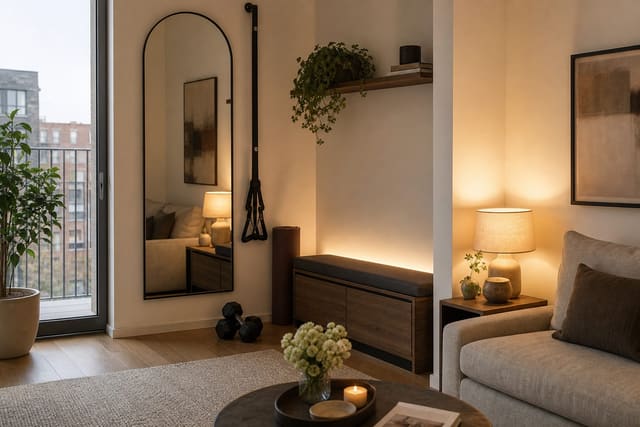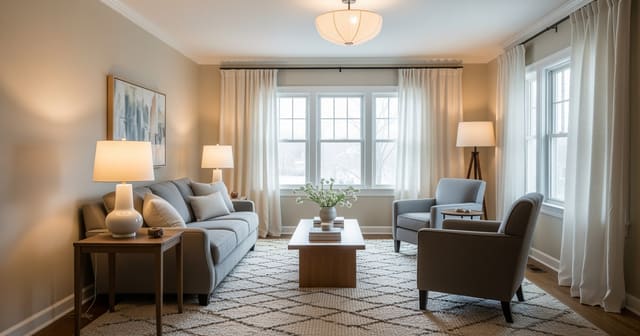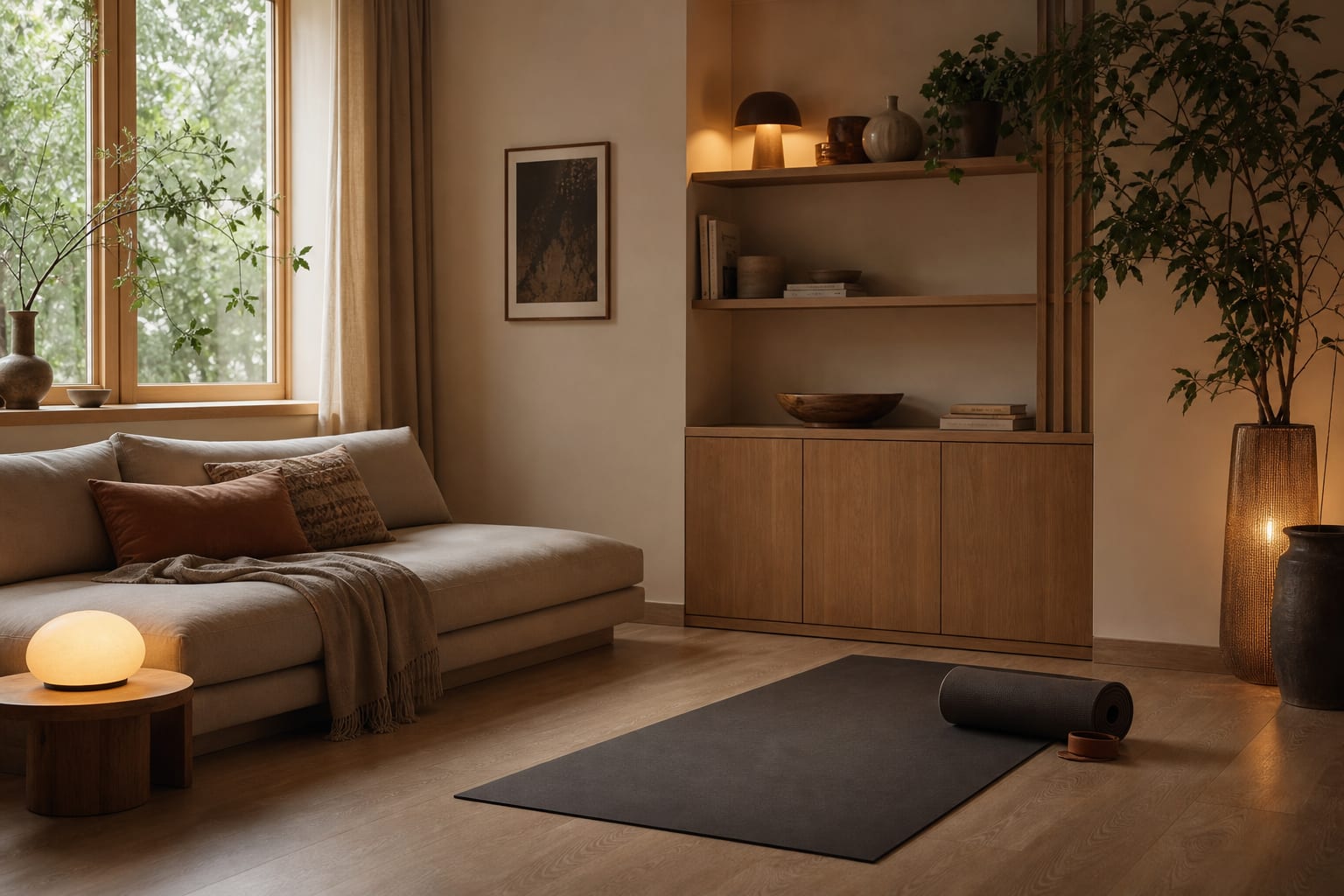
Living room yoga space ideas work best when you protect one repeatable patch of floor rather than improvising each time. Claim a 6x4 mat zone with real clearance, a movable coffee table, warm dimmable light, and one closed storage spot for blocks and a strap. Without those four pieces, the mat quietly moves to the closet.
What Makes a Living Room Yoga Zone Work?
A standard mat measures about 24 by 68 inches, but the usable zone needs to be closer to 6 by 8 feet so lunges, side planks, and arms overhead feel safe. Choose the edge of the room, not the center, unless the space is unusually large — beside a sofa, in front of a low media unit, or near a window all work.
Leave at least 24 inches of clearance on the long side of the mat, 30 inches if your practice includes wide stances or a strap. Keep 18 inches clear at the top of the mat so your head and hands aren't pressed against a console table. If this room doubles as a workout space, the same clearance logic applies as in a small apartment workout zone.
Angle the mat toward the quietest wall rather than the television, especially in an open-plan room. That small rotation turns leftover floor into an intentional corner instead of a performance space for the whole household.
Which Furniture Choices Let the Mat Come Out Fast?
The coffee table is usually the obstacle. A heavy trunk or oversized rectangle turns a 10-minute stretch into a furniture-moving project, so pick a table light enough to slide with one hand or swap it for two side tables. A round table 30 to 36 inches wide leaves softer circulation than a large rectangle in most apartments.
If the table stays put daily, add felt glides and leave a clear parking spot 16 to 18 inches from the sofa. Sofas with exposed legs and 6 to 8 inches of underneath clearance let you tuck blocks or a folded blanket nearby without cluttering the floor. Sectionals work only if the open side forms a natural rectangle for the mat.
The goal is removing one daily friction: the mat should come out in under 30 seconds and disappear just as fast.
Test layouts on your own room photo before committing — keep the room structure, daylight, and main walkway visible so the preview solves the space you actually have.
How Should Light, Storage, and Texture Support Practice?
Yoga needs gentler light than TV watching. Use a shaded lamp, sconce, or dimmable floor lamp around 2700K to 3000K, and avoid a harsh ceiling fixture directly over the mat since downlight turns savasana into a spotlight moment. If the room already reads gray, check your wall color and bulb warmth against north-facing living room lighting choices.
A layered plan works best: one warm lamp near the mat, low ambient light elsewhere, no bulb in your direct sightline. The same principles behind layered living room lighting apply here, with the yoga corner getting the softest layer.
Keep storage close, closed, and narrow:
- An 8 to 10 inch deep basket holds a strap, blocks, and towel without swallowing the corner.
- Wall hooks work for straps, but skip a full equipment display.
- A lidded bench 14 to 16 inches deep stores props without blocking circulation.
On texture: use a grippy mat over hardwood or laminate, and if the mat sits over a rug, choose low pile so corners don't bunch.
What Mistakes Ruin a Living Room Yoga Corner?
- No movement clearance. A plant stand or pouf may photograph well, but it fails the moment your elbow hits it in a twist — keep decor outside the 6 by 8 foot working rectangle.
- Defaulting the mat toward the TV. Fine for video classes, but it makes every practice feel like screen time; face a quieter wall for non-video sessions.
- Open equipment racks. They only look tidy when every prop is perfectly aligned — closed baskets or a slim cabinet look calmer day to day.
- Ignoring doors, pets, and kids. A mat in a door's swing path or beside the toy shelf invites constant interruption; leave a 30-inch walkway clear.
- Making the corner too precious. If it needs a perfectly rolled blanket and glass vessel to look complete, it won't survive a real Tuesday — use washable textiles and one plant instead.
How Can You Preview the Layout Before You Commit?
Floor clearance is hard to judge from memory, so use AI to test the zone before moving furniture. Upload a photo from a corner that shows the sofa, coffee table, window, rug, and main walkway — leave real clutter like the pet bed or blanket basket in frame, since that's what decides whether the zone survives daily life.
Ask for versions testing the mat beside the sofa, near the window, and in front of the media wall, while keeping the same rug and wall color. Add practical prompts: 24 inches of side clearance, a movable coffee table, a warm 2700K lamp, closed prop storage, and a clear walking path.
The best preview isn't the prettiest one — it's the one where the sofa still works, the table has somewhere to go, and the mat stays welcome even rolled away. For the broader workflow, see the AI design complete guide as your parent checklist.
Frequently Asked Questions
How much floor space do I need for living-room yoga?
A 6 by 4 foot clear mat zone covers most flows and vinyasa sequences. You can borrow temporarily from the coffee-table footprint if the table is light enough to slide 18 inches onto a rug.
What flooring works under a yoga mat in a living room?
A standard yoga mat performs well over hardwood, LVP, or a low-pile rug. High-pile rugs tilt under the mat and make balance poses unstable, so move the mat off the rug for tree pose and warrior series.
Where do I store yoga props in a living room?
Use one closed, lidded basket or a low side-table drawer for two blocks, one strap, and one bolster. Visible props read as clutter and can make the practice feel associated with mess instead of calm.
Can I share the yoga zone with the dog?
Yes. Keep a separate small dog bed within view of the mat so the dog has its own spot during practice, since rotating the mat onto a dog-hair-magnet rug makes both the practice and the rug miserable.
What lighting works for evening yoga?
Use one dimmable 2700K floor or table lamp at around 30 percent brightness for evening flows. Overhead cans wash everything flat and push the space toward "gym" instead of "living room."
> Try this: Ready to see this on your own room? Open ReDesign and run the preview before you buy, paint, drill, or move furniture.
Three transformations to try
1. 6x4 mat between sofa and coffee table with closed prop basket 2. Mat in front of window with floor lamp at 30% and bolster 3. Slide-out yoga zone where sofa shifts 24 inches for the mat