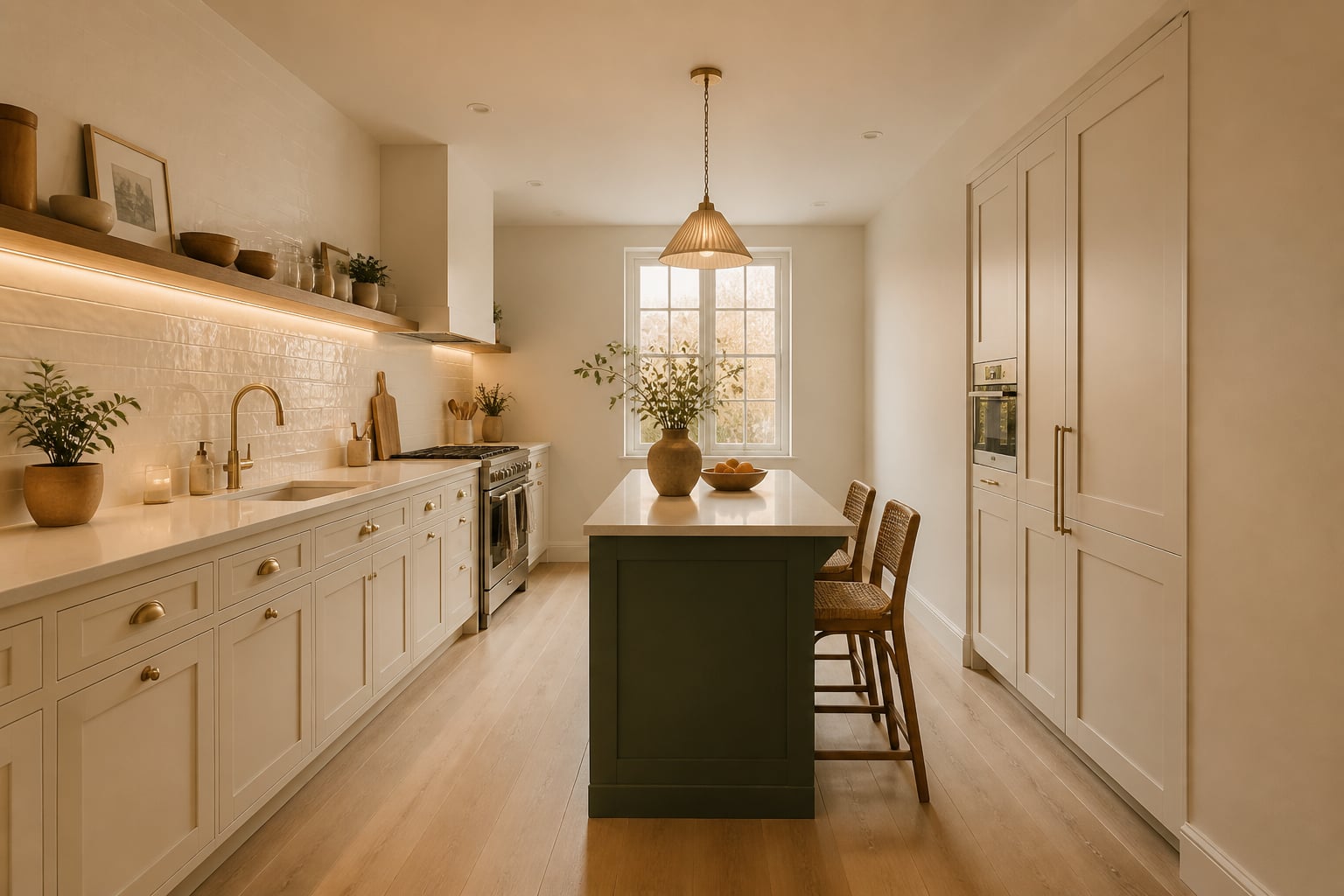
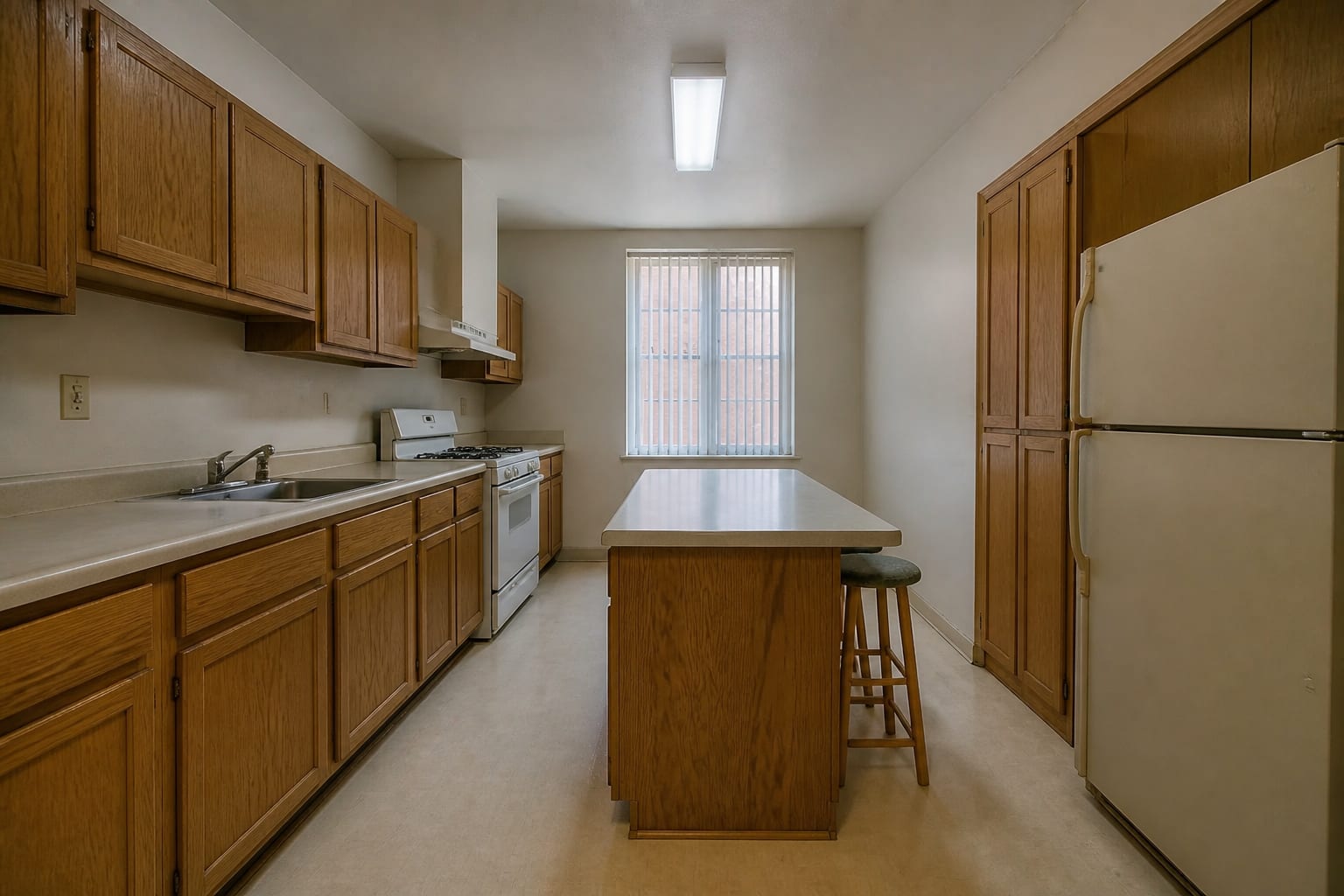
A long narrow kitchen reads as a room instead of a hallway when work zones stack end-to-end (cook, prep, clean), the run breaks visually at the middle with a hood or window, and cabinet color shifts every 8 to 10 feet so the long view doesn't blur. The aisle is the design; everything else has to respect it.
"A long narrow kitchen needs one calmer side before it needs another cabinet."
What makes a long narrow kitchen feel wider than a corridor?
Protect one clean aisle, concentrate the hardest-working storage on one or two walls, keep sightlines open at the far end, and light the counters instead of the floor. A single-cook kitchen can work with roughly 36 inches between opposing runs, but 42 inches feels better once drawers, dishwasher doors, or a second person enter the zone regularly.
A long wall of identical cabinets reads like a train car. Break it with a window, hood, open shelf, rail, or a change in cabinet height. A 30 inch range with a hood, a 24 inch sink base under a window, or a 36 inch prep stretch can become the rhythm that stops the eye from sprinting down the room.
If the kitchen is extremely tight, study a one wall kitchen layout before assuming two parallel runs are mandatory. One strong work wall plus a shallow storage wall can feel wider than a squeezed galley with doors colliding in the middle.
The layout decision that beats a default galley
The core decision: does both long walls deserve full-depth cabinetry? Often one 24 inch working wall and one slimmer wall beat two heavy runs fighting across the aisle.
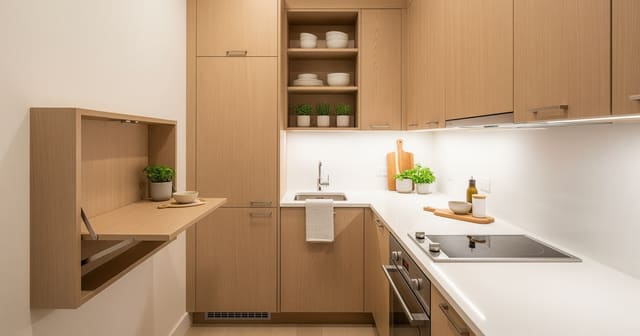
Use the 24 inch side for sink, dishwasher, range, and main prep counter. Let the opposite side do lighter work: 12 inch pantry cabinets, 10 inch open shelves, a peg rail, or a coffee ledge. That asymmetry reads as designed rather than merely squeezed.
Appliance doors are the hidden hazard. A dishwasher door can span most of the aisle; an oven door can stop traffic; a French-door refrigerator needs elbow room on both sides. Place the dishwasher beside the sink so its open door doesn't trap the cook between two cabinets, and give the refrigerator's handle side 12 to 15 inches of nearby landing space.
Don't let the far end become a storage graveyard. Give it a window with a shade, a tall pantry wall, a small banquette, or art above a narrow console. A blank or cluttered end wall makes the whole room read unfinished.
Peninsulas are risky here. One can work near an open dining area if it leaves at least 36 inches at the entry and keeps stools outside the cooking lane; otherwise it's a traffic jam with a countertop.
Test this on your own room photo with ReDesign before choosing a direction, keeping the doorway, windows, and fixed features visible so the preview solves the room you actually have.
Which narrow kitchen design moves earn their inches?
The best moves make the room easier to cook in while visually widening the aisle. Skip anything that adds thickness without adding function.
- Light the work wall continuously. Warm, clean light around 3000K placed toward the front of the cabinet lights the chopping zone instead of just washing the backsplash.
- Limit full-height blocks. Keep pantry towers in one zone and leave 30 to 36 inches of open counter for real prep space.
- Go shallow where the aisle is tight. A 10 to 12 inch cabinet holds glasses, spices, or cereal without squeezing the walkway.
- Run flooring lengthwise, quietly. Long planks or 12 by 24 inch tile with calm grout stretch the room better than a busy, high-contrast pattern.
- Keep hardware slim. Bar pulls of 4 to 6 inches avoid snagging hips and towels in a tight aisle.
Lighting deserves its own discipline: a single center ceiling fixture lights the aisle, exactly where no one preps food. Layer recessed or track lighting along the counters using the planning in kitchen task lighting placement to keep shadows off the sink, range, and prep surface.
Color helps but can't fix bad clearances. Pale walls, satin cabinet finishes, and lighter counters bounce more light around a skinny room. For a kitchen with little natural light, borrow the approach in make a dark kitchen feel bright: fewer heavy uppers, layered warm light, dark finishes kept below eye level.
Common long narrow kitchen mistakes to avoid
- Treating it as a decorating problem first. Pretty pendants won't matter if an oven door blocks the only standing space. Tape the aisle and appliance swings before choosing finishes.
- Cabineting both walls just because the wall is there. If two 24 inch runs leave a tight aisle, downgrade one side to shallow storage or open shelving.
- Using a runner that's too thick or busy. It should sit flat with a few inches of visible floor at the cabinet base, not curl into a tripping hazard.
- Making every finish horizontal. Long rails, tile bands, and flooring seams overstate the corridor. Add vertical pauses: a hood stack, tall art, or a full-height pantry at one end.
- Ignoring the entry view. The first sightline shouldn't be a refrigerator side, trash bin, or cluttered cart, since a narrow kitchen reads its full length immediately.
Use AI to preview your narrow kitchen before you commit
Upload one photo from the entrance, one from the far end looking back, and one straight shot of the main work wall. Keep cabinet doors closed and counters clear enough to show the layout.
Ask for specific layout tests rather than a vague "beautiful kitchen." Try one preview with a single full-depth cabinet wall, shallow pantry opposite, 3000K under-cabinet lighting, and a clear 42 inch aisle. Run another with darker lowers, open shelves on one side, and a framed end wall, no peninsula.
Check whether the refrigerator blocks the entrance, whether the end wall pulls the eye forward well, and whether the lighting hits the counters instead of glowing down an empty aisle. AI can't confirm plumbing, venting, or cabinet ordering dimensions, but it can show whether the space wants a true galley, a one-wall plan, or a cleaner end-wall focal point before you spend on cabinets.
After the preview, tape a 24 inch depth on the working side and 12 inch on the shallow side, then walk the route with a grocery bag and open every appliance door to confirm the clearance holds.
Frequently Asked Questions
How wide does a long narrow kitchen need to be?
Galley runs need 42 to 48 inches of clear floor between cabinet faces, with 60 inches if two cooks work at once. Single-wall runs need 36 to 42 inches of clearance to dining or living space beyond.
Should a long narrow kitchen have one wall of cabinets or two?
Use two walls when the floor is 9 feet wide or more for a true galley. Use one wall plus an island at 11 feet or more, and one wall only when the room is 7 to 8 feet wide with dining in the other half.
How do I break up the visual length of a long kitchen?
Add a hood centered halfway down the run, a window above the sink, or a 24-inch cabinet color shift at the midpoint. The eye needs one visual stop before it reaches the end wall.
Where do appliances go in a long narrow kitchen?
Sequence cook (range, hood), prep (counter, sink), and clean (dishwasher, trash) along the run so the cook never crosses the dishwasher's door arc. Put the refrigerator at one end to keep it clear of the work zone.
Can a long narrow kitchen have a dining table?
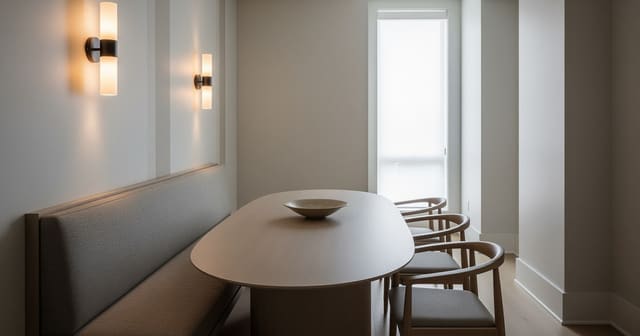
Yes, if the run is 10 feet or more wide. Place a 30-inch round or 36 by 60-inch rectangle table at one end with bench seating against the wall; otherwise dining belongs in the adjacent room.
> Try this: Ready to see this on your own room? Open ReDesign and run the preview.
Three transformations to try
1. Galley run with hood centerline break 2. Single-wall long kitchen with island opposite 3. End-of-run breakfast nook with bench