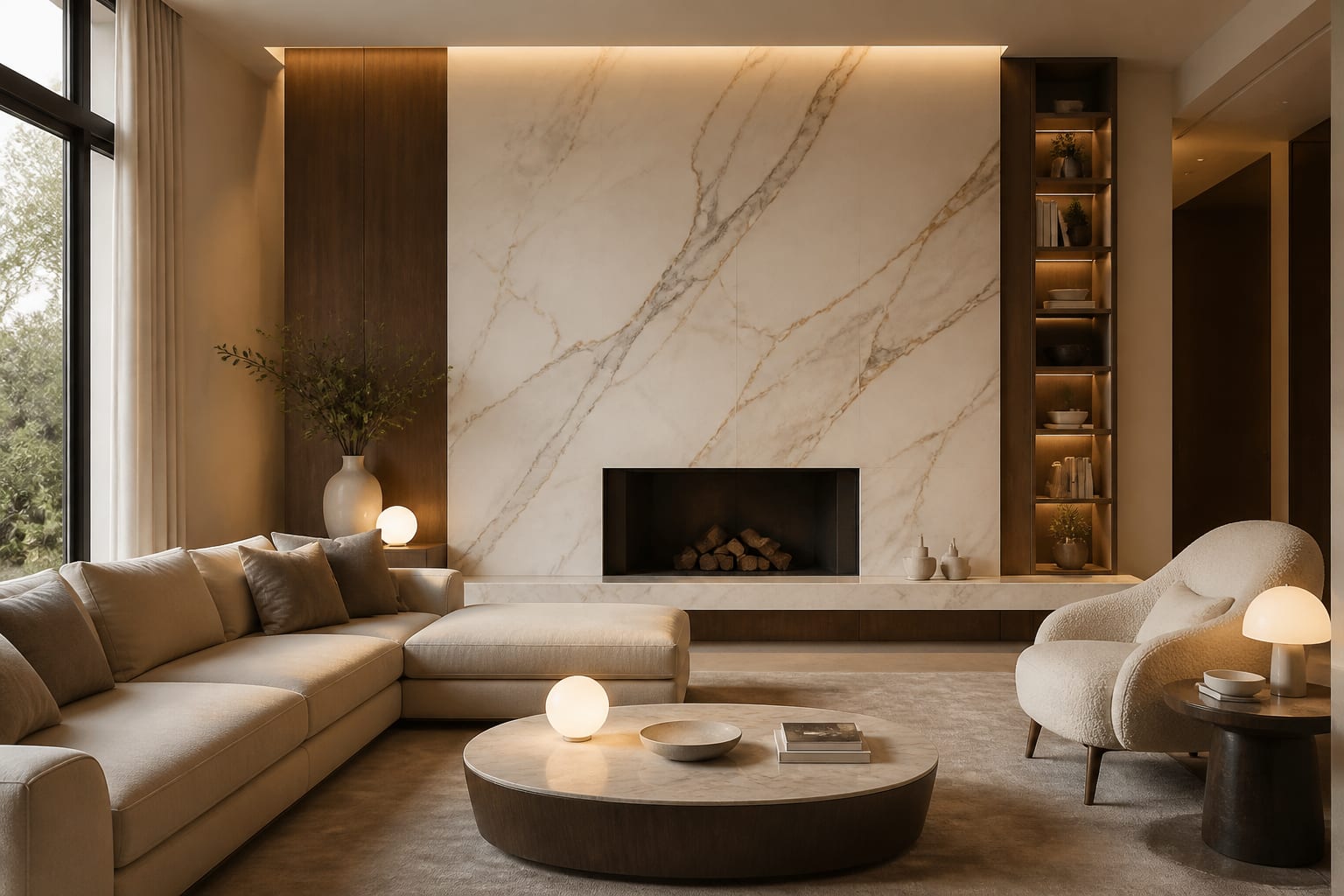
Marble works best as a punctuation mark, not a paragraph. One well-placed slab — a fireplace, a single backsplash, a bar top — reads as quiet luxury, while marble on every surface in a room starts to feel like a hotel lobby that is trying too hard. Restraint is the whole game with this stone.
Where you put marble matters far more than how much you buy, so spend the budget on one hero moment people actually touch and see up close rather than spreading it thin.
Five ways to use marble at home
These are the placements that deliver the most impact for the budget. Start with exactly one and let it carry the whole room.
- Waterfall island: run a Carrara or Calacatta slab over the top and down both ends; the continuous vein is the showstopper and needs no other ornament around it.
- Bookmatched feature wall: mirror two slabs floor-to-ceiling behind a bed or fireplace for a single, gallery-grade statement that doubles as art.
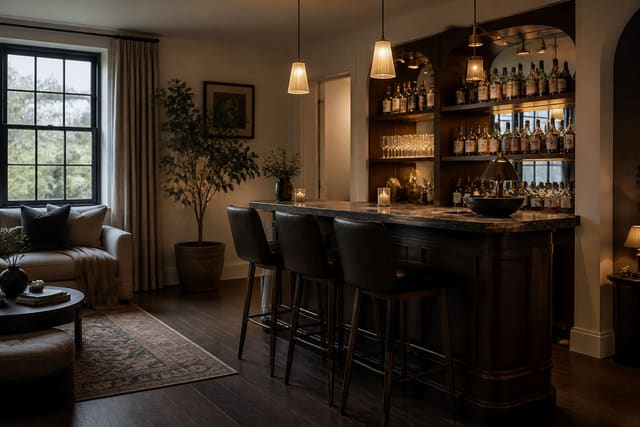
- Marble-topped bar or cart: a 24-inch round of leftover slab makes a low-cost, high-impact serving surface — a natural fit with the kinds of setups in these home bar ideas.
- Slab backsplash: carry the counter material up the wall in one piece to skip grout lines entirely behind the range.
- Floating shelves and ledges: thin marble shelves at 3/4 inch thick read as jewelry against a painted wall.
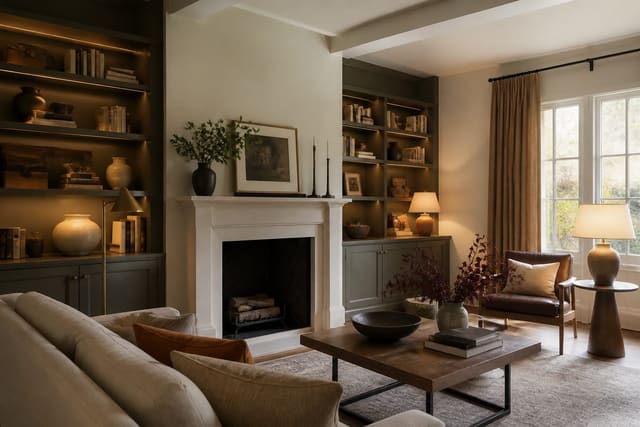
That bookmatched wall pairs especially well with flanking storage; integrating it with built-in shelving ideas frames the stone and keeps it from floating awkwardly on a bare expanse of drywall.
A few smaller moves stretch the look further if a slab feature is out of budget. A marble tabletop or coffee table reads as the same luxury at a fraction of the square footage. Marble accessories — a heavy mortar, a tray, a pair of bookends, a lamp base — scatter the material through a room without a single contractor invoice. Even a marble-tile niche in a shower or a fireplace hearth gives you the stone's coolness in a contained, affordable dose. The rule holds at every scale: one clear gesture beats marble smeared everywhere, and the smaller pieces let you test the look in a room before you commit to a permanent slab.
Pick the right marble for the look
Not all marble reads the same, and the variety you choose sets the entire tone. The decision is mostly about how loud you want the veining to be.
Carrara is the soft-spoken default — a cool gray-white background with fine, feathery gray veins, and it is the most affordable, often $40 to $75 per square foot for the slab. Calacatta is the showpiece, with a brighter white field and bold, dramatic veining in gray or gold; it commands $100 to $250 and up because it is rarer. Statuario splits the difference with a clean white base and crisp, more pronounced lines than Carrara.
For floors and high-traffic surfaces, lean toward smaller, denser veining and a honed finish so wear blends in. Save the big, theatrical Calacatta movement for vertical surfaces and low-contact tops where it gets seen and rarely touched.
Finish is its own lever. A polished surface reads glossy and formal, deepens the color, and reflects light, but it telegraphs every etch ring; a honed matte finish feels softer and more current, and forgives daily wear far better. For a kitchen counter that will see real use, honed is almost always the smarter call even if the showroom pushes the high-gloss slab.
Scale your slab choice to the room, too. A bold Calacatta vein that looks magnificent on a 10-foot island can feel chaotic squeezed onto a small 3-foot vanity. Match the boldness of the stone to the size of the surface, and a quiet Carrara often serves a compact powder room better than a dramatic stone fighting for room.
Real marble versus the smart fake
The honest truth is that most kitchens are better off with a marble-look engineered surface. A working island that takes lemon, wine, and coffee daily will etch real marble within weeks, and not everyone wants that lived-in patina that purists romanticize.
Quartz that mimics Calacatta now runs $50 to $100 per square foot installed and resists acid completely, while genuine marble runs $75 to $250 and demands resealing every 6 to 12 months. Porcelain slabs go even thinner at 6 mm and work beautifully on walls and floors where weight and budget matter. Save the real stone for low-contact drama — a vanity, a fireplace, a side table — and use the engineered version anywhere it gets worked hard day in and day out.
If you do commit to real marble on a counter, decide upfront whether you can live with patina. Sealed marble still etches from acid because etching is a chemical reaction with the surface, not a stain a sealer can block. Embrace the matte rings as character or pick the fake — there is no third option that stays pristine.
Pair marble so it feels warm
Marble alone can read cold and hard, so it needs warm company nearby. The classic counterpoints are unlacquered brass, walnut or white-oak wood, and matte black metal, each of which gives the eye something warm to land on.
- Brass fixtures against white Carrara is the timeless combination for a reason — the warm metal lifts the cool stone.
- Warm wood cabinetry under a marble counter keeps a kitchen from feeling like an operating room.
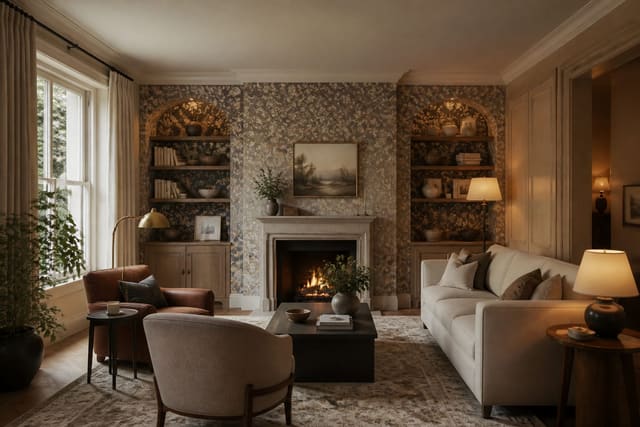
- A bold textile or pattern nearby balances the stone's coolness; a single papered wall from these wallpaper ideas adds warmth opposite a marble feature.
Keep grout and the surrounding tones soft and warm rather than stark white, and the marble will feel collected and intentional instead of clinical. Lighting helps too: a warm 2700K bulb flatters marble's gray and gold veins, while a cold 5000K light drains the stone and exaggerates its chilly side. The same slab can read inviting or sterile depending on nothing more than the bulb above it, so choose the temperature deliberately and let it do half the warming work for you.
Use AI design to preview marble before you commit
Marble is a major spend, and a sample chip never shows you how aggressive the veining looks stretched across a whole island or a full feature wall. Scale changes everything with this stone, and the wrong slab can dominate a room you meant to calm.
Upload a photo of your kitchen, bathroom, or living room to Re-Design and let the AI design tool render a Carrara, Calacatta, or marble-look finish directly in place. You can test a dramatic bookmatched wall against a subtle honed counter in your own lighting before you commit to a slab that might fight everything else in the room.