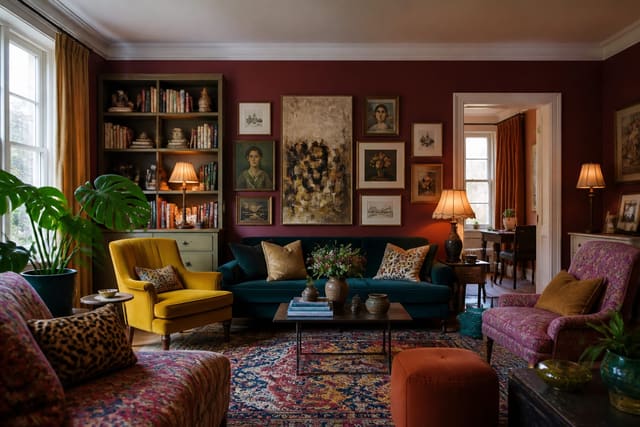
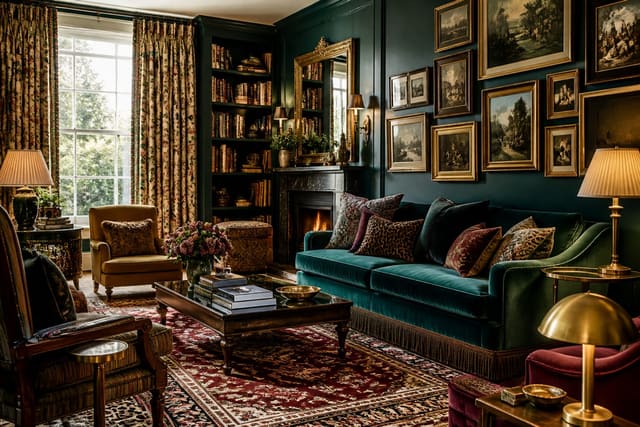
A maximalist bathroom trades white subway tile for saturated colour, patterned surfaces, a statement mirror, and textiles that feel gathered rather than matched. Done well, it stays practical: bathroom-safe materials, deliberate grout choices, and one or two visual anchors keep the room expressive instead of chaotic, even in a small footprint.
How do I choose bold tile, paint, and grout?
Treat tile as decoration, not background. Patterned encaustic-style tile, Moroccan zellige, hand-painted motifs, checkerboard layouts, and colourful mosaics all suit maximalist bathrooms.
Floor-to-ceiling tile is the boldest option. It wraps the room in pattern and makes even a compact bathroom feel deliberate rather than under-finished.
If full coverage feels like too much, pair tile with saturated paint on the remaining walls: deep green, oxblood, cobalt, aubergine, terracotta, or ink blue. This works like colour drenching, but ventilation and moisture-resistant finishes matter more in a bathroom.
Grout colour shifts the whole effect:
- Charcoal or black grout sharpens each tile and emphasises the pattern.
- White grout against dark tile creates crisp, graphic contrast.
- Colour-matched grout blurs the joints so busy patterns read as one continuous surface.
Don't scale down automatically for small rooms. A powder room or ensuite can handle a large repeat, strong colour, or dramatic floor, since the reduced square footage keeps material costs lower while the enclosed space amplifies the colour.
Should I tile the whole room or just a feature wall?
A feature wall delivers impact with more control. Cover one wall, typically behind the toilet, bath, or vanity, in patterned tile, and keep the other walls simpler so the feature stays the focal point.
- Patterned tile wall with plain painted side walls.
- Saturated painted walls with a graphic tiled floor.
- Dramatic wallpaper above tile or panelling.
- A colourful vanity against simpler wall tile.
Wallpaper needs the right specification for bathrooms: use vinyl-coated or non-woven washable wallpaper. Standard paper wallpaper is a genuine maintenance risk, it can bubble, lift at the seams, and peel with humidity, so avoid it in shower areas or anywhere hit by direct water unless the product is rated for that use.
For a calmer version, apply wallpaper or tile only on the upper half of the wall and keep the lower half plain. You get pattern at eye level, the room stays grounded, and future refreshes (paint, accessories) are easier since the main treatment stays put.
How do I use the vanity, mirror, and textiles to add drama?
A painted vanity can transform the room without any retiling. Jewel tones work best: emerald, navy, cobalt, teal, plum, or ruby turn a plain unit into the room's strongest statement.
Use paint made for kitchens and bathrooms, oil-based or a water-based equivalent. Standard wall emulsion isn't durable enough; humidity and repeated wiping cause peeling and patchy wear. Clean, sand, prime if needed, and let each coat cure before heavy use.
Hardware finishes the look: brushed gold or brass handles warm up jewel tones and make the vanity feel designed rather than just repainted. Chrome can work with cooler palettes, but brass tends to suit layered maximalism.
Give the mirror presence, a large ornate frame, vintage shape, scalloped edge, smoked glass, or gilding. In a small bathroom, a big mirror also bounces light, which keeps a saturated palette feeling rich instead of dark.
Textiles are the easiest colour move. Colour-block towels using three or more jewel tones, emerald, teal, cobalt, sapphire, amethyst, deep turquoise, stacked or folded on open shelving. A single matching set looks flat by comparison.
Round out the scheme with:
- A ceramic soap dish or tray in a contrasting colour.
- Potted plants that tolerate humidity.
- Patterned bath mats instead of plain white.
- Framed art or a bold print kept away from splashes.
- Brass hooks, towel bars, or cabinet pulls that repeat the metal finish.
For more layering ideas at whole-room scale, see Maximalist Living Room Ideas and scale the same principles down to your bathroom.
Bring the look home with Re-Design
Before buying tile, wallpaper, or paint, test the direction on a real photo of your bathroom. Upload your room to Re-Design and preview bolder tile, jewel-tone cabinetry, saturated walls, ornate mirrors, and colourful accessories, a fast way to compare a feature wall against a full-pattern scheme before committing to materials.
Frequently Asked Questions
What does a maximalist bathroom look like?
It combines bold patterned tile, saturated wall colour, a statement mirror, colourful textiles, and decorative accessories. The strongest rooms are layered but still built around a clear focal point, such as a feature wall or a jewel-tone vanity.
Are small bathrooms good for maximalist design?
Yes. Small bathrooms are ideal because less tile, wallpaper, or paint is needed to create a strong effect, and the enclosed space makes bold colour feel immersive rather than overwhelming.
Can I use wallpaper in a bathroom?
Yes, but choose vinyl-coated or non-woven washable wallpaper made for bathrooms. Standard paper wallpaper can bubble and peel in humid conditions, especially near baths, showers, and sinks.
What grout colour should I use with bold tile?
Use charcoal or black grout to define each tile and sharpen the pattern, white grout with dark tile for graphic contrast, or colour-matched grout when you want the surface to read as smoother and more continuous.
What is the easiest maximalist bathroom update?
Paint the vanity in a jewel tone and switch hardware to brass or brushed gold. Use kitchen-and-bathroom-specific paint rather than standard wall emulsion so the finish holds up to humidity and cleaning.
How do I keep a maximalist bathroom from feeling messy?
Repeat a few colours across tile, towels, paint, and accessories, and let one element, the floor, a feature wall, or the vanity, dominate. If you're new to the style, start with the fundamentals in What Is Maximalism?