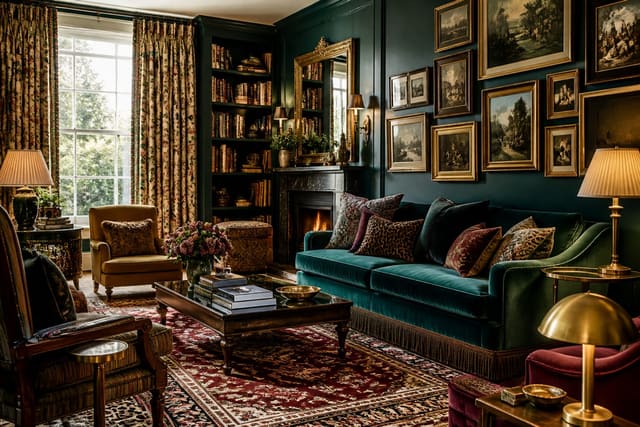
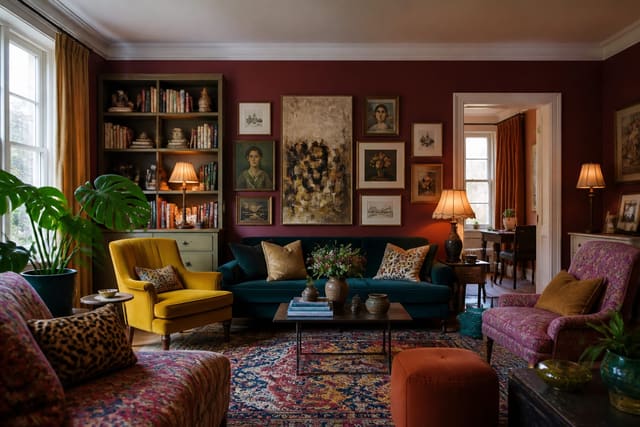
A maximalist dining room pairs saturated, colour-drenched walls with an oversized chandelier, mismatched chairs, and a richly styled table to turn ordinary meals into an occasion. The goal is theatrical, layered, and personal, not minimal, using dark colour, mixed textures, and dense styling to make the space feel dramatic yet still functional for gathering.
Why Does Colour-Drenching Work So Well in a Dining Room?
Dining rooms are used in shorter, more ceremonial bursts than living rooms or kitchens, which makes them the easiest place to try a strong palette. Wrapping the walls, trim, doors, and even ceiling in one saturated colour, like aubergine, oxblood, ink blue, forest green, or blackened teal, creates a cocoon effect that makes candlelight and glassware glow.
A 10–20 LRV range is a useful reference for dark dining room walls: dark enough to feel theatrical, but workable when paired with bright linen, reflective finishes, and warm light. In a small room, dark colour blurs the boundaries intentionally; in a larger one, it makes the space feel more intimate. This look has stayed a strong trend from 2022 through 2026, but it reads less trend-led when the colour ties to something personal, like art, china, or a rug.
Try this sequence:
- Choose one saturated wall colour first.
- Repeat it on trim for a colour-drenched finish.
- Add contrast with ivory, butter yellow, blush, or patterned linen.
- Use warm bulbs and candlelight so walls feel rich, not flat.
- Hang art densely, leaving breathing room around doors and serving pieces.
For more on this technique, see Colour Drenching Interior Design.
How Do You Mix Dining Chairs Without Making the Room Feel Cluttered?
Chair mixing adds personality without adding clutter: the table stays visually steady while the chairs do the storytelling. Keep the table uniform and choose chairs in 2–3 complementary colours or styles rather than random pieces. A dark wood table might pair with burgundy velvet end chairs, olive side chairs, and vintage cane seats; a glossy black table might work with chartreuse, cream, and leopard-print upholstery.
If you're nervous, hold one element constant: same chair shape in different colours, or different shapes in the same stain or upholstery family. You can also make the end chairs more dramatic while keeping side chairs simpler.
Check the measurements before committing to a chair:
| Element | Typical Range |
|---|---|
| Dining chair seat height | 17–19 inches |
| Dining table height | 28–30 inches |
| Chair-to-tabletop clearance | 10–12 inches |
These are useful standards, but vintage pieces, thick aprons, or sculptural bases can vary. A maximalist room still needs to let guests sit, pull in, and move their elbows comfortably. For more on expressive interiors, read What Is Maximalism?
Bring the Look Home with Re-Design
Before painting, buying chairs, or swapping the chandelier, upload a photo of your dining room to Re-Design and generate transformations from that same real space. Test dark colour-drenched walls, vintage crystal lighting, mixed chair palettes, gallery walls, and dramatic tablescapes, then compare which version feels bold, balanced, and livable.
How Big Should the Chandelier Be, and How Do You Style the Table?
Lighting makes the room theatrical. An oversized brass chandelier, vintage crystal fixture, Murano-style glass piece, or sculptural pendant should announce the room rather than whisper above it.
A common sizing guideline: add the room's length and width in feet, and use that number as the chandelier diameter in inches. A 12ft x 14ft room suggests a 26-inch chandelier; for maximalist effect, scale up 20–30% if ceiling height and table size can support it. Height matters too: with 8-foot ceilings, hang the chandelier bottom 30–36 inches above the tabletop, adding about 3 inches per extra foot of ceiling height. Narrow rooms, long tables, or heavy fixtures may need adjustment.
Treat the table as part of the design. Start with a cloth or runner, then layer stacked plates, coloured glassware, patterned napkins, eclectic candlesticks, and abundant flowers or botanicals. A few combinations:
- Dark green walls, brass chandelier, ivory linen, amber glassware, burgundy flowers.
- Plum walls, vintage crystal, striped napkins, silver candlesticks, pale pink roses.
- Inky blue walls, mismatched chairs, cobalt glasses, white plates, sculptural branches.
- Chocolate walls, leopard upholstery, cream candles, smoked glass, citrus on the table.
If your home already leans bold, carry one colour or material through from nearby rooms; see Maximalist Living Room Ideas for connecting spaces without making every room identical.
Frequently Asked Questions
What does a maximalist dining room look like?
It looks layered, dramatic, and personal, with saturated walls, a large chandelier, mixed dining chairs, patterned textiles, an art wall, candlelight, and a table styled with colour, flowers, and collected objects.
Is colour-drenching a good idea in a dining room?
Yes. Dining rooms are contained and occasion-based, so a bold all-over colour feels immersive rather than overwhelming. Dark 10–20 LRV shades work especially well paired with warm lighting and light table linen.
Can dining chairs be mismatched and still look intentional?
Yes, if you limit the mix to 2–3 complementary colours or styles and keep the table consistent. Repeating a material, shape, or colour family across the chairs makes the combination look designed rather than leftover.
How large should a maximalist dining room chandelier be?
Add the room's length and width in feet to estimate diameter in inches, then scale up 20–30% for maximalist impact. Treat this as a starting guideline and adjust for table size, ceiling height, and the fixture's visual weight.
How do you make a maximalist dining room feel comfortable?
Balance spectacle with function by keeping chair clearances practical, leaving walkways open, using dimmable warm light, and ensuring the table can still hold food, glasses, elbows, and conversation.