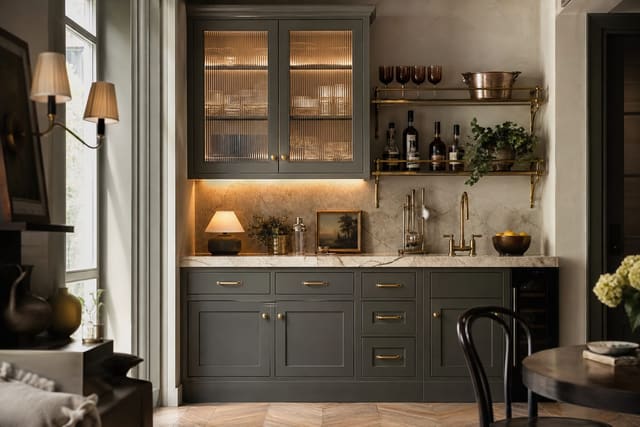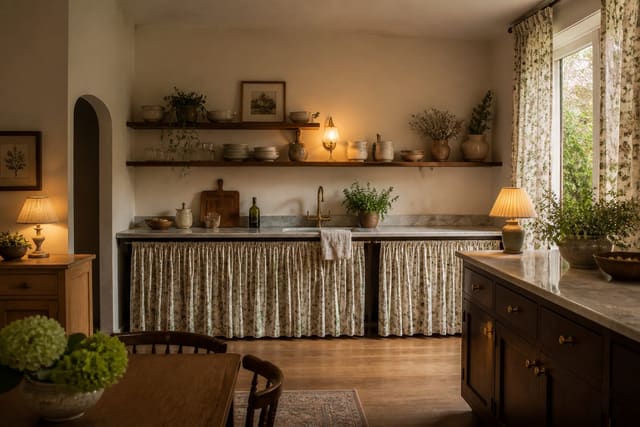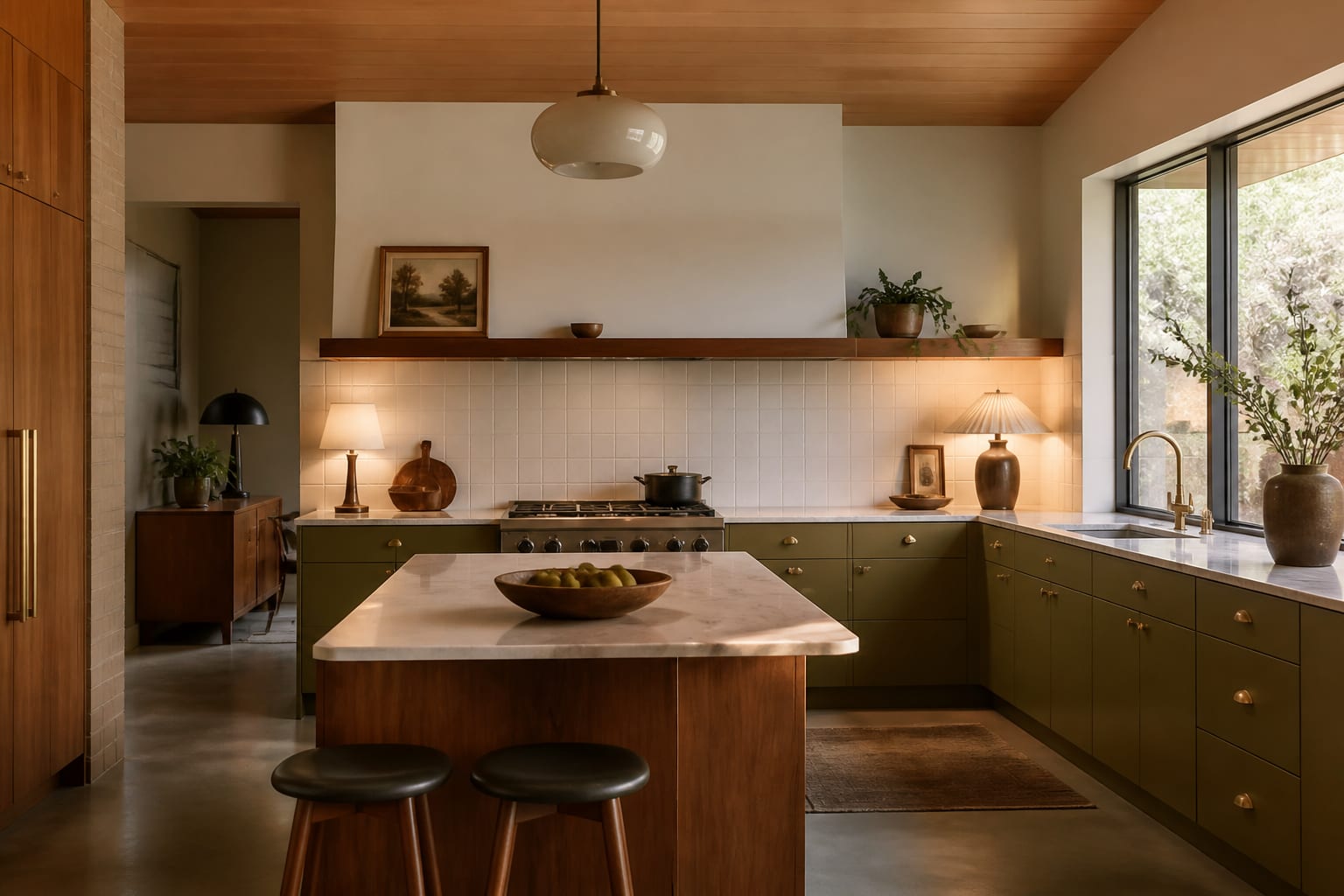
A mid century modern kitchen relies on flat-front cabinets in warm walnut or teak, clean horizontal lines, a bold accent color, and globe pendant lighting. Skip raised-panel doors entirely. This combination of honest wood grain, one saturated hue, and sculptural round fixtures gives the room a vintage character that still feels current and functional today.
What Cabinets Define The Style?
Choose flat, slab-front doors that show off the wood grain instead of raised panels or ornate molding. Walnut and teak are the signature choices; a high-quality veneer or warm wood-look laminate captures the same effect for less. Run the grain horizontally across base cabinets to reinforce the era's love of long, low lines.
Keep hardware minimal: slim tubular pulls in brass or matte black, or routed finger pulls with no visible hardware. Avoid heavy knobs and decorative bin pulls, which fight the streamlined look. Consider these variations:
- Open walnut shelving instead of upper cabinets, to display ceramics and glassware.
- Cabinets extended to the ceiling for a built-in, architectural feel.
- A tall pantry cabinet with a matching flat front to hide clutter.
- Refaced boxes with new flat veneer fronts instead of a full replacement, for a lower-cost path to the same look.
Book-match the veneer grain across adjacent doors for a custom, considered detail. A calm, continuous plane of warm wood interrupted only by slim hardware is what makes this style read as both retro and current decades later.
See also our guide to Kitchen Home Bar Design for more mid century modern kitchen ideas.
How Do I Add Color And Contrast?
Pair warm wood with one bold, saturated hue. A two-tone scheme works well: keep upper cabinets and open shelves in natural walnut, then run the lower cabinets or island in avocado green, burnt orange, mustard, or deep teal. For a calmer room, use crisp white uppers and reserve the bold color for the backsplash or a single furniture piece.
Keep countertops simple so the cabinets and color do the talking:
| Countertop | Why It Works |
|---|---|
| Warm white quartz | Neutral backdrop for bold cabinet color |
| Butcher block | Matches cabinet wood tone directly |
| Terrazzo | Colorful flecks nod to the era while feeling fresh |
Layer in mixed materials the period loved: brass or chrome hardware, a stone or tile backsplash, and warm leather or cane on seating. Bar stools with tapered wooden legs and curved backs reinforce the theme, and keeping metal finishes consistent across hardware, faucet, and lighting makes the room feel deliberate. If full-color cabinets feel too permanent, carry the hue through a stand mixer or open-shelf ceramics instead.
For a related angle, read Cottagecore Kitchen Ideas.
What Backsplash Fits A Mid Century Kitchen?
The backsplash is the easiest place to inject personality, so skip plain subway tile. Geometric shapes read as period-correct while feeling current:
- Hexagons, elongated penny rounds, or a diamond pattern
- A glossy finish in mustard, sage, teal, or terracotta that ties to the cabinetry
- A full-height run behind the range or up to the underside of the upper cabinets for a stronger statement
For a quieter option, use vertically or horizontally stacked rectangular tile in warm off-white with a slightly handmade glaze for texture. A slab backsplash that continues the countertop material up the wall also suits the era's architectural instincts, especially in terrazzo or a warm-veined stone.
Grout color matters: a matching tone keeps the surface calm, while a contrasting grout emphasizes the geometric pattern. Order loose tiles and tape them beside your cabinets first, since glaze color often shifts warmer or cooler next to real wood. Plan the layout so cut tiles land at the edges, not the center.
What Lighting And Layout Work Best?
Over an island or peninsula, hang a row of globe or dome pendants in brass, white, or smoked glass. Their round forms contrast the kitchen's straight lines and cast a warm, even glow. A single larger globe or a sputnik fixture suits a breakfast nook or a spot above the sink; choose warm bulbs around 3000K so food and wood tones look appealing.
Hang island pendants with the bottom of each fixture 30 to 36 inches above the counter, high enough to clear sightlines but low enough to pool light where you work. Add under-cabinet lighting for bright prep surfaces without cluttering the clean lines, and a toe-kick light beneath lower cabinets for a soft night glow.
For layout, prioritize a smooth work triangle between sink, range, and refrigerator. Open the kitchen toward an adjacent dining or living area where possible, using an island as the boundary. Keep the island low-profile with tapered-leg stools that tuck underneath, and integrate appliances behind flat panels where budget allows so a continuous run of wood reads as architecture rather than a wall of stainless steel.
- Install horizontal-grain walnut cabinets with slim brass tubular pulls.
- Paint the lower cabinets or island avocado green for bold two-tone contrast.
- Tile a full-height backsplash in glossy hexagons or geometric mustard tile.
- Hang a row of brass globe pendants over the island work surface.
- Swap upper cabinets for open walnut shelving to display ceramics.
- Choose terrazzo or butcher block counters that complement the wood cabinets.
- Add tapered-leg bar stools with curved cane or leather backs.
Bring The Look Home With Re-Design
Test these ideas before any contractor starts. With Re-Design, upload a photo of your current kitchen and preview flat-front walnut cabinets, a two-tone green island, geometric tile backsplashes, and brass globe pendants placed on your actual walls and counters. Compare an avocado lower run against a teal one, or see how open shelving changes the upper wall, and explore several directions in minutes.
Frequently Asked Questions
What cabinets define a mid century modern kitchen?
Flat, slab-front cabinets in warm walnut or teak define the style, ideally with horizontal grain and slim brass or matte black pulls. Skip raised-panel doors and ornate knobs. Wood veneer or warm laminate offers the same clean look at a lower cost when solid wood is out of budget.
How do I add color to a mid century modern kitchen?
Pair warm wood cabinets with one saturated accent like avocado green, burnt orange, or teal on the lower cabinets or island. Reinforce that color through a geometric backsplash. Keep countertops simple in white quartz, butcher block, or terrazzo so the wood and accent color stay the focus.
What lighting works in a mid century modern kitchen?
Globe or dome pendants in brass, white, or smoked glass work best over an island, with a larger globe or sputnik fixture above a nook. Use warm bulbs near 3000K and add under-cabinet lighting for prep. The round forms contrast the kitchen's straight cabinet lines beautifully.
Do I need a full remodel to get this look?
No. Refacing existing cabinet boxes with flat wood-veneer fronts, adding a bold backsplash, swapping pendant lighting, and painting a lower cabinet run can deliver the mid century look without a studs-out renovation or replacing every cabinet box.