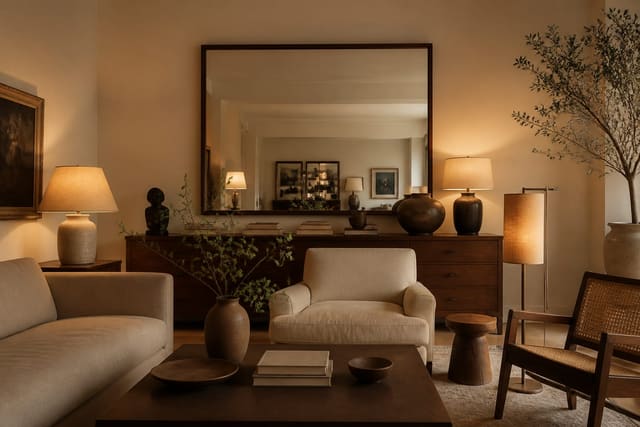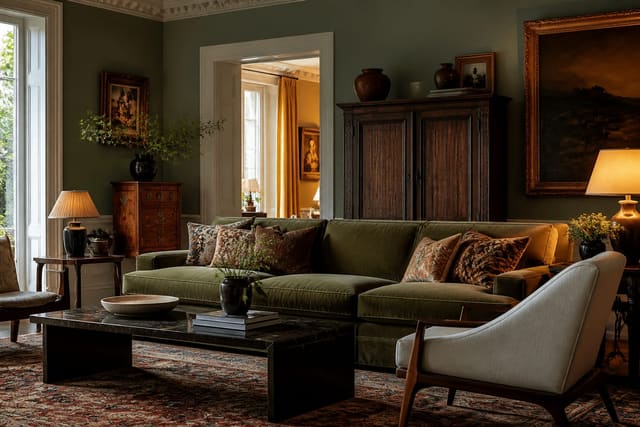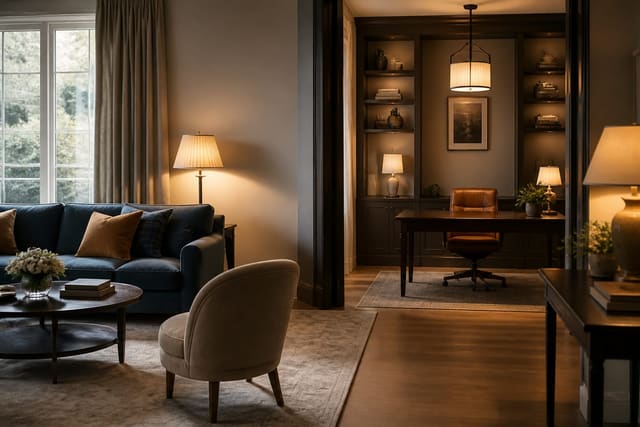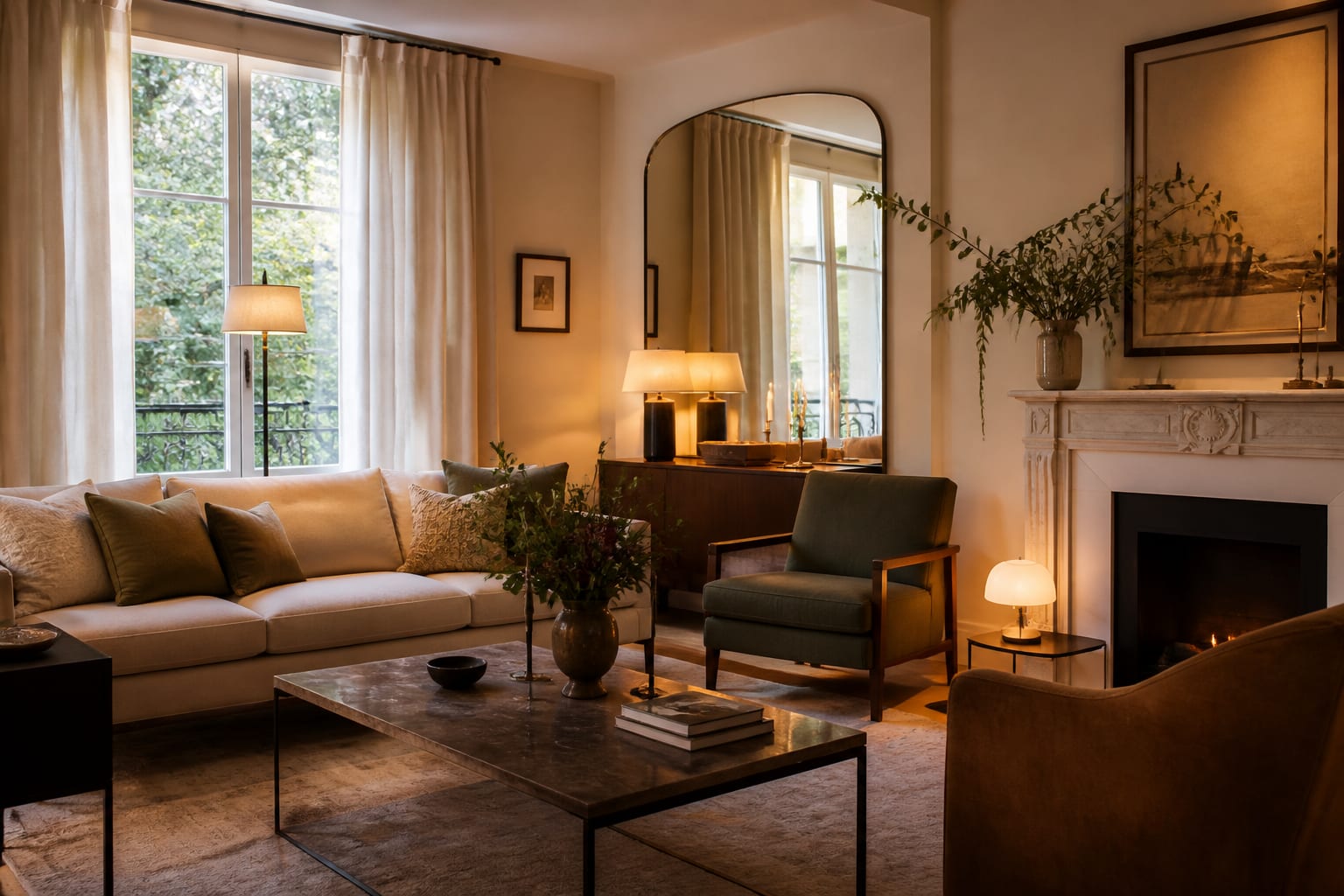
How do mirrors make a room look bigger? They reflect whatever sits in front of them, so the wall appears to open into a second copy of the space, and they bounce daylight into the dim corners that usually make a room feel boxed in. The honest answer is that placement matters more than size: a 24-inch mirror across from a window beats a 48-inch one stranded on a dark interior wall every time.
I treat a mirror as a lighting tool first and a decor object second. Get the angle and the reflected content right, and a cramped room reads noticeably more open and several shades brighter without a single added watt. Get them wrong and an expensive mirror just doubles whatever is dull. The numbers below cover where to hang, how big to go, and how to avoid the glare that ruins the effect.
Why placement beats size
A mirror only helps as much as whatever it happens to reflect. Aim it at a window and it effectively becomes a second source of daylight, sometimes lifting the perceived brightness of a small room by a real, visible margin. Aim that same mirror at a dim corner and it simply doubles the dimness. So before you measure for size, decide exactly what the glass will show when you stand at the room's main entry.
The two strongest positions are directly opposite a window and perpendicular to it on an adjacent wall. Opposite gives you the brightest bounce; perpendicular widens the room and catches light at an angle that feels less like a mirror staring straight back at you. In a long, narrow room, a tall mirror on the long wall stretches the short dimension by reflecting the far end into view. Dim spaces benefit most of all, and the broader logic behind brightening a dark room with smart choices applies directly here: a mirror is one of the cheapest ways to redistribute the light you already have rather than buying more of it.
Size and height: the numbers
For a mirror over a console, sofa, or mantel, aim for roughly two-thirds the width of the piece below it. A 60-inch console pairs cleanly with a 36-to-40-inch mirror. Leave about 4 to 8 inches of breathing room between the top of the furniture and the bottom of the frame so the two read as a deliberate group rather than a collision of objects.
Height is where most people drift off course. Center the mirror so its vertical midpoint sits 57 to 60 inches off the floor, the standard gallery eye line. Over a 32-inch console, that usually lands the bottom edge a few inches above the surface. For a leaning floor mirror, 65 to 70 inches tall gives a full head-to-toe reflection and a real sense of height; lean it at a slight angle so it catches the ceiling line and exaggerates the room's vertical reach. A large mirror also helps a space that pulls more than one duty, and many setups that blend two distinct styles in one room lean on a single oversized mirror to keep a split layout reading as one coherent space.
When you are shopping or placing the mirror, run through this checklist:
- The frame finish either matches your existing metals or contrasts cleanly, never a vague near-miss.
- The reflected content is something you genuinely want doubled from the room's main vantage point.
- The mirror is plumb and centered to the furniture, not the wall, whenever the two differ.
- The glass sits far enough from any bare overhead bulb to avoid a harsh reflected hot spot.
Multiplying light without glare
Reflective surfaces compound, which is the whole point and also the main risk. A mirror near a lamp can roughly double the usable light in a corner, but a mirror set directly across from a bare bulb throws hard glare into the seating zone. Offset the mirror 12 to 18 inches from a strong fixture, or angle it a few degrees, so it spreads light evenly rather than blasting a single bright spot. In a flexible room the payoff is bigger still; spaces that work as both an office and a guest room, like several single-room layouts built to serve two purposes, get more even light from one well-aimed mirror than from extra lamps that only crowd the floor.
The shape and frame of the mirror change the effect, too. A frameless or thin-framed mirror disappears into the wall and reads almost like a window, which sells the illusion of a second room hardest. A heavy ornate frame, by contrast, reads as an object first and a portal second, so it adds character but opens the space a little less. In a tight room chasing maximum size, I reach for the thinnest frame I can find, in a finish within one or two steps of the wall color so the edge nearly vanishes.
Finish on the glass itself is worth a thought as well. Antiqued or smoked mirror looks beautiful but reflects 20 to 40% less light than clear glass, so save those for a decorative wall and keep a clean, clear mirror anywhere brightness is the actual goal. If you want the openness without the literal reflection, a large 48-inch clear mirror near the entry usually does the most work per dollar in a small room. A pair of slim mirrored panels flanking a doorway can mimic that effect too, widening the wall by reflecting the room from two angles at once while staying out of the traffic path.
Common mistakes to avoid
The most common mistakes to avoid begin with hanging too high, so the mirror reflects the ceiling and the tops of the doorways instead of the room and the people in it. Keep that 57-to-60-inch centerline no matter how tall the wall is. The second mistake is reflecting clutter: a mirror across from a messy console or an open closet simply shows you twice the mess, so audit the reflection before you drive a single nail.
Undersizing is everywhere too. A 12-inch mirror on a wide blank wall reads as an afterthought; that spot wants something 40 inches or wider, or a tight grouping that behaves as one large shape. People also ignore weight and hardware: a 40-inch framed mirror can run 25 to 40 pounds, so anchor into a stud or use a rated wall anchor rather than a single drywall nail. Finally, avoid pointing a mirror straight at a bright window if you sit facing it for hours, since the bounce-back can read 2 to 3 times brighter than is comfortable; offset the angle and the glare disappears.
Use AI design to preview mirror placement before you commit
The tricky part of mirrors is that the entire payoff depends on what yours will reflect, and that is genuinely hard to picture while you stand in the room holding a tape measure. Re-Design removes that uncertainty: upload a photo of your small or dim room and the AI design tool can show a large mirror opposite the window, a leaning floor mirror tucked into the corner, or a console-and-mirror pairing, so you see the brighter, more open result before you buy anything.
I like generating two or three placements from a single upload and comparing them at a glance. You can test whether the mirror should face the window for maximum brightness or sit perpendicular for added depth, and judge each option against your real walls, light, and furniture instead of a staged showroom. That preview is the difference between a mirror that truly opens up a room and one that just hangs there reflecting an empty ceiling.