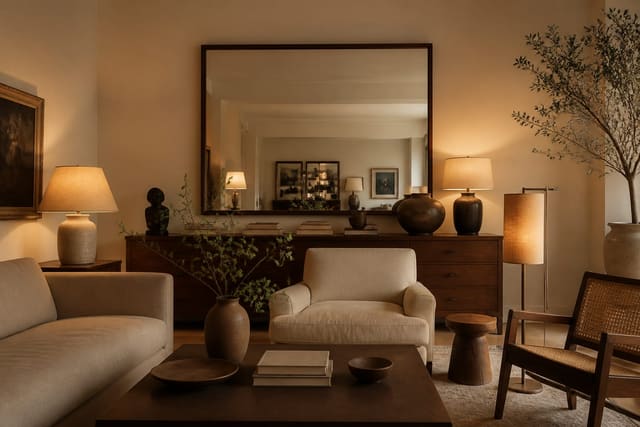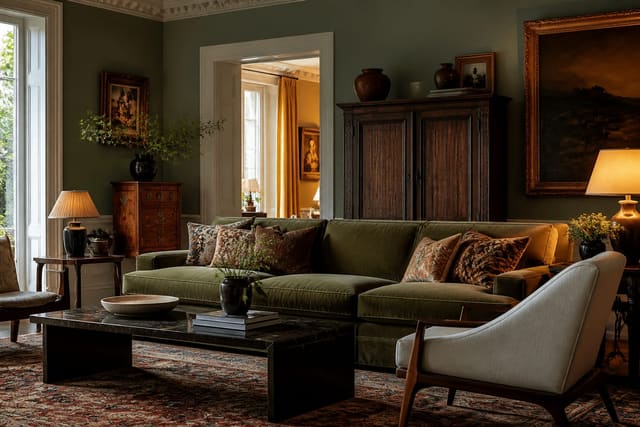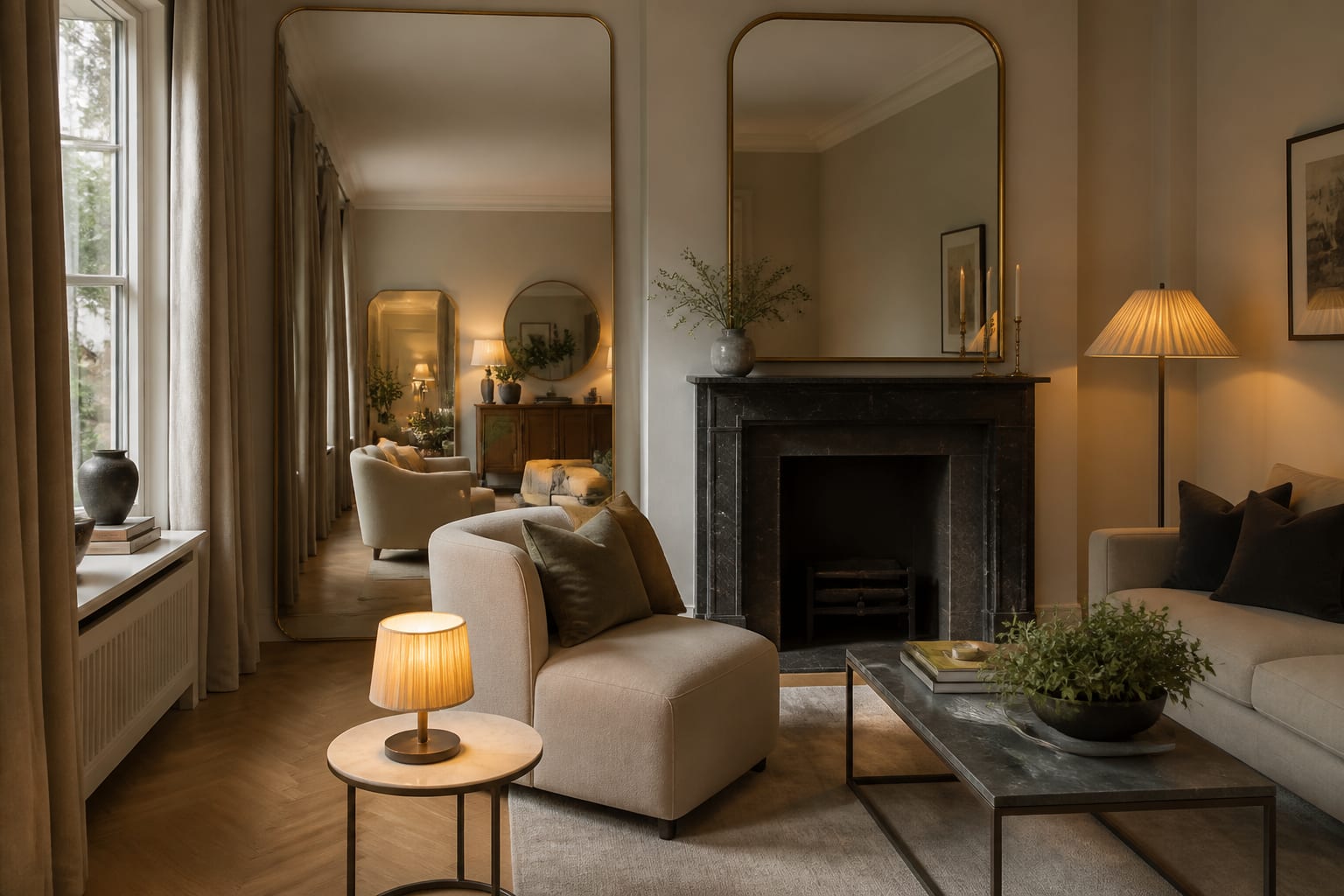
Hang a large mirror where it reflects a window or a light source, and a cramped room instantly feels deeper and brighter, because the mirror borrows the view and doubles the light. The mistake I see most is a small mirror stuck on a random wall, reflecting nothing useful and doing nothing for the space. My read is that mirror placement beats mirror size, though bigger usually helps too. Aim the reflection at something worth doubling and the room opens up; aim it at a blank wall and you have just hung decoration.
Mirrors create the illusion of space in two ways: they bounce light around a room and they reflect a view that reads as more depth. Get the placement and the scale right and a 10-by-10 room can feel noticeably larger. Here are the rules I use to make a mirror actually pull its weight.
Place the mirror where light lives
The whole trick of using a mirror to enlarge a room comes down to what it reflects, so start with the light. A mirror hung opposite or just beside a window catches daylight and throws it deeper into the room, brightening corners that the window alone never reaches. In a dark or narrow space, this is the single highest-impact move, and it pairs naturally with the other brightening tactics in my dark room solutions guide.
Directly opposite a window gives you the strongest light bounce and effectively doubles the view of whatever is outside, which reads as extra depth. Beside a window works almost as well and avoids any glare bouncing straight back at a seated position. What you want to skip is a mirror facing a blank wall or a cluttered shelf, because a mirror reflects exactly what sits in front of it, and doubling a pile of clutter just makes the room feel busier.
At night the same logic applies to lamps. A mirror positioned to catch a lamp or a sconce spreads that warm light across the room after dark, so the space stays open-feeling once the sun is down. In a hallway with no window at all, a mirror at the far end reflects whatever light spills in from adjoining rooms and visually lengthens the corridor, which is why entryways and narrow passages are the spots where a single well-placed mirror earns its keep the most.
Scale the mirror to the wall
Size is the second lever, and most people undersize the mirror. A small mirror floating on a big wall barely registers, while a large mirror that fills the wall reads almost like a second window. Above a console or sofa, aim for a mirror that spans at least 60% of the furniture width, and on an open wall, a piece covering 60% or more of the visible wall makes the strongest impression.
A leaning full-length mirror is the easiest big-impact option in a small room. Choose one 65 inches or taller and lean it against the wall; the floor-to-near-ceiling line draws the eye upward and stretches the room vertically. Here is how I size and place mirrors for the most space-enlarging effect:
- Pick one large mirror over a cluster of small ones for a clean, deep reflection.
- Span at least 60% of the furniture width when hanging above a console or sofa.
- Lean a 65-inch-or-taller mirror to add vertical height to a low room.
- Center hung mirrors at 57 to 60 inches so the reflection meets eye level.
- Aim the reflection at a window, a view, or styled shelving, never clutter.
Height follows the eye-line rule. Center a wall-hung mirror at 57 to 60 inches from the floor so the reflection lands where people actually look, and keep the bottom edge 4 to 6 inches above a console top so the two relate.
Shape and finish change the effect
The mirror's frame and shape adjust how it reads. A frameless or thin-framed mirror disappears into the wall and maximizes the sense of openness, while a heavy ornate frame becomes a decorative object that happens to reflect. For pure space-enlarging power, lean toward simple frames. A round mirror softens a boxy room, and an arched or tall rectangular mirror exaggerates ceiling height.
Finish matters in a layered room too. A mirror with a brass or black frame can tie into other metals you already have, the same coordinate-your-finishes thinking I use when I mix design styles. Just remember that the bigger and simpler the glass, the more the mirror works as a space trick rather than as art. A pair of matching tall mirrors flanking a doorway can also fake a set of windows where none exist, which is one of my favorite moves in a windowless room.
Common mistakes to avoid
The most common mistake is hanging a mirror that is far too small, so it reads as a token accent and does nothing for the sense of space. Size up until it covers 60% of the wall or furniture below it.
The second mistake is aiming the reflection at clutter or a blank wall, which either doubles the mess or reflects nothing worth seeing. Point it at a window or a styled view. A third is hanging the mirror too high, so the reflection shows the ceiling instead of the room; center it at 57 to 60 inches. A fourth is scattering several small mirrors across a wall, which chops up the reflection and looks busy rather than open; one large mirror beats a crowd of little ones. The last common mistake is choosing a heavy ornate frame when openness is the goal, since the frame competes with the very illusion you want.
Use AI design to test mirror placement before you hang
The hard part of decorating with mirrors is that the effect depends entirely on placement, and you cannot judge a reflection until the mirror is up and the screws are in. Re-Design takes that risk away. Upload a photo of your room and the AI design renders mirrors of different sizes and shapes on the walls you are considering, so you can see how the reflection and the light bounce play out before you drill.
Because you upload your real space, the preview keeps your true window position, wall color, and furniture in frame, so you can tell whether a large mirror opposite the window actually opens the room or just doubles a cluttered corner. Try a leaning full-length against a hung statement piece, test frameless versus framed, and find the spot that makes the room feel biggest before you commit a single anchor to the wall.