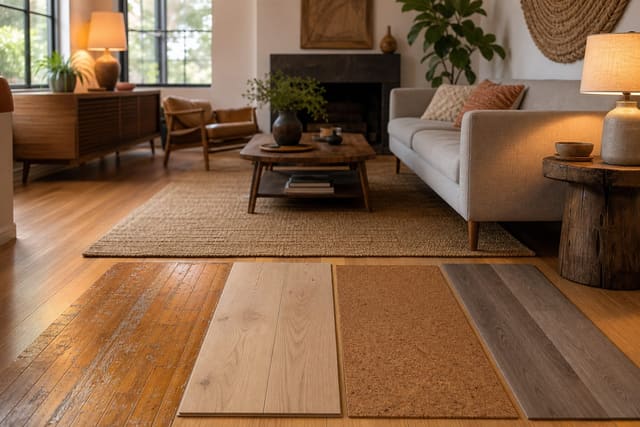
Mixed flooring transitions look intentional when the seam follows an architectural line, the height step is under 1/4 inch (or bridged by a strip), and both materials share the same warm or cool undertone. Mixed flooring isn't the problem — sloppy transitions are. Tile against wood, vinyl against carpet, or two plank floors can all work once height, break line, and strip profile are decided before the final cuts.
How do you handle flooring transitions between different floor types?
Match the finished floor heights, place the break at a logical threshold, and choose a strip profile that protects both materials without becoming the main feature. The strip is a construction detail first — it keeps edges from chipping, carpet from fraying, and toes from catching.
Start with height. Floors finishing within about 1/8 inch of each other can use a flat metal, wood, or vinyl T-molding. A difference near 1/4 inch or more calls for a reducer sloping from the higher floor down. Once the gap reaches roughly 1/2 inch, treat it as a real step: wider, lower-contrast, and easy to see.
Then decide where the material changes. In a doorway, center the break under the closed door so neither room borrows the other's flooring. In an open plan, line the break up with a cabinet run, beam, cased opening, stair edge, or the back of an island. A random line across open floor almost always reads as a budget compromise.
Where should the strip go when rooms meet awkwardly?
Put the transition where the eye already expects a pause. Doorways are easiest since the casing frames the seam — center the strip under the door slab and check door-swing clearance once it's installed, since even a low reducer can scrape a door that was already tight.
Open-plan rooms need more discipline. When kitchen tile meets living room wood, line the seam with the cabinet or island edge rather than wherever spills happen to land. Tile can extend 6–12 inches past the cabinet face to protect the work zone, but a field that wanders halfway into the sofa area shrinks the living room visually.
Direction matters too: avoid a thin sliver of plank meeting tile. Keep cut pieces at least 2–3 inches wide, moving the seam if needed. Homes with several entries face the same planning problem as a room with too many doorways — every opening needs a clear route, not its own flooring accident.
In hallways, keep the walking path calm; a high-contrast strip every few feet chops the floor into bands. If three rooms meet at one spot, pick one dominant flooring direction and let smaller rooms transition off it.
Test this on your own room photo with ReDesign — keep the doorway, walls, windows, furniture, and fixed features visible so the preview solves the room you actually have.
Which transition strip works for tile, wood, vinyl, or carpet?
Choose the profile by material and height, not by the prettiest sample in the aisle.
- T-molding: for nearly level floors. The center stem drops into the gap; the cap bridges both edges. Leave the manufacturer's expansion gap (often about 1/4 inch for floating planks) instead of pinching the floor tight.
- Reducer: for a higher floor, common where tile sits above vinyl or older hardwood. Wide, gradual reducers read better than narrow, steep ones.
- Schluter-style metal edge: protects tile at bathrooms, mudrooms, and kitchens. Match the finish to nearby hardware — brushed nickel near chrome plumbing, brass near warm pulls, black only if black repeats elsewhere.
- Carpet transition bar: for stretched or tucked carpet. Don't trap carpet under a flat strip; a proper tack strip or clamp profile keeps the edge from curling.
- Stained wood: only when it genuinely relates to the wood floor. A mismatched oak strip between walnut-look vinyl and porcelain tile isn't neutral — a quiet metal profile is more honest if you can't match species or stain.
Color matters too: bright silver across dark floors draws attention to every height change, while matte bronze, satin nickel, or stained wood disappears better. If the new floor dulls a darker room, pair the plan with lighting tricks for darker rooms before ruling out the darker option.
Common mixed flooring transition mistakes
The biggest mistake is treating the strip as a cover-up for bad planning. A strip protects an edge; it can't make an off-center break look intentional. Tape the seam on the floor before installation and view it from the entry, sofa, sink, and hallway.
Other common errors:
- Ignoring finished height until installation day. Build a sample stack with every layer — subfloor, membrane, mortar, tile, pad, plank, adhesive, and the profile — before ordering.
- Running two wood-look floors together without contrast. Gray oak vinyl against warm oak laminate reads as a failed match, not a layered palette; add a metal or stone threshold if tones are close but not identical.
- Using tiny diagonal seams outside patterned or historic entries. Straight breaks aligned to architecture look cleaner in most modern rooms.
- Skipping light checks. Glossy tile beside matte wood can flash in sun, and a pale reducer beside dark planks can look wider than it is — the same logic behind mirrors that amplify light applies here.
Use AI design to preview the floor change before you commit
Floor transitions are hard to judge from samples because the real question is whether the break line, material color, plank direction, rug placement, and doorways all work together. An upload-and-preview tool lets you test that before a contractor cuts tile or orders reducers.
Photograph the room entry and the adjoining room. In the prompt, name the materials and the exact transition — for example, warm white tile meeting medium oak planks at the island edge with a slim brass reducer, planks running toward the windows, no raised threshold. Run a second version with the break centered in the doorway, and a third with one floor continuing through.
Compare previews for alignment, not styling flair: does the transition make the kitchen look planned or shorten the living area? Does the strip color relate to hardware or lighting? Renters can preview peel-and-stick tile against existing laminate with low-profile rubber reducers; owners can test permanent tile edges and flush wood saddles before the finish floor is locked in. The preview won't certify subfloor flatness or code compliance, but it shows whether the transition is worth doing before the floor is already installed.
What final checks make the transition feel intentional?
Stand on both sides of the threshold and look down from normal walking height. If the strip is the first thing you notice, the contrast is too high, the placement is wrong, or the materials are fighting. A good transition should help floors meet quietly, not become the loudest line in the room.
Walk the route barefoot — no sharp lip, rocking strip, or hollow click. Keep main circulation at least 30 inches wide near the transition, wider around kitchens, entries, laundry rooms, or wheelchair routes. Check robot vacuums, stroller wheels, and doors before calling it finished.
Repeat one finish nearby so the transition has company: a brass strip near cabinet pulls, a black edge near a stair rail, a wood saddle near trim. Two or three small echoes make the change look designed, safe, and calm rather than hidden.
Frequently Asked Questions
Where should a flooring transition go?
Always at a doorway, archway, counter end, or change in room function — never in the middle of an open floor plane. Mid-room transitions read like a mistake regardless of the materials chosen.
Do I need a transition strip between hardwood and tile?
Yes, when the height difference exceeds 1/4 inch or the materials need expansion space. T-molding or reducer strips in a matching wood tone are the standard fix.
Can I transition without a metal strip?
Yes, if both materials finish at the same height, using a flush-set tile border row at the doorway. It's the cleanest look but requires a precise installation.
Should the two floors have similar tones?
They should share the same undertone family — both warm or both cool. Clashing undertones make a transition look accidental even when the seam itself is clean.
Does AI preview floor transitions before I commit?
Yes. Upload photos of both rooms and the transition zone, and an AI preview shows material pairings and break-line placement before any installation begins.
> Try this: Ready to see this on your own room? Open ReDesign and run the preview.
Three transformations to try
1. Hardwood to tile at kitchen doorway 2. LVP to tile at bathroom doorway 3. Carpet to hardwood at bedroom threshold