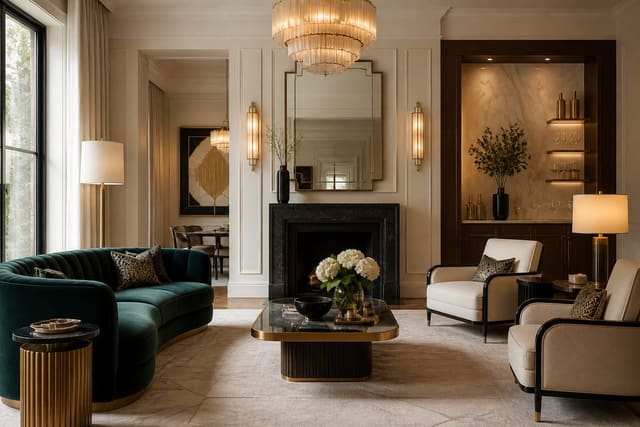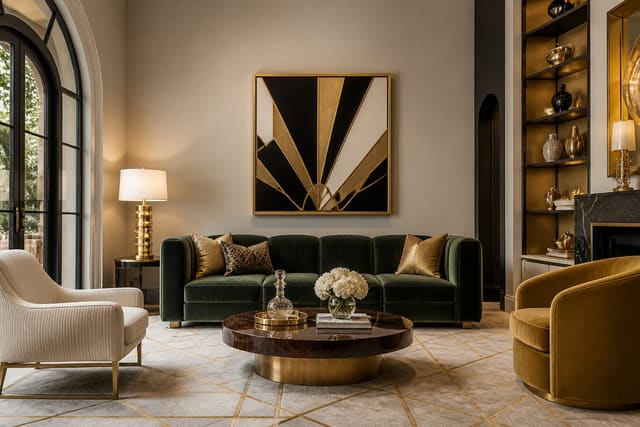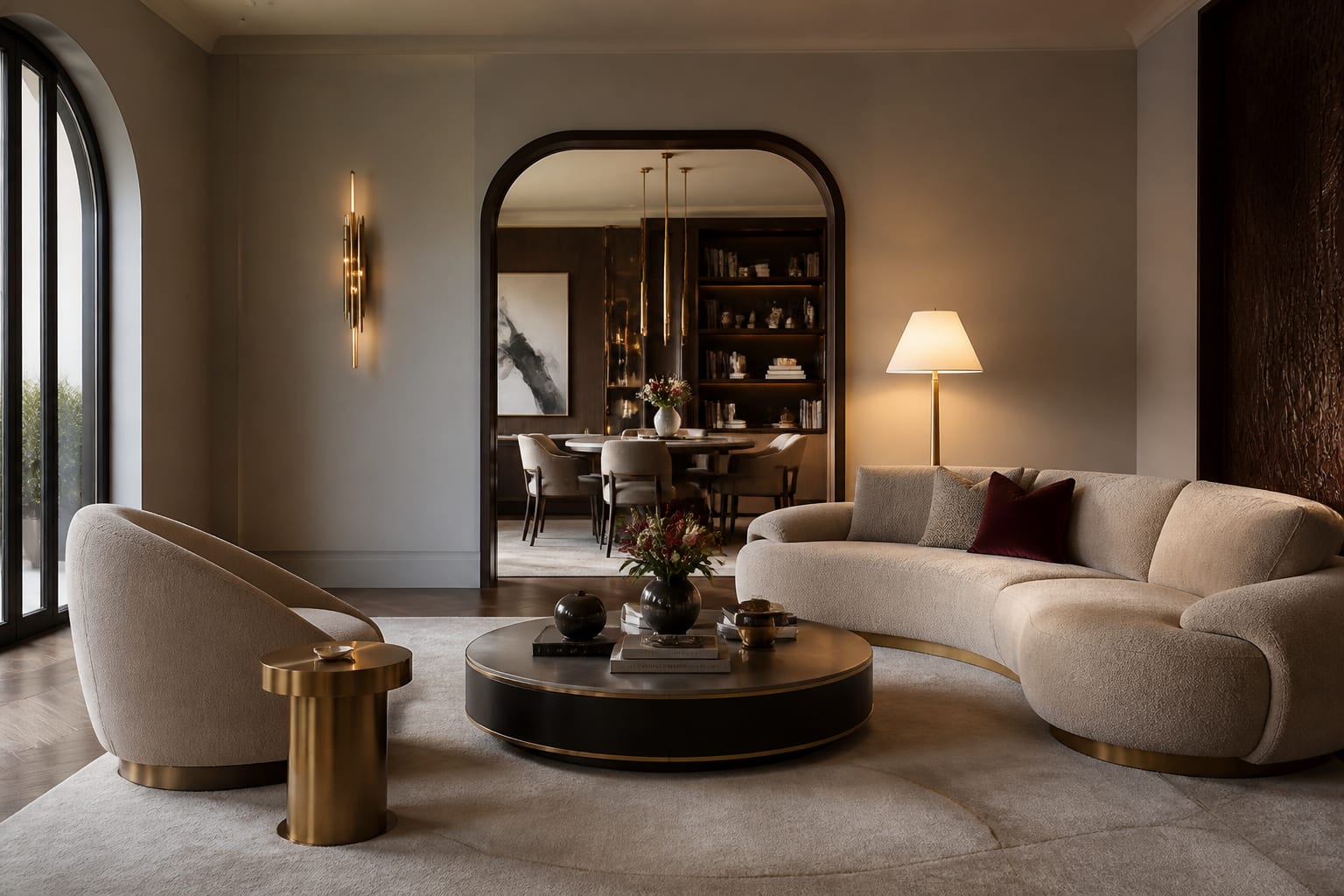
Modern art deco works best when you treat the original style as a vocabulary, not a costume. The era's geometry, symmetry and metallic shine still feel fresh, but a contemporary home cannot survive being drenched in chevrons and gold from baseboard to ceiling. The smarter approach is selective glamour, where a few deliberate deco gestures sit inside calm, modern rooms with breathing space. This guide lays out a restrained framework built on quantified rules, repeated motifs and current materials, so the result reads sophisticated rather than themed. Done well, modern deco gives you the drama and craft of the period while keeping the clean proportions and livability that make a home feel current rather than like a museum set.
Lead With Selective Glamour, Not Excess
The defining discipline of modern art deco is knowing what to leave out. Original interiors layered ornament densely because the era celebrated abundance, but a contemporary room reads as cluttered and dated if you copy that intensity wholesale. The fix is a strict ratio. Keep metallic finishes to roughly 10% to 15% of a room's visible surfaces, counting hardware, lighting, frames and trim together, so the shine punctuates rather than dominates. That single rule prevents the most common failure, where so much brass and mirror accumulates that the space tips from glamorous into gaudy. Choose one statement piece per room and let everything else support it, whether that hero is a fluted media cabinet, a sunburst mirror or a sculptural light fixture. When two or three pieces compete for the lead role, the eye has nowhere to rest and the composition loses its confidence. Surround the glamour with quiet. Generous expanses of plain wall, solid upholstery and uncluttered surfaces give the deco elements room to register, and that contrast between rich and restrained is precisely what makes the rich parts feel expensive. Negative space is a design material here, not an absence of one. Think of each room as a sentence with one or two emphasized words rather than a paragraph in all capitals. Modern deco also leans on quality over quantity, so a single well-made brass-and-marble side table delivers more than a roomful of cheap gilded accessories. The era's craftsmanship was always part of its appeal, and a restrained scheme lets that craftsmanship show. When you find yourself wanting to add one more shiny object, that is usually the moment to stop, because the most sophisticated version of this style is defined as much by its discipline as by its drama.
See also our guide to What Is Art Deco Design for more on modern art deco interior design.
Repeat Geometric Motifs With Intention
Geometry is the backbone of deco, and the modern version depends on repetition handled with intention rather than randomness. Pick a single motif as your throughline, such as a fan, a sunburst, a chevron, a stepped ziggurat or a series of concentric arcs, then repeat that one shape at least three times across the room in different scales and materials. You might see the fan in a cushion print, again etched into a cabinet door, and a third time in the pattern of a rug, so the eye reads a deliberate rhythm instead of disconnected decoration. That rule of three is what distinguishes a curated deco room from a pile of vaguely period objects. Vary the scale as you repeat, because identical sizing everywhere flattens the effect, while a large motif on a feature wall echoed by a small one on a tabletop creates depth and hierarchy. Symmetry reinforces the geometry, so balance pairs of objects around a central axis, flank a fireplace or console evenly, and let the architecture's natural lines guide where the motifs land. Restraint still applies. Two competing geometric families in one room usually fight, so commit to a primary motif and allow at most one secondary pattern in a supporting role. Linework matters as much as the shapes themselves, and crisp edges, clean stepped profiles and confident curves read as deco while soft or muddy execution does not. Use trim, inlay and grout lines as quiet places to extend the geometry, since a stepped crown molding or a banded floor border carries the language without shouting. Handled this way, the repeated motif becomes the thread that stitches the whole room together, giving even a restrained, modern scheme an unmistakable sense of period intention beneath its contemporary calm.
For a related angle on modern art deco interior design, read Art Deco Color Palette.
Choose Modern Materials and a Tight Palette
Material choice is where modern deco separates itself from a period reproduction. The era loved exotic woods, lacquer, marble, chrome and mirror, and most of those translate beautifully into a current home when paired with cleaner contemporary finishes. Honed rather than polished stone, matte lacquer rather than mirror-shine, and brushed rather than gleaming brass all soften the glamour into something that feels of the moment. A tight palette keeps the whole scheme coherent, so hold yourself to three core colors plus one metal that appears consistently throughout. A typical modern deco palette pairs a deep grounding tone such as forest green or navy, a warm neutral like cream or oatmeal, an accent jewel tone, and brushed brass as the unifying metallic. Mixing metals is one of the fastest ways to look unintentional, so pick one temperature and commit. Texture carries a lot of the period feel without adding pattern, so velvet upholstery, fluted wood, reeded glass and bouclé all bring tactile richness that reads luxurious in photographs and in person. Modern deco also rewards a bit of ceiling height, and rooms with 9 feet of clearance or more let dramatic lighting and tall vertical lines breathe the way the style intends, though lower rooms can compensate with vertical motifs that draw the eye upward. Lean toward natural materials with depth over cheap imitations, because a small piece of real marble or solid brass outperforms a large plastic facsimile every time. Keep the overall surface mix balanced between matte and reflective, since an all-gloss room feels hard while an all-matte one loses the signature deco sparkle. The right materials, held inside a disciplined three-color palette, are what let a modern deco room feel both glamorous and genuinely livable across years rather than seasons.
Balance Contrast Without Overdoing It
Contrast is the engine of art deco, but a modern interpretation calibrates it carefully so the room reads bold rather than harsh. The classic black-and-gold or black-and-white pairing still works, yet a contemporary scheme usually softens the extremes, swapping pure black for charcoal or deep ink and adding a mid-tone so the jump between light and dark feels graduated rather than jarring. Think in terms of a dominant tone covering most surfaces, a secondary tone for furniture and larger pieces, and a sharp accent reserved for the smallest, highest-impact details. That hierarchy keeps the drama controlled. Contrast should also work in texture and finish, not just color, so a matte charcoal wall behind a polished brass fixture creates tension and interest even within a near-monochrome palette. Lighting is central to managing all of this, because warm, layered light flatters metals and rich tones while a single cold overhead fixture flattens them. Aim for multiple sources at different heights, a sculptural overhead piece, sconces mounted about 60 inches from the floor at eye level and a lamp or two for low ambient glow, all on dimmers so the same room can shift from bright to atmospheric. Glamour without restraint quickly reads as a hotel lobby, so resist the temptation to make every element high-contrast at once. One dramatic dark-and-bright moment per sightline is plenty, and the surrounding calm is what makes that moment land. Pay attention to how the contrast photographs and how it feels at night, since deco interiors are often at their best under lamplight when the metals glow and the shadows deepen. The aim throughout is a room that feels confident and a little theatrical yet still relaxes you, achieved by treating contrast as a precise instrument to be tuned rather than a volume knob to be turned all the way up.
Here are the common mistakes to avoid: - Drenching every surface in gold and brass until the room reads gaudy. - Mixing multiple metal finishes instead of committing to one temperature. - Crowding several statement pieces into one room with no clear hero. - Forcing pure black-and-gold contrast everywhere with no softening mid-tone. - Using one geometric motif only once so it reads accidental, not intentional. - Relying on cheap plastic or gilt imitations rather than real materials with depth.
Bring the look home with Re-Design
Modern art deco depends on careful balance, and that balance is hard to judge from a moodboard alone. Upload a photo of your room to Re-Design and preview the look before buying, testing how much metallic the space can carry, whether your three-color palette holds together and how a single statement piece reads against your real walls and light. Trying charcoal instead of black, or brushed brass against your existing floor, shows where the contrast lands before you spend. Preview a few restrained directions, compare them side by side, then commit to the version that feels glamorous yet livable.
Frequently Asked Questions
How is modern art deco different from the original style?
Modern art deco borrows the era's geometry, symmetry and metallic glamour but applies it far more sparingly. Where original interiors layered ornament densely, the contemporary version surrounds a few deliberate deco gestures with calm, plain space and cleaner materials. Finishes lean matte and honed rather than mirror-bright, and palettes stay tight, giving the rooms the period's drama without its visual heaviness.
How much metallic is too much in a deco room?
A useful guideline is keeping metallic finishes to roughly ten to fifteen percent of a room's visible surfaces, counting hardware, lighting, frames and trim together. Beyond that, the shine stops punctuating the space and starts dominating it, which is when glamorous tips into gaudy. Committing to a single metal temperature throughout also keeps the metallics reading as intentional rather than accumulated by accident.
Does modern art deco work in small or low-ceiling rooms?