Navy is the color that lets a kitchen feel bold and classic at the same time, which is exactly why it has outlasted every prediction that it would fade as a trend. The frequent misstep is treating navy like a safe neutral and washing the whole room in it under cool lighting, which leaves the space feeling cold and corporate. The stronger play is to use navy as a deep, confident anchor, balanced by warm metals, a light counter, and enough contrast that the color reads rich rather than heavy. Handled with intent, a navy kitchen feels tailored and timeless, closer to a well-cut suit than a passing fad.
Why navy reads classic instead of trendy
Navy borrows its authority from places we already associate with permanence: tailoring, libraries, naval uniforms, and old paneled studies. That heritage is why a navy kitchen rarely looks of-the-moment in a bad way. Unlike a bright, fashion-driven color, navy is a deep near-neutral that sits quietly behind brass, marble, and wood and lets those materials carry the warmth. It is dark enough to feel substantial and grounding, yet it has none of the starkness of pure black, so it flatters a kitchen meant for daily life rather than just for show.
It is also forgiving in a practical sense. Deep navy hides the scuffs, splatters, and fingerprints that plague a white kitchen, especially on the lower cabinets that take the most abuse. A matte navy will show greasy hand marks near the handles, though, which is one reason a slight sheen earns its place on doors that get touched a hundred times a day. The trade-off is light: a saturated navy absorbs a good deal of it, so the room needs more fixtures and warmer bulbs than a pale kitchen would. If you are torn between going dark and staying bright, comparing it against white kitchen ideas is worth the time, since navy gives you durability and drama where white gives you airiness and a sense of space.
How to keep navy warm rather than cold
The single biggest factor in whether a navy kitchen feels inviting or icy is the warmth you set against it. Start with the metals. Brass, gold, and aged bronze are navy's natural partners, and the contrast between cool blue and warm metal is what makes the whole scheme feel intentional and rich. Polished chrome and brushed nickel will work, but they reinforce the coolness, so use them only if you genuinely want a sharper, more modern edge. Plan pulls around 5 to 6 inches on standard 30- to 36-inch base cabinets, scaling up to 10 inches on the widest drawer fronts.
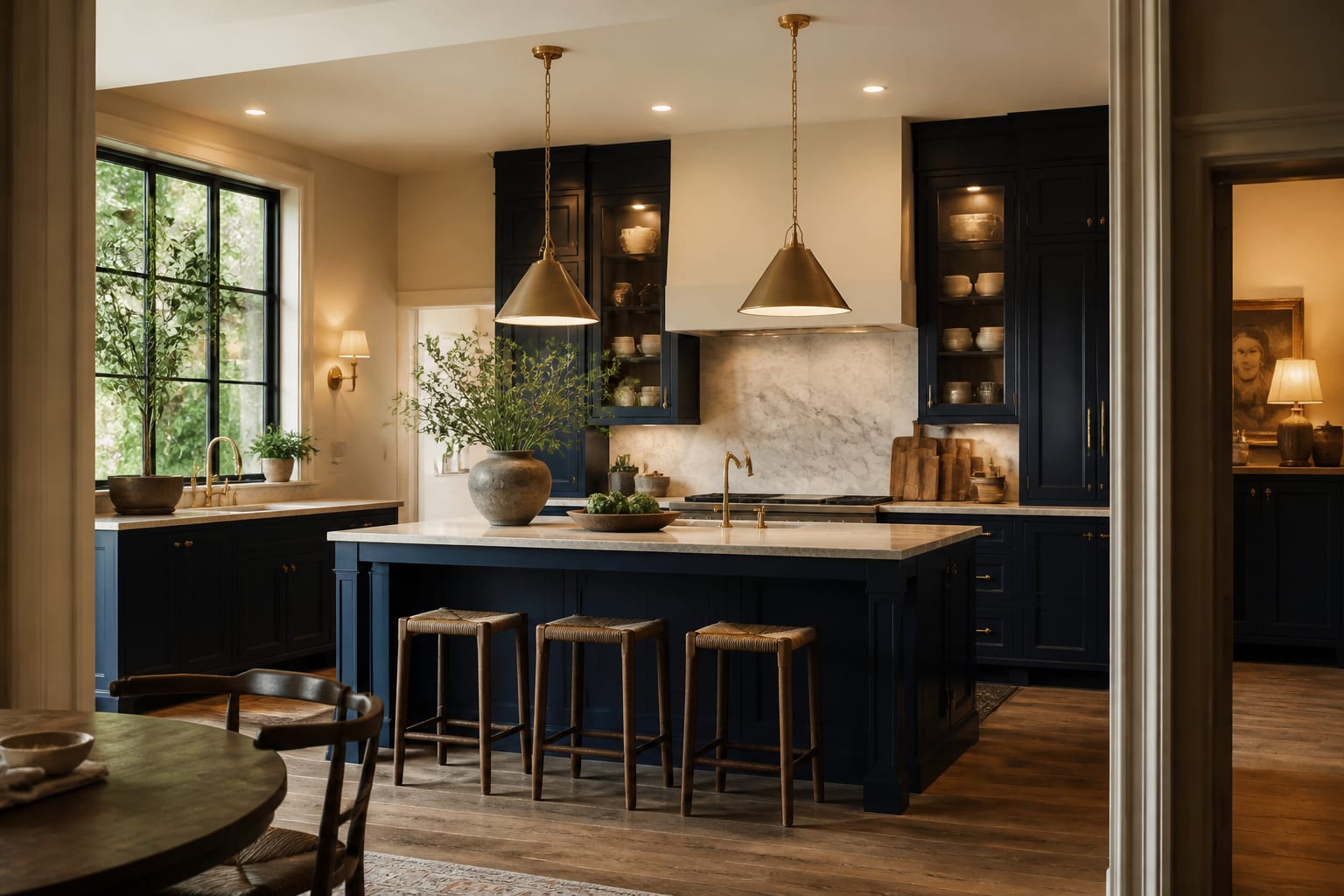
Counters and backsplash carry the rest of the warmth. A white or softly veined marble counter brightens the navy and keeps the room from reading like a cave, while a warm-white subway or zellige backsplash bounces light back into the space. Wood is the other great softener here: a butcher-block run, an oak open shelf, or a wood floor introduces a warmth that no metal alone can supply, and it keeps the deep blue from tipping into something austere. Lighting is non-negotiable: install warm 2700K to 3000K LED strips under the wall cabinets and warm pendants over the island, since cool 4000K-plus daylight bulbs drain the warmth and leave navy looking gray. A navy kitchen island topped with white marble and lit by two brass pendants is the most reliable way to land the color in a room that otherwise stays light.
Where navy works, and how much of it to use
How much navy your kitchen can carry depends almost entirely on its size and daylight. A small or dim kitchen handles navy best as a two-tone scheme, deep blue on the base cabinets and the island, with warm white or pale wood on the uppers, so the color grounds the room at counter level while the top half keeps it open. This is the layout that lets renters and owners of compact kitchens enjoy the drama without the room closing in. The island-only approach is even gentler, giving you a single navy anchor in an otherwise neutral space.
Kitchens with strong light and higher ceilings can take navy all the way, uppers and lowers, with the color wrapped onto a range hood and pantry doors for a fully enveloping, study-like effect. There, warm wood shelving and brass hardware become essential to break up the depth. Glass-front upper cabinets are another useful release valve, since they punch holes of light into a wall of deep blue and keep the run from feeling like a solid block. If even full navy feels too restrained, a dark kitchen in charcoal or near-black pushes the same idea further, but navy remains the friendlier, more classic version, the one that reads tailored rather than severe and works in a traditional and a modern room alike.
Navy blue kitchen ideas to try
- Run navy base cabinets with warm-white uppers and brass pulls for a balanced two-tone classic.
- Top a navy island with white marble and hang two brass pendants for a single confident anchor.
- Wrap a kitchen fully in navy, including the range hood, and break it up with warm wood open shelving.
- Pair navy cabinets with a zellige backsplash in warm white to bounce light and add hand-made texture.
- Choose unlacquered brass hardware so it patinas over time and deepens the navy's heritage feel.
- Set navy against honed marble counters and white oak floors for a tailored, library-like kitchen.
- Use navy only on a pantry or scullery to test the color before committing the main run.
- Add warm 2700K under-cabinet lighting so the navy glows rather than flattening to gray after dark.
See it first in Re-Design
Navy shifts dramatically between a bright morning and a lamp-lit evening, and a paint chip will not show you that swing in your own room. Upload a photo of your kitchen into Re-Design and re-design the cabinets in a deep navy, a softer slate-blue, and an inky midnight to see which depth your light supports. You can preview a full navy kitchen, a navy-and-white two-tone, or a navy island on its own, then swap brass for nickel and marble for quartz, so you confirm every pairing before you commit to a paint or a cabinet order.
Frequently Asked Questions
Is a navy kitchen a passing trend?
Navy has shown unusual staying power because it functions as a deep near-neutral rather than a fashion color. Its associations with tailoring, libraries, and classic interiors keep it from feeling tied to any single moment. Paired with brass and marble, a navy kitchen reads timeless, which is why designers still specify it long after lighter trend colors have faded.
What counter goes with navy cabinets?
White or softly veined marble and warm-white quartz are the strongest partners, brightening the navy and keeping the room from feeling dark. The contrast between the pale counter and the deep cabinets is central to the look. Avoid a heavy, dark counter against navy, which can drain the room of light and make the space feel closed in.
Does navy make a kitchen look smaller?
Saturated navy absorbs light, so a full navy treatment can make a small, dim kitchen feel tighter. The fix is a two-tone layout, navy lowers with white or pale-wood uppers, plus warm 2700K to 3000K lighting and reflective brass. Used that way, navy adds depth and richness without shrinking a modest kitchen.
What hardware works best with navy cabinets?
Brass, gold, and aged bronze are the standout choices, because their warmth contrasts beautifully with the cool blue and stops the room from feeling cold. Brushed nickel and chrome work if you want a sharper, more modern look, but they reinforce the coolness. Scale the pulls to the doors for a balanced, tailored result.