Open plan living was sold to all of us as the dream, and then a lot of people moved in and discovered their dream echoes like a parking garage. The honest answer is that open plan is not a flawed idea; it is an unforgiving one. A wall hides a multitude of sins, and when you remove it, every sound, smell, sightline, and draft has nowhere to go but everywhere at once.
The good news is that almost all of the classic complaints, noise, undefined space, heat loss, and cooking smells drifting into the sofa, have specific fixes that do not involve rebuilding the wall you just paid to knock down. Below I work through the four problems people actually email about and the design moves that solve each one, with the dimensions and materials I rely on.
The noise problem, and how to tame echo
The complaint I hear most is sound. One big room with hard floors, large windows, and a tall ceiling behaves like a drum, so the dishwasher competes with the television and a phone call becomes a group activity. The cause is reverberation: sound bouncing off parallel hard surfaces with nothing soft to absorb it.
The fix is adding soft mass at the surfaces that bounce sound the most, which are the floor, the windows, and the ceiling. Layer a dense wool rug with a felt pad underneath, hang full-length curtains on a ceiling-mounted track set 4 to 6 inches below the ceiling even where there is no window, and choose an upholstered sofa over a leather one in a particularly live room. Bookshelves loaded with books and a few large potted plants also break up the flat planes that sound loves to ricochet off, and they earn their place visually at the same time. If the ceiling is the worst offender, acoustic panels disguised as art or a fabric-wrapped baffle do real work, and a single 8 by 10 foot rug under the main seating zone often cuts the harshness more than anything else you can add. The same low-light tricks that help a gloomy corner often double as sound softeners, which is why the upholstery and textile moves in AI design dark room solutions overlap so neatly with acoustic ones.
Defining zones without building walls
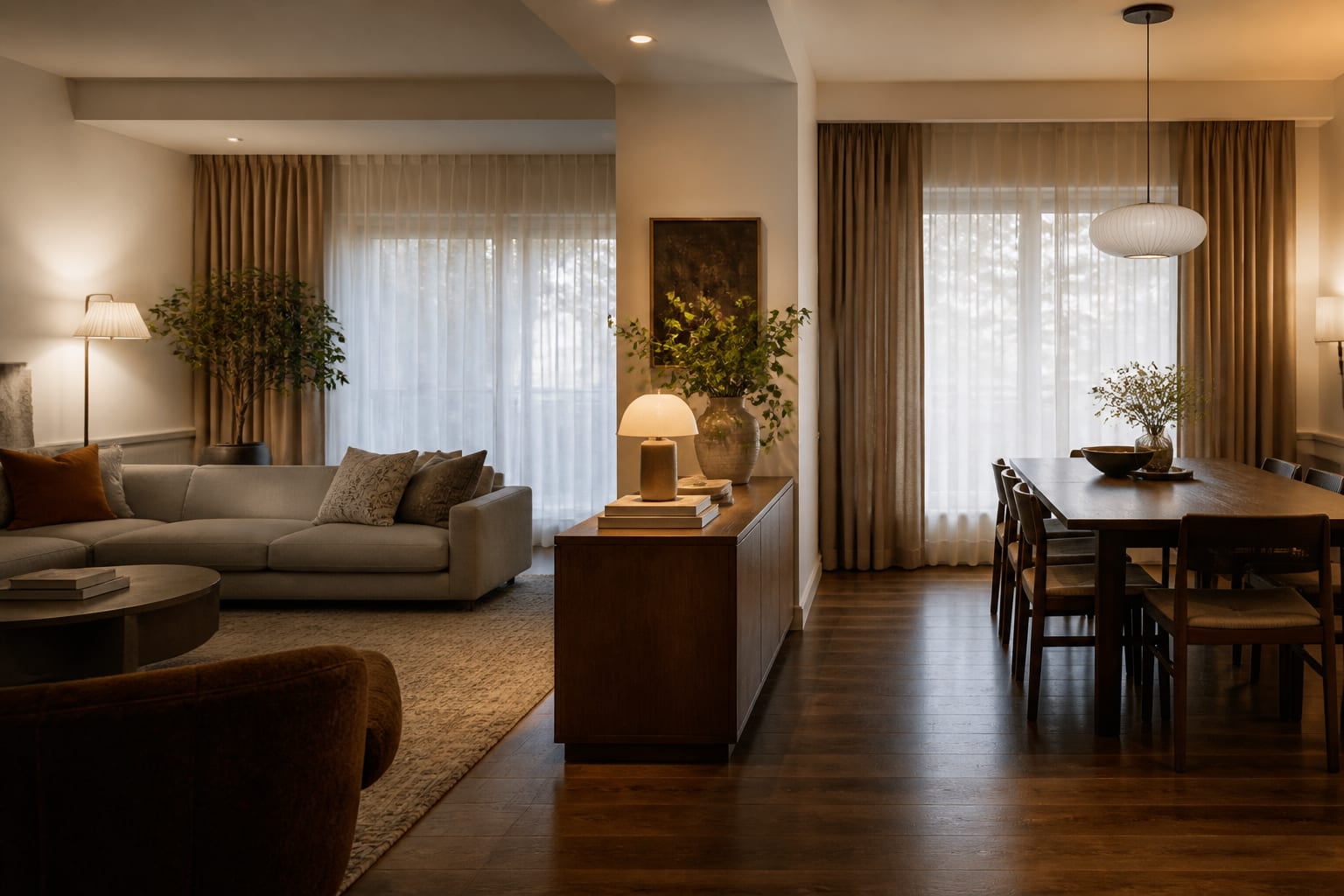
The second problem is that an undivided box reads as one purpose, so the dining area, the living area, and the work nook blur into a single ambiguous expanse where nothing feels settled. You solve this with implied boundaries rather than physical ones, and there are several reliable tools to choose from:
- Area rugs that draw a footprint around each zone, sized so the furniture relates to the rug rather than floating beside it.
- A back-of-sofa console or a low bookshelf 36 to 42 inches tall used as a freestanding divider that you can see over.
- A change in lighting, a pendant over the dining table versus warm lamps in the lounge, to signal that you have crossed from one room into another.
- Ceiling treatments or a painted accent zone that visually caps a specific area without touching the floor.
Grouping unlike functions in one room is its own discipline, and the principles in how to mix design styles help when your dining set and your sofa do not naturally agree. The goal is rooms you can feel but cannot trip over.
Heating, smells, and the practical headaches
The least glamorous problems are often the most maddening. A large open volume is hard to heat evenly: warm air from the kitchen pools at the ceiling, and the far corner stays cold. Running 600 or more square feet off a single thermostat almost guarantees one zone is wrong. Add ceiling fans set to run clockwise on low in winter to push warm air back down, and where you can, split the space into heating zones with separate controls.
Cooking smells are the other big one, because there is no door to contain them and a Sunday roast can announce itself from the sofa three rooms away. A properly sized range hood, vented outside and rated for at least 400 cubic feet per minute over a standard range, does most of the work; a recirculating hood that just filters and returns the air does almost none, and the difference is night and day in a shared volume. Position the hood to cover the full cooktop footprint, and keep at least 24 to 30 inches of clearance between the burners and the hood so it captures the plume before it spreads. When the open zone has to flex between functions, say a dining table that becomes a desk, the layered approach in dual purpose room ideas keeps each use from leaving residue, visual or otherwise, on the next.
Common mistakes to avoid
The most common mistake is pushing every piece of furniture against the walls, which makes a big room feel both empty in the middle and cramped at the edges. Float the seating inward and let the rug anchor it. The second mistake is using a rug that is too small; a 5 by 7 foot rug under a full living zone looks like a postage stamp and actively un-defines the space you were trying to define.
Another frequent error is matching everything in a doomed attempt at cohesion, which flattens the room into a furniture showroom with no sense of separate purpose. A little contrast between zones is what makes them legible. People also forget vertical scale: an 11 foot ceiling needs tall elements, so a 30 inch lamp and low art leave the upper third of the room feeling unfinished. Finally, do not skip the acoustic step and assume you will get used to the echo. You will not, and retrofitting soft surfaces after you have furnished everything is the expensive way to fix it.
Use AI design to preview open plan zones before you commit
The scary part of an open plan is that the changes are big and the room is already built, so guessing wrong is costly. With Re-Design you upload a wide photo of the whole space and test the zoning moves visually first: drop in an 8 by 10 foot rug under the lounge, add a low console behind the sofa, hang ceiling-height curtains, and see whether the room finally reads as two or three places instead of one undefined hall.
I find it most useful for the divider question, because a half-height bookshelf or an island can either rescue a layout or strangle the light, and that is almost impossible to judge from a floor plan. Upload the photo, generate a few zoned arrangements with different rug sizes and divider heights, and you can commit to the version that keeps the openness you wanted while killing the chaos you did not.