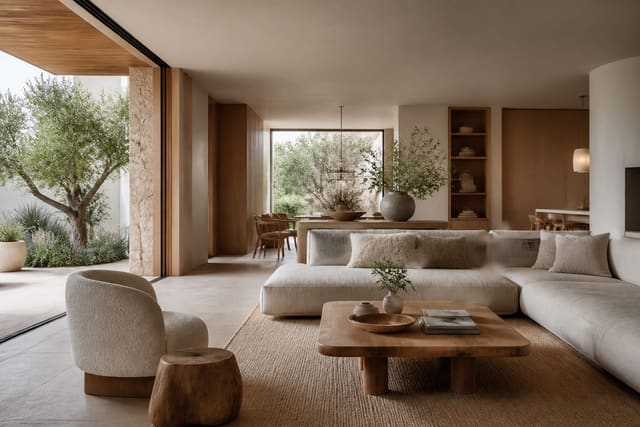
An organic modern color palette leads with warm neutrals like creamy white, greige, sand, and clay, layered with low-saturation accents like sage, terracotta, and ochre. Walls typically fall in the 50-70 LRV range, undertones stay warm (yellow, red, orange), and color shows up through texture and materials rather than bright paint or bold pattern.
What Colors Belong in an Organic Modern Palette?
The base should look like plaster, stone, linen, unglazed ceramic, pale timber, and dry earth: warm white, ivory, oatmeal, sand, mushroom, clay beige, warm greige, and soft taupe. This reflects the broader shift from cool grey minimalism toward warm neutrals that has defined interiors since 2022. Organic modern keeps modern design's clean lines but removes the coldness with earthy undertones and hand-finished texture.
A simple test: choose colors that could plausibly appear in stone, soil, dried grass, linen, wood, or clay. A typical palette includes:
- Warm white walls with a creamy or ivory undertone
- Sand or greige upholstery
- Pale oak, ash, or walnut wood tones
- Clay, terracotta, or rust in ceramics and textiles
- Muted sage in cushions, cabinetry, art, or upholstery
- Soft black, bronze, or dark brown for contrast
Texture carries the depth here. A creamy wall next to raw oak, limewash, linen, bouclé, and handmade ceramic lighting doesn't need aggressive color to feel rich. See our Bouclé Fabric Guide for fabric options that support this look.
What LRV and Undertone Should Organic Modern Walls Have?
Wall colors should stay in the neutral range with a warm undertone (yellow, red, or orange). Cool blue, violet, or green-grey undertones push a room toward Scandinavian, coastal, or industrial territory instead.
For most rooms, target the 50-70 LRV range. LRV (Light Reflectance Value) measures how much light a color reflects, from 0 (black) to 100 (white); this band stays light without feeling sterile. The exception is creamy warm whites: Benjamin Moore White Dove OC-17 sits at LRV 85.4, well outside that range, but its warmth keeps it from reading clinical, making it one of the best light, organic modern base colors.
Always test samples on at least two walls under morning light, afternoon light, and warm artificial light at night. Night testing under incandescent bulbs reveals yellow, red, and orange undertones most clearly.
Which Paint Colors Work Best?
A few colors consistently support the look:
| Paint | Type | LRV | Best Use |
|---|---|---|---|
| Benjamin Moore White Dove OC-17 | Warm white | 85.4 | Walls, ceilings, trim, open-plan continuity |
| Benjamin Moore Abalone | Warm greige | Moderate-high | Walls when white feels too sharp, beige too flat |
| Sherwin-Williams Clary Sage | Muted sage green | Moderate | Built-ins, mudrooms, office walls, textiles |
| Sherwin-Williams Cavern Clay SW 7701 | Warm terracotta | 30 | Accent wall, fireplace, powder room, exterior |
| Sherwin-Williams Warm Stone | Earthy brown | Low-moderate | Doors, cabinetry, millwork, cocooning dens |
Cavern Clay works best as an accent rather than a whole-room color unless the space has strong natural light, since its low LRV can feel enveloping across all four walls.
Bring the Look Home with Re-Design
Choosing beautiful colors is easy; knowing whether they work with your room's actual light, floors, and furniture is harder. Re-Design lets you preview warm whites, clay, sage, greige, and terracotta accents in seconds before buying paint or furniture. Upload your room, apply the organic modern look, and test whether White Dove, Cavern Clay, or sage accents fit your space.
How Do You Add Color Without Losing Restraint?
Keep walls as a calm, neutral envelope and introduce color through layered pieces: upholstery, rugs, art, throws, ceramics, and lampshades. A muted sage lounge chair is easier to live with than four sage walls, and a terracotta rug grounds a room without overwhelming it.
Ways to apply the palette:
- Paint walls a creamy warm white; add clay-colored ceramics on open shelving.
- Choose a warm greige sofa with muted sage cushions and an ivory throw.
- Use a terracotta accent wall behind a bed, keeping bedding linen and warm white.
- Pair pale oak furniture with a sand rug and soft black metal lighting.
- Add ochre through one large textile rather than several small accessories.
- Use desaturated blush in art or a vintage rug for warmth without sweetness.
- Choose bronze or blackened metal hardware over shiny chrome.
For a full room plan, start with our Organic Modern Living Room Ideas and apply the palette with discipline.
Which Colors Should You Avoid?
Some colors simply belong to other styles. Skip cool blue-greys, which read coastal or grey-modern rather than organic modern. Avoid stark whites, which flatten natural materials and make warm woods look yellow by contrast. Skip jewel tones like emerald, sapphire, and ruby, which create a glam direction, and bright primaries, which break the earthy mood.
The test: if a color feels like wet paint, a candy wrapper, or a gemstone, it's wrong for this palette. If it feels like pigment mixed with clay, chalk, ash, linen, or sun-baked earth, it's right. For a broader style overview, read What Is Organic Modern?
What's a Simple Formula for Building the Palette?
Use a 70-20-10 structure: 70 percent warm neutral (walls, large upholstery, drapery, major rugs), 20 percent natural material color (wood, stone, cane, rattan, leather, plaster, or warm-cast concrete), and 10 percent muted accent (sage, terracotta, ochre, blush, or earthy brown).
A living room example: White Dove walls, warm greige sofa, pale oak coffee table, ivory wool rug, blackened bronze floor lamp, sage cushions, and a terracotta ceramic lamp. A bedroom version: warm white walls, sand linen bedding, walnut bed frame, clay lumbar pillow, soft brown wool rug, and one abstract print with sage and ochre tones.
The palette should look related, not matched. That's the difference between a showroom and a room that feels lived in.
Frequently Asked Questions
What colors are used in organic modern design?
Organic modern design uses warm neutrals such as creamy white, warm greige, sand, taupe, clay, and earthy brown, paired with muted accents like sage green, dusty terracotta, warm ochre, and desaturated blush. The overall palette stays low-saturation, warm, and nature-based rather than bright or cool-toned.
What LRV is best for organic modern walls?
Most organic modern wall colors work well in the 50-70 LRV range, which keeps rooms bright but not cold or stark. Creamy warm whites can go higher, such as Benjamin Moore White Dove OC-17 at LRV 85.4, because its warmth prevents a clinical feel despite the high reflectance value.
Is Cavern Clay good for organic modern interiors?
Yes, Sherwin-Williams Cavern Clay SW 7701 is a strong choice with an LRV of 30 and a warm terracotta tone. Use it on accent walls, exteriors, fireplaces, powder rooms, or furniture rather than all four walls, since it can feel heavy without abundant natural light.
Can organic modern use grey?
Yes, but choose warm greige rather than cool blue-grey. A good organic modern grey carries beige, taupe, red, yellow, or brown warmth; if it reads icy, steely, or blue under evening light, it doesn't fit the palette.
Should organic modern walls be white or beige?
Either works, but undertone matters more than the label. A creamy warm white can look more organic than a flat beige, while a rich warm greige can feel warmer than plain white. Always test samples in your own room's lighting before committing.