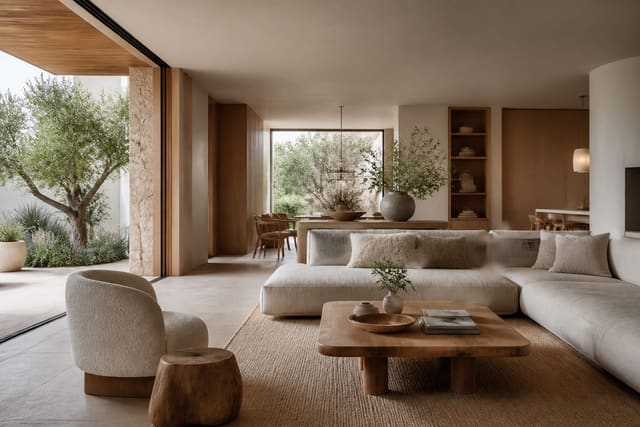
An organic modern home office pairs a clean-lined wood desk, soft neutral walls, tactile seating, hidden cables, and light styling into a room that feels calm and human rather than like a corporate office at home. Get there with natural materials, restrained color, and enough negative space that the room stays focused instead of sterile.
What Makes a Desk Work in This Style?
The desk needs to look sculptural and function cleanly at once. White oak reads lighter and airier; walnut adds depth and a moodier tone. Either works as long as the form stays simple and the top stays uncluttered. For the broader style, see What Is Organic Modern?
Organic modern swaps glossy laminate and chrome for wood grain and matte finishes while keeping minimalist discipline. Seated desk height runs 28 to 30 inches; standing desks suit most users at 38 to 42 inches, with forearms roughly parallel to the floor as the real guide.
Cable chaos breaks the look fastest. Choose a desk with grommets, a modesty panel, a rear cable tray, or a built-in raceway, or add an adhesive under-desk raceway to an existing piece.
- White oak for a light palette, walnut for a richer one.
- A full modesty panel if the desk back faces the room.
- A leather or wool desk mat only if it corrals objects, not for decoration.
- One tray for daily items: notebook, pen, glasses, earbuds.
- Power strip mounted under the desk, never on the floor.
How Do You Pick an Ergonomic Chair That Still Looks Right?
The chair is where function should win, but it doesn't have to look like corporate mesh. Look for linen, wool-blend, or bouclé upholstery over an adjustable, supportive frame. Bouclé adds softness without pattern; see the Bouclé Fabric Guide for how to use it without going trendy.
Keep hardware finishes quiet: matte black, warm brass, aged bronze, or pale wood integrate better than polished chrome. The chair back matters too, since it's often visible behind your shoulders on calls.
Prioritize adjustable seat height, lumbar support, and cushioned upholstery in cream, oatmeal, taupe, camel, mushroom, or warm grey. Stark white photographs well but shows wear fast in daily use.
Which Wall Finish Adds Warmth Without Distraction?
Limewash and Roman clay add movement without shouting. Flat drywall reads blank on camera; busy wallpaper competes with your face and screen. A textured plaster-style finish sits in between: dimensional, warm, quiet.
Choose warm off-white, bone, sand, greige, putty, clay, or pale taupe. Strong natural light can handle a slightly deeper neutral; small or north-facing rooms should stay lighter and let wood furniture add depth.
For video calls, aim for texture plus one or two quiet objects behind you, like a floating shelf, a ceramic vase, and a trailing plant, rather than a fully staged backdrop.
Bring the Look Home with Re-Design
Want to see whether your office would look better with limewash walls, a white oak desk, or a softer chair? Upload a photo to Re-Design and generate organic modern transformations in seconds, before buying furniture or repainting.
How Should You Style Shelves Instead of a Bookcase?
Floating oak shelves look lighter and more architectural than freestanding bookcases, keeping the floor open while giving you a spot to display objects without turning the office into storage.
- 60 percent books, ideally neutral or tonal spines.
- 40 percent objects: ceramics, bowls, framed art, plants, sculptural pieces.
- One repeated material, such as white oak or stoneware, for cohesion.
- At least 25 percent empty space so shelves feel calm.
- Fewer, larger pieces rather than many small accessories.
Use one trailing plant or a small sculptural plant rather than scattering tiny pots. If your office connects to a living space, borrow cues from Organic Modern Living Room Ideas: rounded ceramics, low-contrast palettes, and grounded furniture.
What Lighting and Monitor Setup Actually Works?
Place your monitor 20 to 28 inches from your eyes, with the top of the screen at or slightly below eye level, to reduce eye strain and keep your neck neutral. A laptop used daily needs a stand and separate keyboard to avoid a low-screen, hunched-shoulder posture.
Task lighting should hit 400 to 500 lux on the work surface, meaning ambient ceiling light alone isn't enough. Add a directional adjustable arm lamp with a finish that fits the room: ceramic base with linen shade, matte metal arm, or aged brass.
Layer natural daylight, a warm overhead or wall light, and the task lamp for focused work. If the desk faces a window, use woven shades or linen curtains to cut glare.
What Palette Keeps the Room Warm but Not Flat?
Stick to warm white, oatmeal, sand, stone, taupe, mushroom, clay, charcoal accents, and natural wood, with contrast coming from texture and shape rather than sharp color jumps. One dominant wood tone, one wall texture, one metal finish, and two or three textile tones are enough for the room to feel expensive.
If the desk is walnut, keep shelves walnut or compatible dark oak; avoid mixing in orange-toned pine. Add softness where productivity spaces usually get hard: a wool rug under the desk, linen curtains, an upholstered chair, and ceramic accessories.
Frequently Asked Questions
What does an organic modern home office look like?
It looks warm, uncluttered, and tactile: a clean-lined wood desk, soft neutral walls, hidden cables, an upholstered ergonomic chair, floating shelves, plants, ceramics, and layered lighting. The overall feeling is focused but not corporate.
What is the best desk for an organic modern office?
A solid white oak or walnut desk with simple lines is strongest. Look for integrated cable management, in-desk grommets, a rear tray, or a modesty panel so cords stay hidden, and keep the surface large enough to work on without becoming a dumping ground.
Are limewash walls practical in a home office?
Yes. Their soft variation adds warmth without visual distraction and reads well on video calls, especially in warm neutrals like bone, sand, clay, putty, and greige.
How far should my monitor be from my eyes?
About 20 to 28 inches, with the top of the screen at or slightly below eye level. If you use a laptop, add a stand plus a separate keyboard and mouse for better posture.
How bright should home office task lighting be?
Aim for 400 to 500 lux on the work surface using an adjustable arm lamp to supplement ambient light. Directional task lighting keeps the space functional for reading, writing, or evening work without making the room feel harsh.