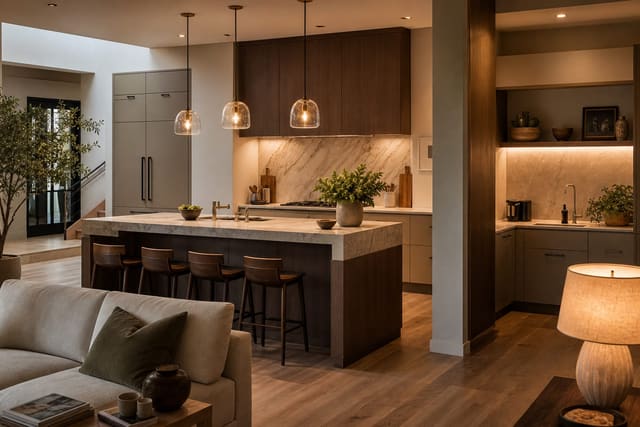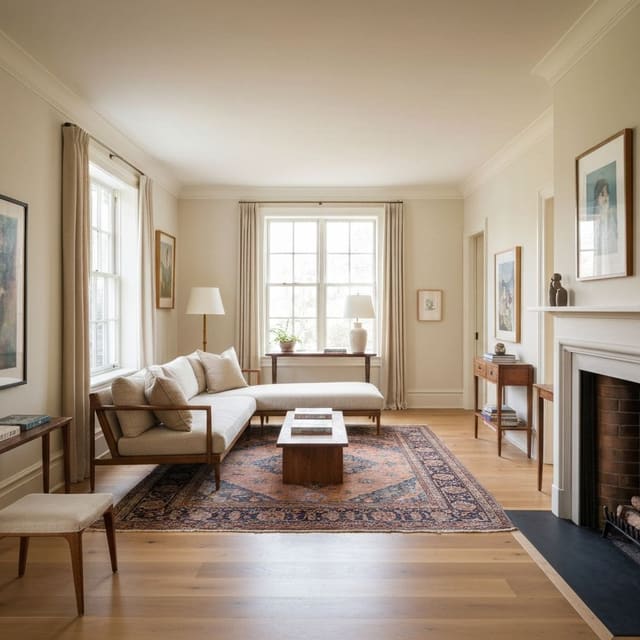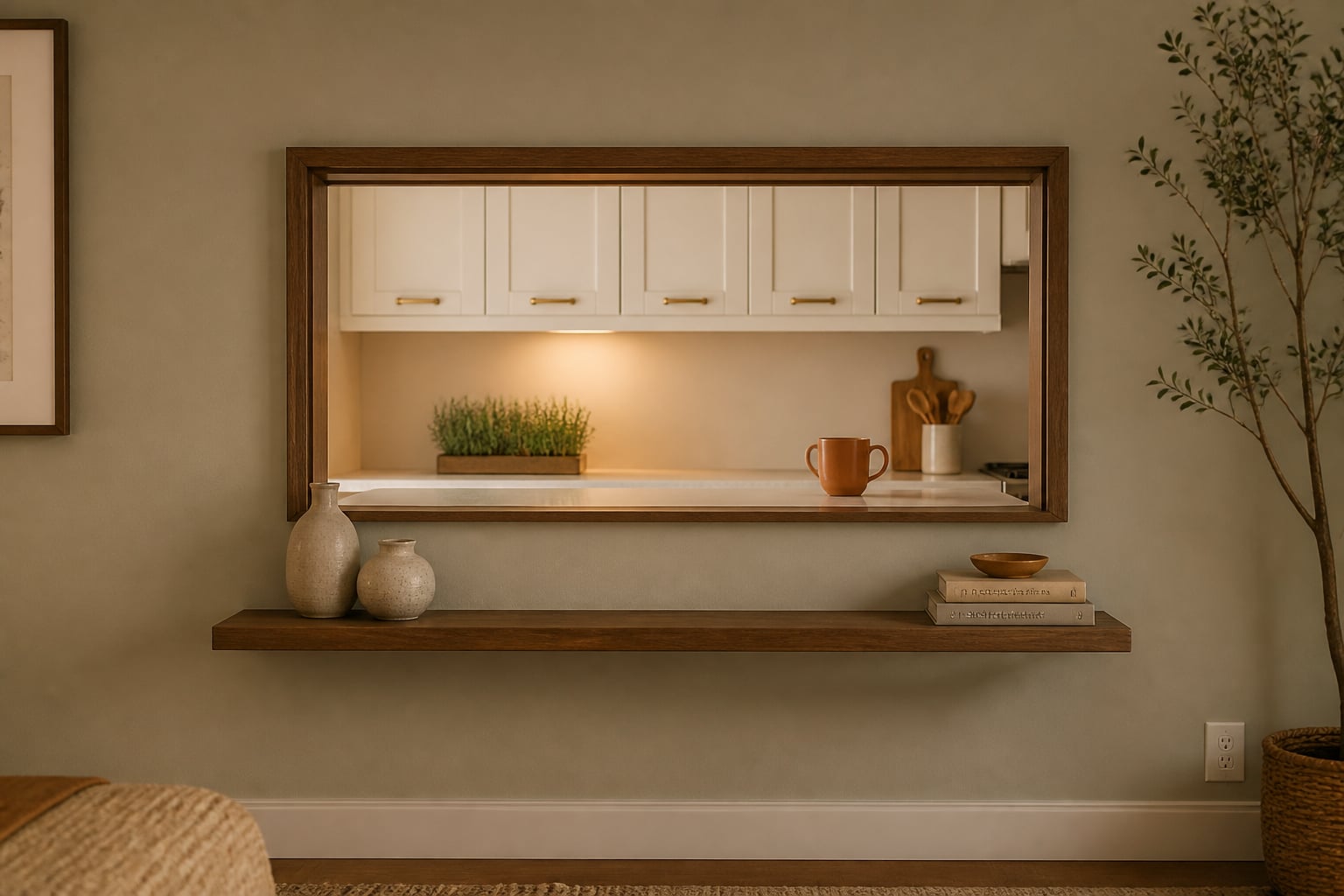
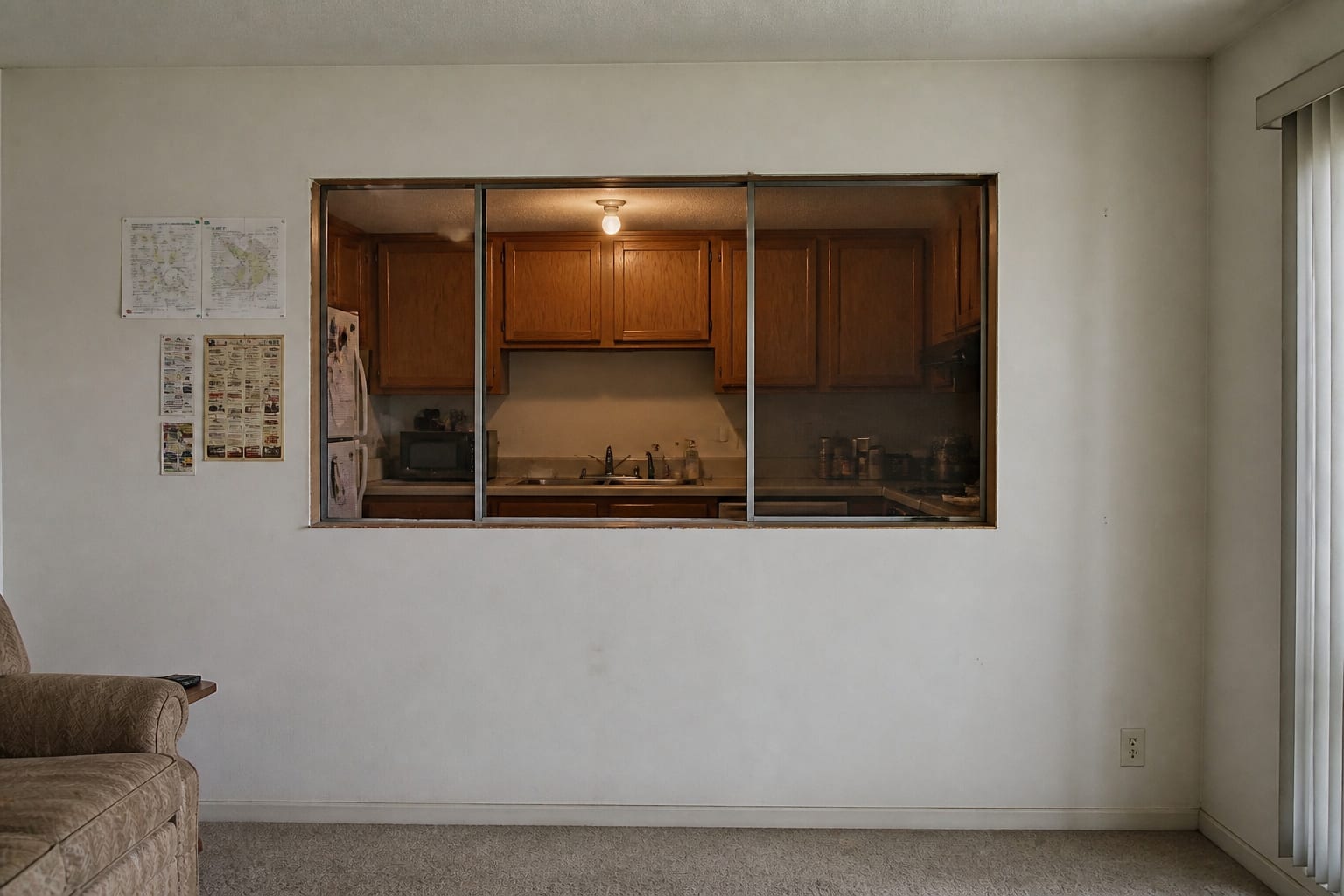
A pass-through between kitchen and living room reads intentional when the opening is 36 to 60 inches wide with a 12 to 16-inch counter bar on the living-room side, the kitchen ceiling matches the living-room ceiling line, and the kitchen finish carries over the frame in trim or paint. An unframed opening is not "open concept" — it's a construction scar unless trim, counter depth, lighting, color, and furniture placement all support it.
"A pass-through works like a frame: the trim decides whether the kitchen reads as a view or a chore."
What makes a kitchen pass-through feel intentional?
Give the opening a job — serving ledge, sightline, breakfast perch, or soft boundary — and finish it with a real frame, aligned counter, and matching lighting on both sides. A pass-through wider than 48 inches can handle a stronger casing, a ledge, or stools because it starts acting like architecture. A narrow opening under 36 inches usually works better as a framed view or decorative niche than a pretend bar.
If the opening's bottom sits around 36 inches from the floor, it aligns with standard counter height; closer to 42 inches, treat it as a bar-height ledge and pick stools accordingly. The living room side matters just as much: a sofa back, TV, or bookcase that ignores the pass-through makes it look random from where people actually sit. Use the logic from zoning an open plan without walls: repeat one material, keep a clean walking path, and let furniture backs create soft edges.
The frame decision that controls the whole opening
The frame is what separates "built-in" from "cut out." A casing between 2 1/2 and 3 1/2 inches wide usually gives the opening enough weight without looking like a doorway missing a door. Match the casing to the home, not to a trend — painted trim and a small sill for a 1920s bungalow, a clean wood or drywall wrap for a newer apartment, beadboard for a cottage kitchen. Mixing chunky rustic trim into a flat modern room makes the opening speak a different language from both sides.
Counter depth comes next:
- 4 inches: enough for a plant or a cup, not for eating.
- 6 to 8 inches: a finished edge without inviting knees into the traffic path — good for tight living rooms.
- 10 to 12 inches with 24+ inches of width per stool: needed for actual seating.
Use material to bridge the two rooms. If kitchen counters are quartz and the living room is warm oak, a thin oak ledge connects better than repeating the stone. If the kitchen already runs dark, choose a lighter ledge or casing and pair it with the same approach used to make a dark kitchen feel brighter: reflective surfaces, warm whites, less visual weight up top.
Test this on your own room photo with ReDesign — keep the doorway, walls, windows, main furniture, and fixed features visible so the preview solves the room you actually have.
How should the living room respond to the pass-through?
Treat the opening as a sightline and service point, not the main entertainment wall. If the sofa faces the TV or fireplace, let the pass-through sit beside that composition with a console, art, or lamp that balances its shape.
Protect circulation: a stool needs about 24 inches of width plus roughly 36 inches of clearance behind it if people walk that way. If that clearance isn't possible, skip permanent stools and use the ledge for serving during gatherings instead.
Counter the opening's horizontal line with art — one larger piece, a pair of vertical works, or a tall lamp, roughly two-thirds the width of the blank wall section, reads more deliberate than scattered small frames.
Lighting should serve the counter without blocking the view. Hang small pendants 30 to 36 inches above the ledge with slim shades; if that feels busy, use under-cabinet lighting in the kitchen plus a living room lamp at the same warm 2700K to 3000K range. Compare with kitchen task lighting placement before adding fixtures that cast shadows on the counter.
Keep color restrained. Painting the inside of the opening a contrast color spotlights every imperfect drywall edge — carry the wall color through instead, and save contrast for the ledge, stool finish, or pendant metal.
Common pass-through mistakes to avoid
- Forcing a bar where the room can't support it. Stools that block the route from sofa to kitchen will irritate everyone; use them only when the living room side has a real landing zone.
- Leaving the opening visually raw. Uneven paint, exposed screws, or a mismatched sill make the whole room feel unfinished — spend the budget on crisp trim, caulk, and one properly sized ledge first.
- Letting the kitchen view stay cluttered. Open shelves, cords, and sink mess become living room scenery through the opening; keep one clean backsplash plane and only one or two objects on the ledge.
- Ignoring sound and mess. A pass-through carries noise and clutter more directly than a solid wall — a deeper sill, partial screen, or plant line softens the view without pretending to offer privacy.
- Mismatching finishes between rooms. Repeat at least one finish across the boundary — black hardware, oak tone, brass light, or a stone ledge that relates to the coffee table.
Use AI design to preview your pass-through before you commit
A sketch tells you the ledge depth, but a preview shows whether the opening feels too plain, too heavy, or oddly placed from the sofa. Photograph both sides: one straight toward the kitchen from the living room, one from inside the kitchen looking out, and one wider shot showing the sofa, rug, or TV wall near the opening. Keep the counter clear enough that the tool reads the architecture, not the dishes.
Compare specific variations — a painted 3-inch casing with an 8-inch oak ledge, no stools, and warm under-cabinet lighting versus a 12-inch stone overhang with two backless stools, slim pendants, and matching black hardware. A third pass with no stools and a framed art wall can reveal whether the opening needs function or just better finishing.
Judge from the living room first: Does the pass-through align with anything, or float in the wall? Does the ledge look useful without invading the sofa path? Then test dimensions for real — tape the ledge projection on the floor, mark the casing width, and walk from sofa to kitchen carrying a plate. If the taped version feels natural, the finished pass-through will likely look intentional rather than improvised.
Frequently Asked Questions
How wide should a kitchen pass-through opening be?
Aim for 36 to 60 inches wide and 36 to 42 inches tall above the counter bar. Narrower than 36 inches reads cramped, and wider than 60 inches starts to read like a half-removed wall rather than a designed opening.
Should a pass-through have a counter bar or stay open?
A 12 to 16-inch counter bar on the living-room side adds two to three bar seats and screens the sink and prep zone from the seating area. Pure open passes work only when the kitchen sightline is already designed for display.
How do I treat the trim and finish at the pass-through?
Carry the kitchen wall color across the frame onto the living-room side for at least 6 inches, or run a clean shadow line, so the opening reads as architecture rather than a leftover cut-out.
What lighting works at a pass-through opening?
Use two small pendants over the counter bar at 2700K plus under-cabinet light on the kitchen side. Pendants centered in the opening anchor the architecture and read as a feature rather than an afterthought.
Can a pass-through work when the floor levels differ?
Yes — match the floor finish across the opening, or use a 2 to 3-inch wood threshold, and treat any step as a deliberate raised bar. Mismatched floors with no threshold read as unfinished renovation debt.
> Try this: Ready to see this on your own room? Open ReDesign and run the preview.
Three transformations to try
1. Pass-through with counter bar and two pendants 2. Open pass with trim wrap and matched floor 3. Raised bar pass at a one-step floor change