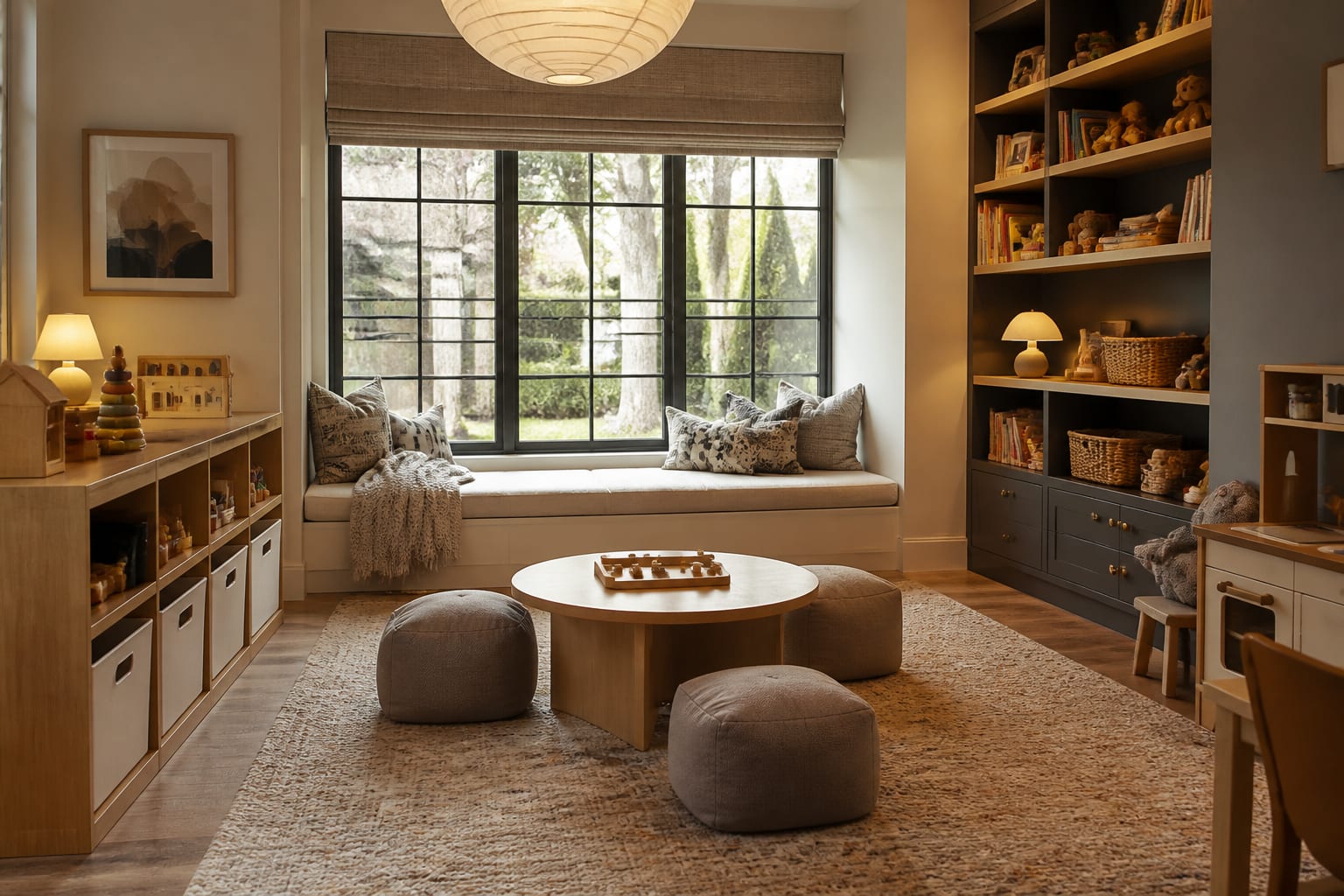
A great playroom is organized around how children actually move, not around how cute it looks in a photo. The strongest layouts split the room into an active zone for movement, a quiet zone for reading, and an art zone for messy projects, then keep storage low enough that a four-year-old can reach it without help. When bins sit at 24 to 30 inches and surfaces wipe clean, kids do the tidying and you stop fighting the room. Plan for the child you have now and the one arriving in three years.
How do you zone a playroom for different activities?
Start by walking the room and deciding where energy should be loudest. The active zone, with open floor for building and climbing, belongs near the entry so running children do not cut through quieter work. Tuck the quiet reading nook into a corner away from the door, ideally with a small armchair or floor cushion and a forward-facing book ledge at about 30 inches so covers are visible. The art zone wants a wipeable table near a window for daylight and, if possible, close to a sink or hard floor that survives spilled paint.
Keep clear pathways of at least 30 inches between zones so a kid carrying a tower of blocks does not trip over a beanbag. Use a low rug to anchor the active zone and a different texture to mark the reading corner, since children read these visual cues faster than any label. If the room is small, let one surface do double duty: an art table at 22 inches tall also works for board games and puzzles, and a bench at 18 inches stores supplies underneath while seating two.
See also our guide to Playroom To Homework Room Ideas for more on playroom ideas.
What storage actually works for young children?
The single biggest predictor of a tidy playroom is whether children can reach the storage themselves. Mount open bins and cubbies so the usable opening sits between 24 and 30 inches off the floor, which matches a preschooler's comfortable reach and removes your job as the lifting crew. Shallow open bins beat deep toy boxes because a child can see every item instead of dumping the whole container to find one car.
Label bins with pictures or photos rather than words so pre-readers can match a toy to its home. Reserve higher shelves, above 48 inches, for fragile items, board games with small pieces, and the toys you are rotating out of circulation. A few closed cabinets keep visual noise down and hide the overflow, which makes the open, reachable storage feel calm rather than overwhelming. Choose bins in a couple of consistent sizes so they stack, swap, and refill without you rebuying the whole system every birthday.
For a related angle on playroom ideas, read Living Room Without Tv Ideas.
Which surfaces and flooring survive playroom life?
Playrooms take a beating, so every surface should answer one question: can I wipe it? Use a scrubbable matte or eggshell paint rated for repeated cleaning, since flat paint absorbs crayon and never recovers. On walls within reach, a wainscot panel or a section of washable, wipe-clean wallpaper around the lower 36 inches takes the worst of the fingerprints and marker.
For flooring, soft and forgiving wins. Foam tiles or a low-pile washable rug cushions falls and muffles the thud of jumping, and interlocking foam can be pulled up and rinsed when a juice box loses. If you have hard floors underneath, a large rug at least 8 by 10 feet defines the active zone and keeps knees comfortable. Avoid high-pile shag, which swallows tiny pieces and is miserable to clean. For the art table, a sealed laminate or a peel-and-stick vinyl mat underneath catches paint and glue, and a wipeable tablecloth saves the surface itself during the messiest projects.
How do you design a playroom that grows with a child?
A playroom you redesign every two years is expensive and exhausting, so build in flexibility from the start. Adjustable shelving is the workhorse here: brackets you can raise as your child grows mean the bins that sat at 26 inches for a toddler move to 40 inches for a grade-schooler without new furniture. Pick a neutral base palette on the large surfaces and add personality through bedding, art, and bins you can cheaply swap.
Plan for changing activities, too. Toddlers need open floor and chunky toys, while older kids want a desk surface around 28 to 30 inches for crafts, homework, and building kits. A toy rotation system bridges the ages: store two-thirds of the toys out of sight and cycle them in every few weeks, which keeps the room engaging and quietly reveals which toys your child has outgrown. Modular seating, like floor cushions and a couple of stackable stools, reconfigures from a reading circle to a craft station in seconds as interests shift.
- Create three clear zones: an active floor area, a cozy reading nook, and a wipeable art station.
- Mount open bins and cubbies at 24 to 30 inches so children can reach and return toys themselves.
- Label storage with pictures instead of words so pre-readers can match each toy to its home.
- Lay foam tiles or a low-pile washable rug to cushion falls and quiet the noise of jumping.
- Use scrubbable eggshell paint and a wipe-clean lower-wall panel to defeat crayon and fingerprints.
- Set up a toy rotation system, storing two-thirds of toys and swapping them in every few weeks.
- Choose adjustable shelving so storage heights rise as your child grows over the years.
- Add a forward-facing book ledge at about 30 inches so covers are visible and inviting.
Bring the look home with Re-Design
Before you commit to bin heights or a new rug, you can re-design the whole playroom virtually first. Upload a photo of the empty or current room and preview different zone layouts, paint colors, and storage walls in seconds, so you can see whether that reading nook reads as cozy or cramped. Trying the active-zone rug and the art-table placement on screen helps you catch a blocked pathway before you buy anything. It is a fast, low-risk way to test a child-friendly plan against your real walls and windows.
Frequently Asked Questions
How high should playroom storage bins be for young kids?
Mount the usable opening of open bins and cubbies between 24 and 30 inches off the floor, which matches a preschooler's comfortable reach. At that height a child can grab a toy and put it back without an adult lifting anything, which is the single biggest factor in whether the playroom actually stays tidy.
What flooring is best for a playroom?
Soft, forgiving, and washable wins in a playroom. Interlocking foam tiles cushion falls and rinse clean, and a low-pile washable rug works over hard floors to define the active zone. Avoid high-pile shag, which swallows small pieces and is miserable to vacuum after a craft session goes sideways.
How does a toy rotation system work?
Store roughly two-thirds of the toys in closed cabinets or a closet, then cycle a fresh batch into the open bins every few weeks. The rotation keeps the playroom feeling new without buying anything, cuts visible clutter, and quietly shows you which toys your child has outgrown and can be donated.
How do you design a playroom that grows with a child?
Use adjustable shelving so bin heights rise as your child does, pick a neutral base palette, and add personality through swappable bins and art. Choose modular seating and a table around 22 to 30 inches that suits toddlers now and grade-schoolers later, so you avoid a full redo every couple of years.