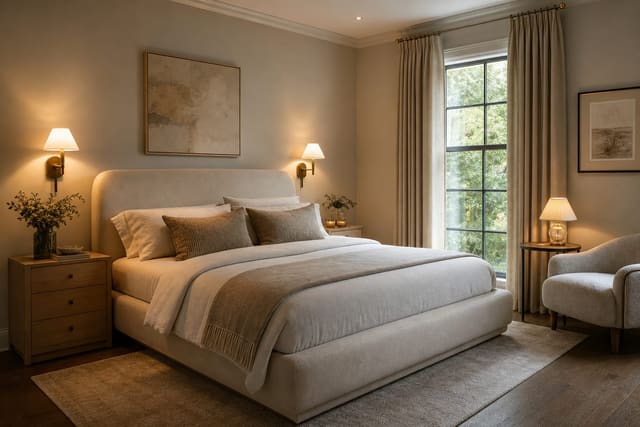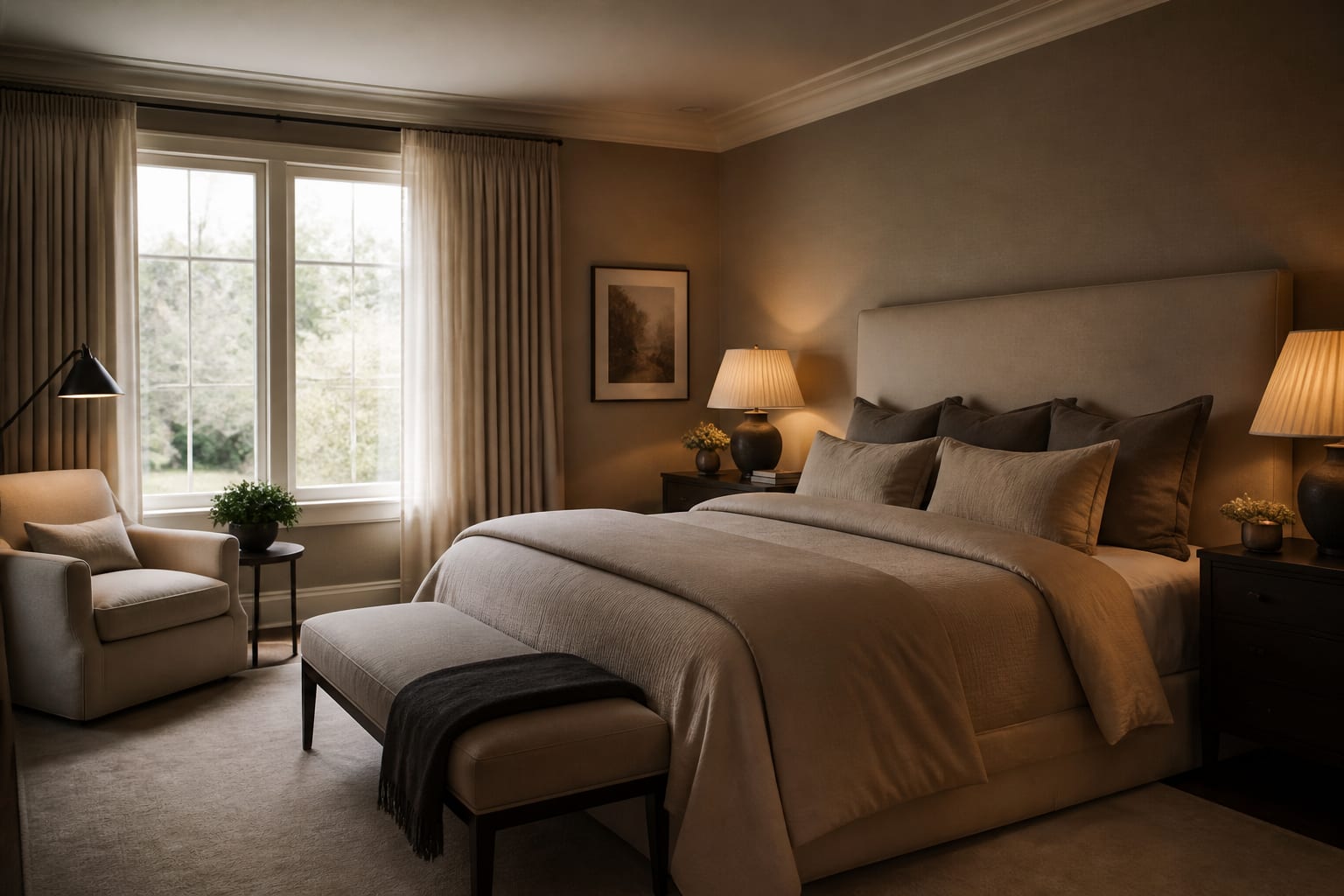
The most compelling bedrooms don't announce themselves — they simply feel right the moment you walk in. Quiet luxury in the bedroom is about editing down to what matters: a palette anchored in warm stone and ivory, textiles with genuine weight, and furniture scaled to the room rather than stuffed into it. It has nothing to do with price tags and everything to do with conviction. Resist the urge to fill every surface. The discipline of leaving space is what separates a room that looks considered from one that looks collected.
Build a Palette That Does the Work
A quiet luxury bedroom starts with color chosen by subtraction, not addition. Pick one warm neutral as your anchor — raw linen, aged plaster, or creamy ivory — and let every other tone in the room derive from it. Introduce no more than two accent tones, and make sure they share the same undertone family so the palette coheres. Cooler grays or bright whites create tension that undermines the calm you're building.
Wall color and trim color matter more than most people expect. Painting trim one shade deeper than the wall, rather than crisp white, softens the architecture and gives the room an enveloping quality that reads as considered. This single adjustment costs nothing beyond a quart of paint and changes how the whole room feels at dusk.
Apply the palette consistently through textiles, too. A duvet, throw, and curtain in the same tonal family — even if the fabrics differ — creates visual rest. Resist the impulse to add a contrasting accent pillow just to break up the monotony. Monotony, handled with texture, becomes serenity.
See also our guide to Small Master Bedroom Luxurious for more on quiet luxury bedroom ideas.
Choose Textiles With Real Weight and Texture
The hand of a textile — how it feels and drapes — is what separates a quiet luxury bedroom from a beige bedroom that happens to be tidy. Linen bedding wrinkles beautifully and signals relaxed confidence rather than striving perfection. A wool or cashmere throw folded at the foot of the bed adds warmth and a subtle signal of quality that synthetic fleece cannot replicate.
Curtains should be full and floor-length — hang the rod within 4 to 6 inches of the ceiling and let the panels puddle 1 to 2 inches on the floor. Skimpy curtains that hover above the sill make even a well-composed room look unfinished. Opt for unlined linen or interlined velvet depending on how much light control you need; both read as intentional rather than default.
Layer the bed in at least three distinct materials: a fitted sheet, a flat sheet, a duvet with a substantial insert, and a woven blanket folded neatly across the lower third. The layers give the bed visual weight and invite you to actually use them, which is the point.
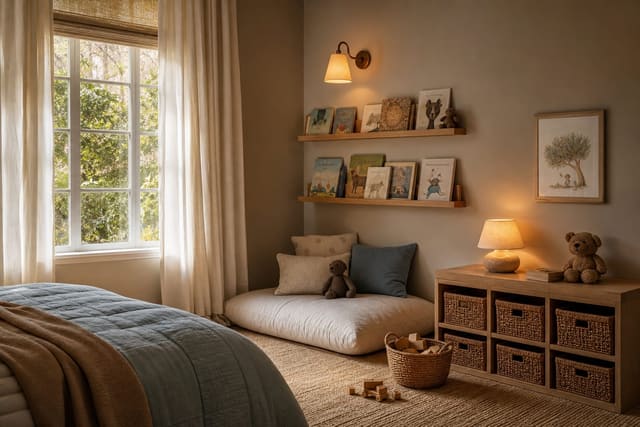
For a related angle on quiet luxury bedroom ideas, read Reading Corner Kids.
Scale Furniture to the Room, Not to a Floor Plan
Oversized upholstered beds look impressive in showrooms and suffocating in actual bedrooms. Measure your room before committing to a headboard height — in a room with 9-foot ceilings, a headboard of 48 to 56 inches reads as grounded without competing with the architecture. In rooms with ceilings under 8 feet, keep the headboard at or below 48 inches.
Nightstand proportion is equally important. The top surface should sit within 2 to 4 inches of the mattress top, and the footprint should be deep enough for a lamp base plus a small object without crowding. Floating nightstands clear floor space visually, which makes even a compact bedroom feel more open.
Leave breathing room. A quiet luxury bedroom is not sparse — it has everything it needs and nothing it doesn't. That distinction lives in the negative space between pieces. If you can't walk comfortably around the foot of the bed with at least 36 inches of clearance, the room is over-furnished and no amount of careful styling will fix it.
Lighting That Flatters the Hour
Overhead lighting is the enemy of a restful bedroom. A single ceiling fixture at full brightness flattens the room and makes every surface look utilitarian. Replace it or dim it, and build a layered lighting scheme from the floor and table up. Bedside lamps at approximately 26 to 28 inches tall from the tabletop to the bottom of the shade put light at reading height without glare.
Bulb temperature is non-negotiable in a quiet luxury bedroom. Use bulbs in the 2700K to 2900K range — warm white, not the cooler 3000K or 4000K that most hardware stores stock by default. That warmth shifts the room from clinical to inviting and flatters the neutral palette you've built.
Consider a dimmer on every switched circuit in the room. The ability to move from 10 percent to 80 percent output without changing bulbs gives you full control over the mood at any hour. The hardware cost is minimal — a standard dimmer switch runs under twenty dollars — and the effect on the ambiance of the room is outsized compared to almost any other single upgrade.
- Replace shiny hardware on dressers and nightstands with unlacquered brass or matte bronze pulls for immediate warmth.
- Add a single large-scale piece of framed art above the dresser instead of a gallery wall cluster.
- Use a linen duvet cover in undyed or stone-washed oatmeal as the visual anchor of the entire bed.
- Place a low upholstered bench at the foot of the bed to add a finished, hotel-like quality to the room.
- Decant everyday items — chargers, lip balm, books — into a shallow lacquer tray on the nightstand to contain clutter.
- Hang curtains from ceiling to floor in a solid woven fabric to add perceived height and soft architectural weight.
- Choose one sculptural bedside lamp per side rather than matching sconces for a curated, less catalog-like feel.
Bring the look home with Re-Design
Before you repaint walls or invest in new bedding, upload a photo of your current bedroom to Re-Design and preview exactly how a quiet luxury palette and textile swap will read in your specific space. The AI renders the changes in your actual room so you can compare a warm plaster tone against your existing floors, assess curtain length, and confirm headboard scale — all before spending a dollar.
Frequently Asked Questions
What colors define a quiet luxury bedroom?
Warm neutrals dominate: ivory, raw linen, aged plaster, greige, and soft taupe. The key is choosing tones with a warm undertone and keeping the palette to two or three closely related shades. Avoid cool grays or stark white, which break the enveloping quality the aesthetic depends on.
How do I add quiet luxury on a limited budget?
Focus on the highest-visibility surfaces first. Replacing a synthetic duvet cover with washed linen, swapping plastic hardware for brass or bronze, and adding floor-length curtains in a simple woven fabric will shift the room more than any furniture purchase. Restraint itself is free — clearing surfaces costs nothing.
Does quiet luxury work in a small bedroom?
It works especially well in small rooms because the aesthetic is built on restraint rather than volume. Scale furniture correctly, use a monochromatic palette to reduce visual fragmentation, and keep storage concealed. A small room edited carefully reads as intimate and considered rather than cramped.