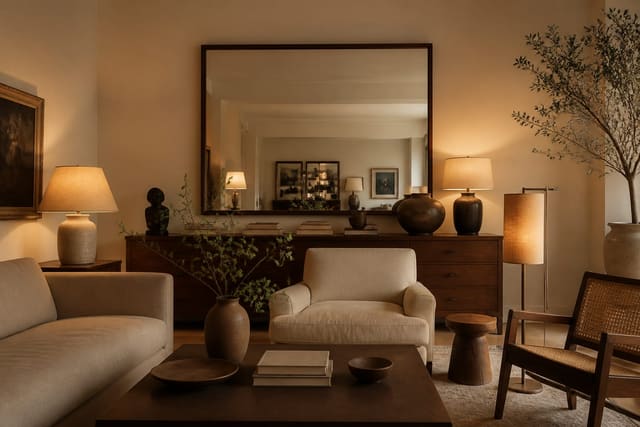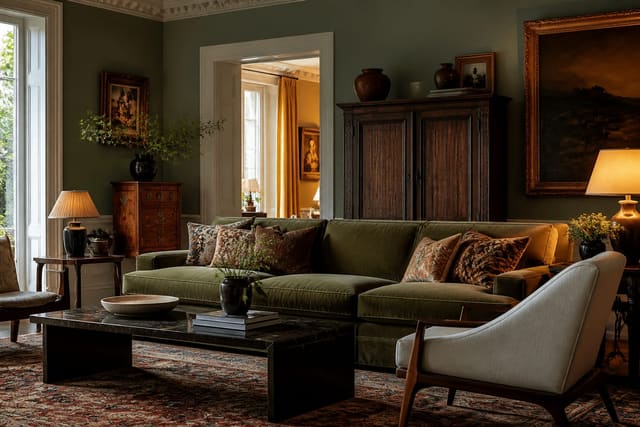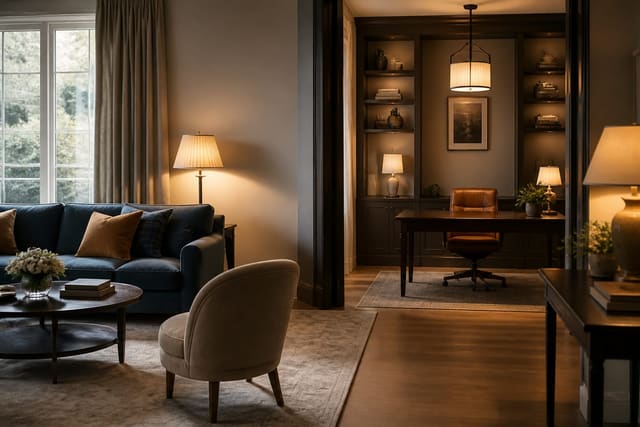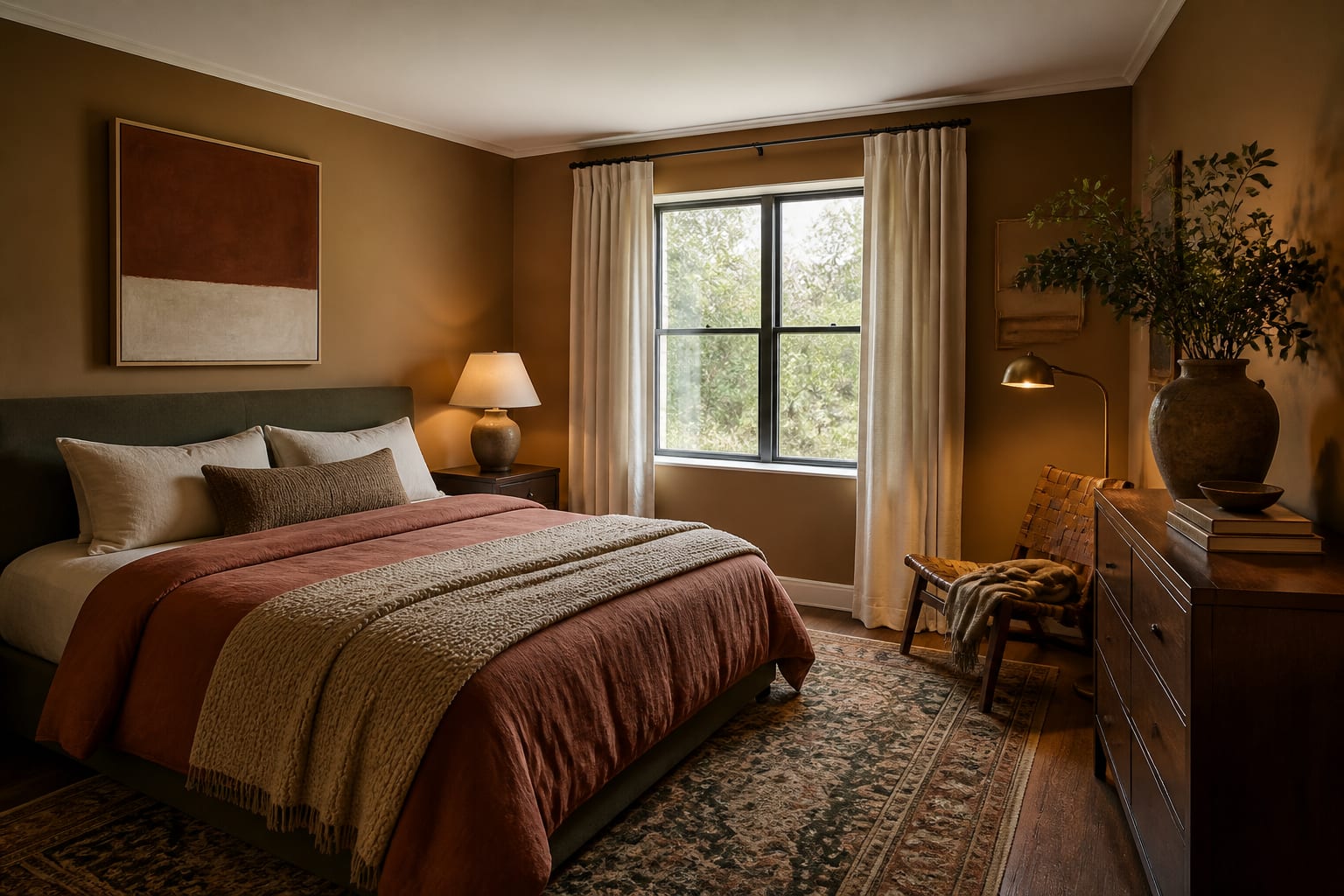
The smartest $500 room refresh ignores furniture almost entirely. A new sofa or bed swallows a tight budget in one purchase and leaves the rest of the room exactly as tired as it was. The better play is to spend on the three things the eye reads first—light, color, and one focal moment—and keep everything else you already own. Done in that order, $500 reads like a redesign rather than a few new throw pillows tossed on a dated room.
Where the $500 actually goes
The reason most budget refreshes fail is that the money goes toward one visible object instead of the whole envelope. A $400 accent chair looks great in the catalog and orphaned in a room whose walls, light, and floor never changed. Treat the $500 as four small budgets working together.
Paint comes first because it touches the most surface area per dollar. One gallon runs $40 to $60 and covers roughly 400 square feet—enough for an accent wall or a small bedroom with a second coat. Lighting comes second: a set of 2700K LED bulbs is about $4 each, and one floor or table lamp in the $40 to $80 range fixes the single-overhead-fixture problem that makes rooms feel like waiting areas. Textiles—a rug remnant, two pillow covers, a curtain panel pair—pull the palette together for around $120. The last $80 buys exactly one focal object: a framed print, a large mirror, or a single plant in a real planter.
If your room reads dark even after new bulbs, the fix is usually reflection and contrast rather than wattage. The same playbook in AI design dark room solutions applies on a budget: a $30 thrifted mirror opposite the window does more than a second lamp.
Before any of those dollars leave your wallet, spend the free hour that makes them count: edit and rearrange. Pulling furniture a few inches off the walls, clearing two-thirds of the small objects from surfaces, and floating the seating around a single center point changes a room's proportions at no cost. Most tired rooms are not under-decorated, they are over-filled, so a refresh that starts by subtracting reads more expensive than one that only adds.
Where you shop stretches the budget as much as how you split it. Secondhand and marketplace sourcing turns a $300 object into a $60 one without looking thrifted, because solid-wood dressers, real-wood frames, and lamps in good shape are abundant and cheap to find—they are simply heavy to move. Reserve the new-purchase dollars for the things that have to be new for fit or hygiene, like a rug pad, bedding, and paint, and let the structural pieces come used. A $40 thrifted side table you repaint reads identical to a $180 new one in a photo, and the $140 you save buys the focal piece outright.
A room-by-room $500 plan
The split shifts slightly depending on which room you are refreshing, but the priority order holds. Use this as a starting allocation:
- Living room: $150 paint on one accent wall, $90 on two lamps, $150 on a washable 5x7 rug, $110 on pillow covers and one large piece of art.
- Bedroom: $120 paint, $80 lamp pair for the nightstands, $200 on a duvet cover and shams, $100 on a headboard you build from a painted plywood panel.
- Home office: $100 paint, $120 task lamp and warm bulbs, $80 on a pegboard and organizers, $200 on a secondhand chair upgrade.
- Dining room: $150 paint, $130 on a single statement pendant, $120 on seat cushions, $100 on a runner and centerpiece.
Mixing inherited and new pieces is where budgets either look intentional or look accidental. The rules in how to mix design styles keep a thrifted dresser and a new lamp reading as one room. If the space has to do two jobs at once, borrow the zoning tricks from dual-purpose room ideas so the refresh does not fight the function.
Two rules hold across every room on that list. First, the rug is the one decorative item worth a real line item, because a too-small rug is the fastest way to make a budget room read cheap; size up until the front legs of the seating rest on it rather than floating in the middle. Second, buy the focal object last, after the paint is dry and the lamps are in, so you choose it to fill the gap the room actually has instead of guessing at the start. Following that order keeps the $80 focal spend from becoming another near-miss purchase pushed into a closet.
If the room genuinely has to flex—a guest room that is also an office, or a living room that hosts dinners—decide its primary job before allocating, because $500 cannot fund two complete setups. Pick the daily use, fund that fully, and let the secondary function borrow with a folding chair or a closed storage piece rather than its own furniture line. A budget that tries to finish two rooms at once finishes neither, and the room ends up reading like a compromise instead of a refresh.
Common mistakes to avoid
The most expensive mistake on a small budget is buying furniture first. A single $300 to $500 piece consumes the whole budget and locks the room's palette before you have tested it, so plan paint and light before any purchase.
The second mistake is spreading the money too thin—buying ten $20 trinkets that read as clutter instead of one $80 object that reads as a focal point. The third is ignoring the bulbs entirely; a 5000K daylight bulb makes even a freshly painted room feel clinical, and the fix costs $4. The fourth is skipping the free step of decluttering and rearranging, which changes how large the room feels before you spend a cent.
Preview your $500 redesign in Re-Design
Frequently Asked Questions
Can you really redesign a room for $500? Yes, if you spend on surfaces and light rather than furniture. Paint, warm bulbs, one lamp, textiles, and a single focal object change the three things the eye reads first. A new sofa cannot, because it leaves the walls, floor, and lighting untouched.
What should I buy first with a $500 room budget? Paint and bulbs. Paint touches the most square footage per dollar at $40 to $60 a gallon, and warm 2700K bulbs at about $4 each reset the entire mood of the room. Both are reversible and low risk.
Is it cheaper to paint a room myself? Almost always. Doing it yourself keeps a small room under $60 in materials, while hiring out a single room typically starts around $300 to $500 in labor—more than the entire refresh budget. Rent or borrow tools rather than buying them.