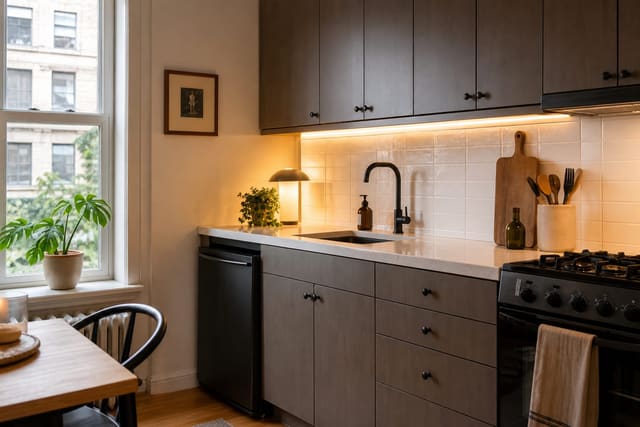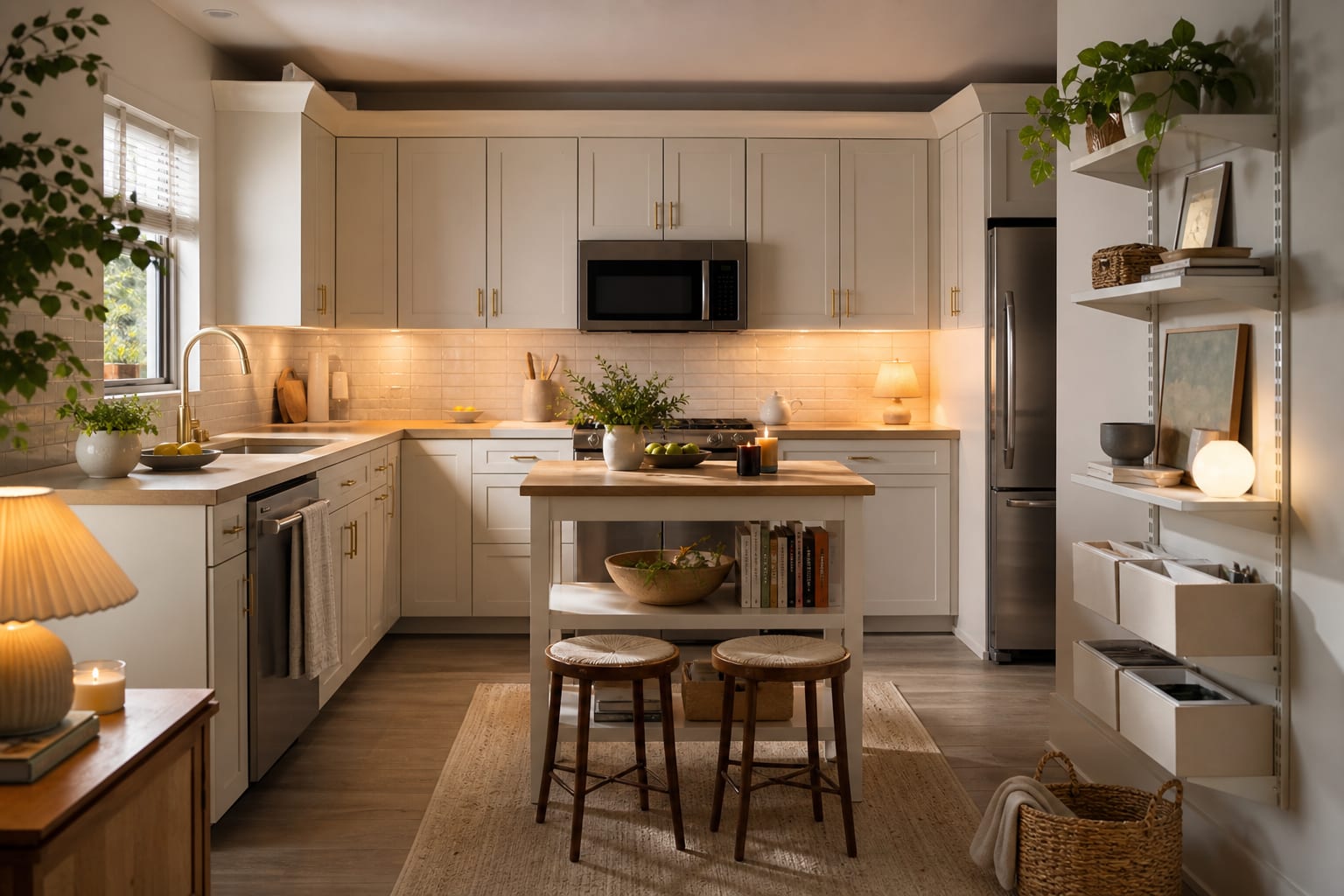
A rental kitchen updates without damage when you swap the hardware (bag the originals), add a peel-stick backsplash above the counter only, cover cabinet fronts in removable contact paper or cabinet wrap, and line drawers with adhesive shelf liner — every move reversible in under an hour at move-out. Skip the six-accessory approach and fix one loud surface instead of distracting from it.
How do you update a rental kitchen without permanent changes?
Work in layers: the wall behind the counter, counter clutter, cabinet pulls, task light, and the floor underfoot. None of these needs demolition. Start with whatever bothers you most in the first 10 seconds — a bad backsplash, dim light, or boring cabinets — and fix that one thing before buying decorative extras.
A renter-friendly update should pass three tests: it uses adhesive, tension, magnets, freestanding furniture, or existing screw holes; it comes off with heat, patience, and a plastic scraper; and it looks good from the doorway, not just in a close-up photo.
Keep the palette tight — one calm neutral surface plus one warm accent is usually enough. White removable tile with black hardware works; white tile, brass handles, blue art, floor stickers, open shelves, and five wood tones looks frantic.
Which temporary kitchen upgrades are worth doing first?
Prioritize light first, backsplash second, hardware third, then decorative storage.
- Add plug-in or rechargeable under-cabinet lights anywhere you chop, rinse, or brew coffee. Mount bars 18"–24" above the counter in 2700K–3000K to avoid a harsh blue-white cast on laminate. See task lighting placement in kitchens for exact positioning.
- Swap cabinet pulls if the existing ones are ugly or grimy. Measure center-to-center (usually 3", 3 3/4", or 5") and buy the same size so you reuse the existing holes. Bag every original pull and screw the day you remove them.
- Add a runner if the floor is the problem but a full removable-tile budget isn't there. Choose low-pile and washable, keep 2" of floor visible along cabinet bases, and skip thick jute near the sink. In a galley kitchen, stop the runner 6"–12" short of the toe-kick.
- Address overall darkness, not just the cabinets. Dark counters, heavy window coverings, and one ceiling bulb can dim even white cabinets — the same fixes used to make a dark kitchen feel bright apply here.
Test these updates on your own room photo with Re-Design — keep the doorway, walls, windows, and fixed features visible so the preview solves the kitchen you actually have.
How do you make removable surfaces look less fake?
Removable surfaces look fake when they ignore the kitchen's real edges. Cut, align, and stop them where a permanent installation would.
- Backsplash: Choose small-scale tile prints or a grout line no wider than 1/16" in tight kitchens — oversized marble veining reads as plastic. Clean the wall with degreaser, let it dry fully, and test one hidden square for 24 hours before committing.
- Stopping points: End the backsplash at the underside of upper cabinets, the counter's outside edge, or a vertical trim line. Wrapping tile around a random corner looks like a craft project. Compare products in the honest peel-and-stick backsplash review before ordering.
- Counter contact paper: Riskier than backsplash since counters take heat, water, and knives. Limit it to a low-abuse zone like a coffee station, leave a 1/8" relaxation gap at turned edges, and never set a hot pan on it.
- Open storage: A freestanding 30"–36" metal baker's rack adds shelf space without touching walls. Keep the top shelf below eye level so a busy kitchen doesn't feel more crowded.
Common rental kitchen mistakes to avoid
| Mistake | Why it backfires | Fix instead |
|---|---|---|
| Drilling new holes or caulking peel-and-stick tile | Turns a reversible update into a repair | Use existing holes, adhesive, magnets, or freestanding pieces |
| Buying the loudest pattern | Fights outlets, seams, and appliance gaps already in the room | Pick a calm backsplash, plain runner, one metal finish |
| Ignoring hardware scale | Tiny knobs on wide doors, or oversized handles on narrow ones, look wrong | Use 4"–6" pulls on base cabinets, 8"–12" on wide drawers |
| Covering every surface at once | Kitchen starts to feel like a sample board | Fix one major surface and let the rest support it |
| Skipping the exit plan | Move-out becomes a scramble | Keep original hardware, photos, and adhesive labels together |
At move-out, a hair dryer, plastic scraper, microfiber cloth, and citrus-based adhesive remover are safer than metal blades or harsh solvents.
Use AI to preview your rental kitchen before you stick anything down
AI previews are useful here because the wrong temporary product still wastes a weekend. Upload a straight-on daylight photo with the ceiling light on, showing the full cabinet run and any appliances that must stay visible. Then test one change at a time — backsplash only, runner only, hardware only, lighting warmth only.
Compare restrained options: a white subway-style backsplash, a warm zellige look, or no backsplash with better lighting and hardware. The winning version usually makes the cabinets look less offensive without turning the kitchen into a theme. Translate the chosen preview into real specs — hardware weight, bulb temperature, runner width, backsplash stopping point — before you shop.
Frequently Asked Questions
Can renters change kitchen cabinet hardware?
Yes. Unscrew the originals, store them in a labeled zip-bag taped inside one cabinet, and install new pulls on the existing screw holes. You can reverse the swap at move-out in under an hour with the saved hardware.
What rental kitchen upgrade has the biggest visual impact?
A peel-stick backsplash above the counter, combined with new pulls and a warm 2700K bulb swap overhead, transforms the kitchen in one weekend without touching cabinets or paint.
Can I paint rental kitchen cabinets?
Rarely worth it. The labor and risk outweigh the reward since even a good paint job means a full strip and repaint at move-out. Use removable cabinet wraps or contact paper instead.
What rental kitchen swap is most often regretted?
Cabinet wraps over dark, glossy, or laminate fronts often peel at the edges within six months of kitchen humidity. Test one cabinet first and budget time for a full strip if it lifts.
How do I make a rental kitchen photograph well?
Clear the counters to three items, swap the overhead bulb for 2700K, display a wood cutting board, and hang one small framed piece on a wall hook. The kitchen will photograph as intentionally designed.
> Try this: Ready to see this on your own room? Open Re-Design and run the preview.
Three transformations to try
1. Swap hardware plus peel-stick backsplash over counter 2. Contact-paper cabinet fronts with warm bulb swap 3. Three-item counter with cutting board and framed art