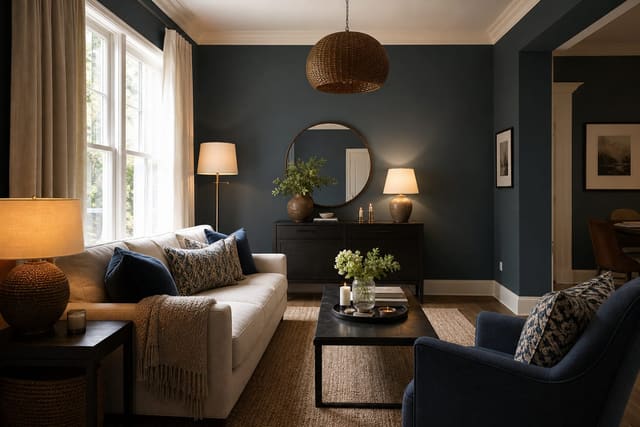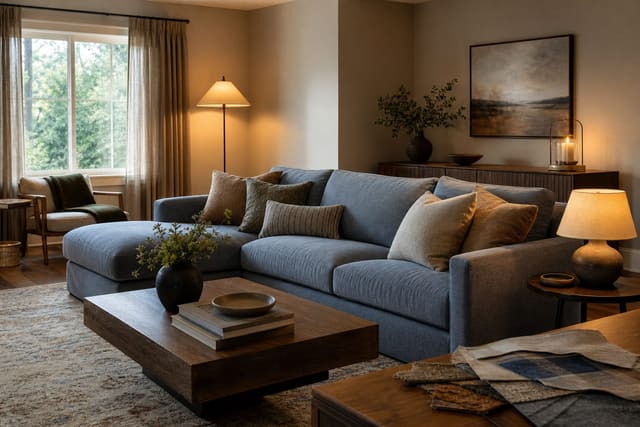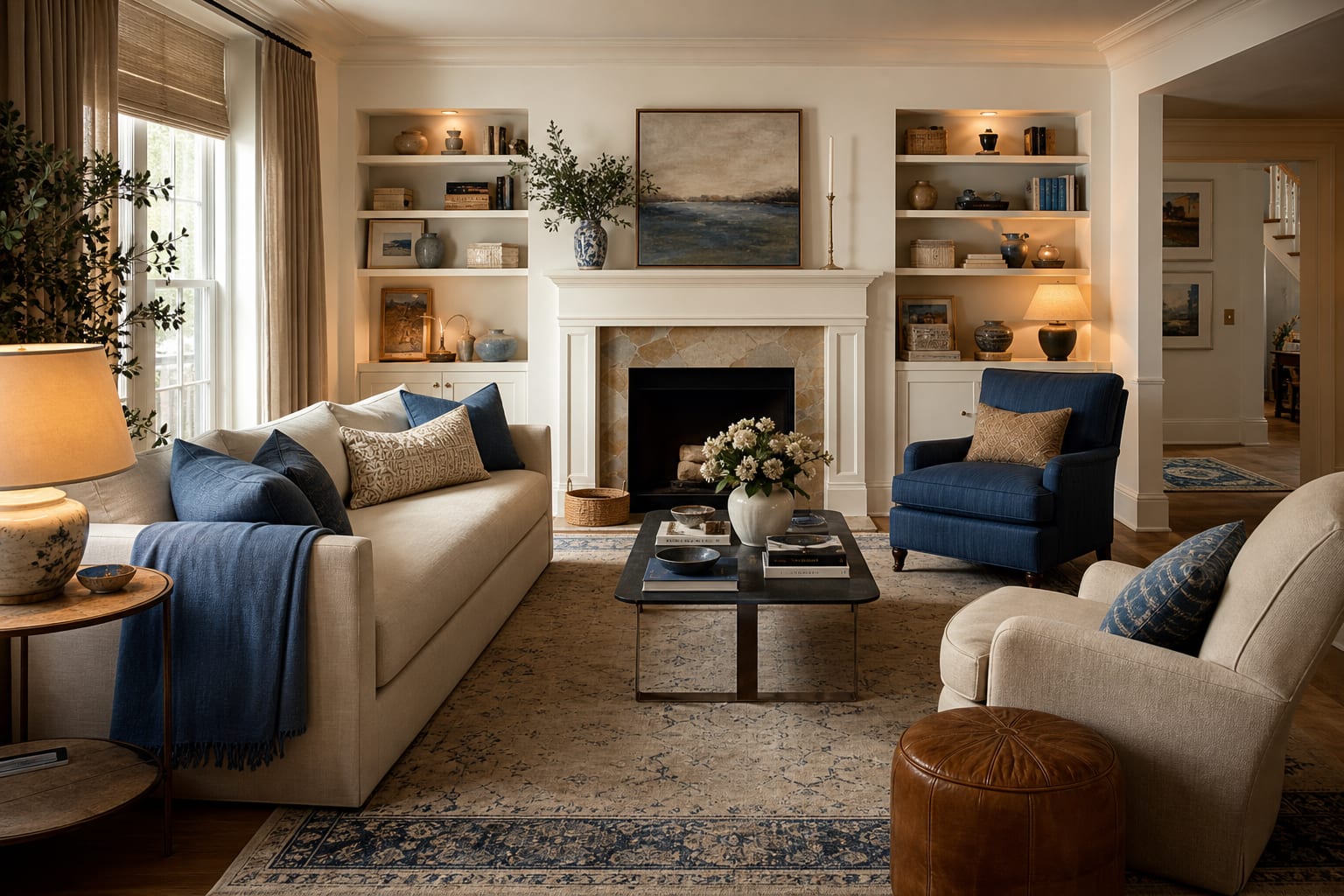
A room with too many colors harmonizes when you pick one dominant color (60%), one secondary (30%), and one accent (10%), then edit out anything outside that trio by repainting, recovering, or removing pieces that fight it. Most clashing rooms aren't too bold — they're unedited. Deciding which colors speak, which whisper, and which leave fixes the room without a single paint sample.
What actually fixes a room with too many colors?
Name the color that already covers the most visual territory — often the sofa, rug, or flooring, not the wall — and give it roughly 60% of the room's weight. Choose one secondary color for about 30% and one sharper accent for 10%. The hierarchy matters more than exact math: one lead, one supporting actor, one line-stealer.
Repetition is the easiest no-paint move. A lone rust pillow looks accidental; rust repeated in a book spine, a print, and a bowl looks chosen. Repeating an accent three times at three different heights usually makes a room feel connected instead of chaotic.
Then find the outliers — a lime throw, a burgundy lampshade, a purple vase, an orange bin can't all be special. Move the oddest pieces to another room or group them so they read as a collection, not noise. If the room is also dim, poor lighting muddies every hue and makes color conflict worse; see creating fake natural light in any room to make your existing palette easier to read.
Which colors should stay, and which should disappear?
Keep the colors that are hardest or most expensive to change: flooring, large rugs, sectionals, tile, and built-ins should lead the palette. An orange oak floor won't disappear under a cool gray scheme — pair it with warm cream, camel, olive, black, or muted blue instead.
Sort every visible color into three piles:
- Anchors — big fixed surfaces you can't easily change.
- Repeats — colors you can echo in textiles, art, and small decor.
- Offenders — colors appearing once that don't flatter the anchors.
Aim for 5-7 visible color families in an eclectic room, 3-5 in a calmer one. Count wood tone, metal finish, black, and white as colors — they affect the eye even when they feel neutral.
Use neutrals as bridges, not filler. A beige pillow with a thin red-and-blue stripe does more to unite a red rug and blue chairs than a plain white one. Watch undertones: bright white beside ivory makes the ivory look dirty, and blue-gray beside yellow-beige can clash. Test any new neutral in the room across morning, afternoon, and evening light. Stick to 2700K-3000K bulbs at 90+ CRI in living spaces so colors don't flatten, and use mirrors to amplify light only when they reflect a window or pale surface, not clutter.
Test this on your own room photo with ReDesign — keep the doorway, walls, windows, and main furniture visible so the preview solves the room you actually have.
Common color mistakes that make a room feel louder
- One new color, no repetition. A single teal chair reads as an accident; repeat teal in art or a pillow within 6-10 feet so it has company.
- Every surface treated as display. Leave 20-30% of visible surfaces quieter than you think — empty space lets intentional color register.
- Mixing clean and muddy tones. A crisp red beside dusty mauve and sage looks harsher than either alone; sharpen the whole palette or mute the bright item with earthier neighbors.
- Ignoring metals and wood as colors. Brass, chrome, black frames, walnut, and pine already add six ingredients before pillows arrive. Limit metals to 1-2 finishes, repeated at least twice.
- Over-matching. Three blues can coexist if they share similar grayness or temperature — aim for family resemblance, not an exact match.
How does AI design help before you buy anything?
Color is hard to judge in your head because every piece shifts once it sits beside the others. An AI preview lets you upload a photo of your actual room and test a stricter palette before moving furniture or ordering returns — the goal is seeing which hierarchy survives contact with your real sofa, rug, and clutter.
Shoot the photo in daylight, room tidy, standing back far enough to show the floor, ceiling line, and at least two walls. If the room has many openings, color may be leaking in from adjacent spaces — the same logic used for rooms with too many doorways applies since sightlines carry color between zones.
Run a few focused versions instead of a total makeover: one with warm neutrals and black accents, one with the rug as color boss, one repeating the sofa color through textiles and art. Keep architecture and major furniture consistent so you're judging the palette, not a dream sofa outside the budget. If a preview only works because every major piece changed, it's a renovation in disguise, not a fix — look for the lowest-commitment version: new pillow covers, one lampshade, edited shelf objects, or art repeating two existing colors.
What should you change first if repainting is off the table?
- Textiles. Curtains should either match the wall for quiet or repeat an anchor color for rhythm. Hang panels 6-8 inches above the casing and let them finish about 1/2 inch above the floor.
- Rug-to-sofa relationship. If both are colorful, one should lead and the other calm down. A busy rug (4+ colors) wants solid pillows and art repeating only 1-2 rug colors; a plain sofa can handle more pattern if scales vary and colors repeat.
- Walls last. Keep frames consistent within a zone — all black, all warm wood, or a deliberate two-finish mix — with 2-4 inches between frames in a grouping. If one artwork holds nearly every room color, give it the central spot and let smaller pieces support it.
Finish by checking the room from the doorway, not your favorite chair — that's where color chaos announces itself. If your eye jumps to five unrelated objects in three seconds, remove two, repeat one color, and add a quiet texture like linen, wool, jute, or unfinished wood. Harmony isn't the absence of color; it's every color having a job.
Frequently Asked Questions
What is the 60-30-10 rule?
The 60-30-10 rule splits room color into three tiers: 60% dominant (walls, large furniture), 30% secondary (rugs, accent furniture), and 10% accent (pillows, art, small decor). Rooms that respect this ratio read calm and intentional instead of cluttered.
How do I pick which color stays and which goes?
The most expensive, hardest-to-change piece — a sofa, large rug, or built-in cabinetry — usually wins and becomes dominant or secondary. Edit everything else to support it; reversing this order means repainting walls more than once.
Can I keep more than three colors in a room?
Yes. Add an undertone family, like a warm metallic or a deep neutral, that ties bright accents together. Well-done four-color rooms feel layered; poorly edited five-color rooms feel chaotic.
Should I repaint or just edit accessories?
Try accessories first. Pulling 30% of soft goods and swapping in one harmonized set often fixes the chaos without repainting. Repaint only after that edit fails to calm the room.
Can AI preview the harmonized result?
Yes. Upload a room photo and an AI tool previews the 60-30-10 palette by removing or recoloring pieces before you commit to any real-world change.
> Try this: Ready to see this on your own room? Open ReDesign and run the preview.
Three transformations to try
1. 60-30-10 harmonized neutral room 2. Edited soft goods to two-color palette 3. Dominant + secondary + accent layered room