A Scandinavian home office works because it removes every element that competes for your attention and keeps only what earns its place on the desk. The aesthetic is not minimalism for its own sake — it is a deliberate framework that reduces visual noise so cognitive energy stays on the work.
The following ideas are drawn from that logic: each one solves a specific focus or comfort problem rather than existing purely for looks. From desk orientation and task lighting to textile warmth and storage discipline, these are the moves that make a Scandinavian home office genuinely productive rather than just photogenic.
A Light, Airy Palette That Keeps the Mind Clear
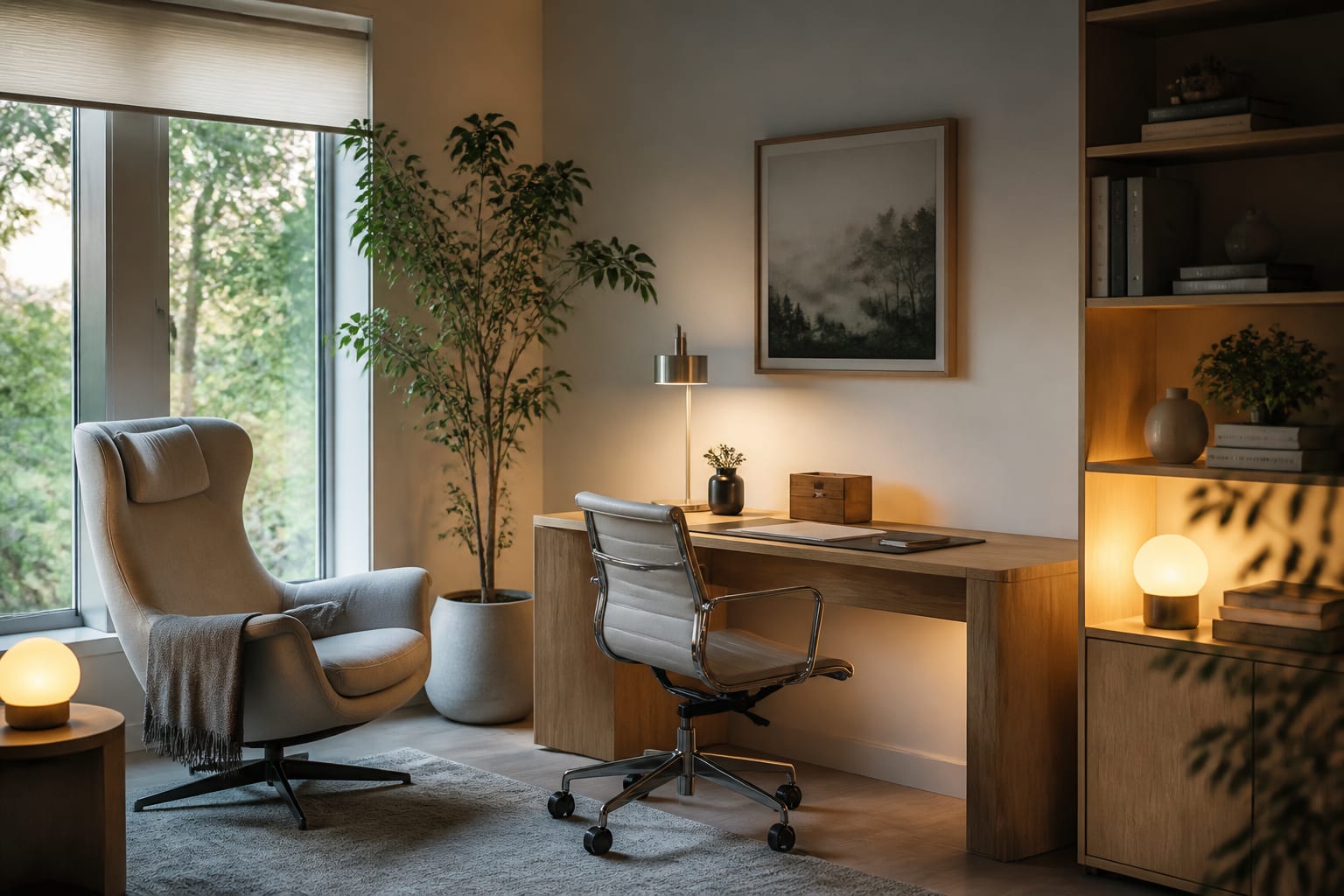
The color scheme in a Scandinavian home office does most of the cognitive work before you sit down. Warm white walls with a light reflectance value above 85 maximize the available daylight without the clinical edge of a true cool-white. Pairing that base with a birch or white-ash desk surface keeps the horizontal plane bright, which reduces the visual fatigue that accumulates over a full workday. A single muted accent — dusty sage, pale slate blue, or warm linen — introduced through a chair cushion or a framed print gives the eye a quiet resting point without pulling attention away from the screen.
Avoid pushing the accent beyond one item. When two or three competing colors appear in a small workspace, the brain registers each one as a low-level distraction and spends micro-moments resolving them throughout the day. A restricted palette sidesteps this entirely. In rooms under 100 square feet, keeping the desk, shelving, and walls within the same tonal family — warm white to light grey — makes the space feel meaningfully larger and calmer at the same time.
The ceiling is often neglected in home-office planning. Painting it the same warm white as the walls removes a hard horizontal boundary and makes a low ceiling feel less oppressive during long seated sessions.
See also our guide to Cottagecore Home Office Ideas for more on scandinavian home office ideas.
Natural Wood and Ergonomic Desk Choices
The desk is the most load-bearing decision in a Scandinavian home office, both functionally and visually. A solid birch or white-oiled ash top at 60 to 72 inches wide provides enough working surface for a monitor, a keyboard, and open notebook space without crowding. Solid wood at 1.5 inches thick sits sturdily on trestle legs or hairpin legs at standard 28 to 30 inch height and requires no additional bracing, keeping the under-desk space open and uncluttered.
Paired with a height-adjustable base, a natural wood top lets you alternate between sitting and standing without replacing the desk entirely. The adjustment range matters: frames that move between 24 and 50 inches accommodate the full range of working postures for most adults. If budget is the constraint, a fixed-height birch or ash top on simple steel trestle legs at 28 inches paired with a good chair costs a fraction of a motorized unit and still delivers the aesthetic.
Chair selection in a Nordic-style office leans toward upholstered frames in warm grey, oatmeal boucle, or undyed wool rather than the hard-plastic task chairs that dominate conventional offices. These materials read as residential furniture from across the room, which matters in multifunctional spaces where the office must disappear visually when the workday ends.
For a related angle on scandinavian home office ideas, read Industrial Home Office Ideas.
Cable and Clutter Management for a Calm Workspace
Visible cables are the fastest way to undercut a Scandinavian workspace. A cable management tray mounted directly beneath the desk surface collects power strips, adapters, and cord slack out of the sightline entirely. At roughly 18 inches long and 4 inches wide, a powder-coated steel tray holds the full cable load for a dual-monitor setup and a laptop charger without becoming visible from a standing position. Routing each cable up through a single grommet hole at the rear of the desk keeps the surface clean from the front and sides.
Storage discipline is equally important. Open shelving looks appealing in room photographs but imposes a daily organizational tax — every visible item on a shelf registers as a low-grade decision or reminder. Closed cabinetry for at least 80 percent of supplies removes that background noise completely. One open shelf reserved for three to five intentional objects — a small plant, a single book, a ceramic mug — delivers the warmth of display without the chaos of an overfull bookcase.
For shared or multifunctional rooms, a wall-mounted fold-down desk with an integrated cable shelf solves the transition between working and living modes. When the surface folds up, the room reclaims its living-room identity without a visible trace of the office.
Layering Hygge Texture and Greenery
A Scandinavian home office earns its warmth through specific material choices rather than color. A flat-weave wool rug in warm grey or natural undyed tones placed beneath the desk chair defines the work zone visually and absorbs sound that would otherwise bounce between hard surfaces. Even a modest 4-by-6-foot rug reduces the acoustic harshness of a room with wood floors and hard walls, which translates directly to better concentration over a full day.
Textiles on the chair matter as much as the rug. A lightweight merino or wool-blend throw folded over the chair back introduces tactile warmth and a sense of considered comfort. This is the core of the hygge principle as it applies to workspaces: the feeling that someone thought carefully about how the room would feel at 4 p.m. in January, not just how it would photograph at noon in summer.
Greenery adds the final layer. A single low-maintenance plant — a snake plant in a matte ceramic pot, a small rubber plant, or a compact fiddle-leaf fig — brings an organic element that softens the right angles of desk and shelving without demanding attention. Place it at desk height or just below for the greatest visual impact, where it sits within the natural sightline rather than high on a shelf where it reads as decoration rather than presence.
- Mount a pegboard in birch or white above your desk to keep tools visible and surfaces clear at the same time.
- Use a single low-profile potted plant — a snake plant or small fiddle-leaf — to add life without visual noise.
- Choose a wall-mounted fold-down desk to reclaim the room when the workday ends in spaces under 100 square feet.
- Install a warm-white LED task lamp with an adjustable arm so light follows the work rather than flooding the room.
- Select a desk chair in light grey or oatmeal boucle that reads as furniture, not office equipment, when not in use.
- Run cable trays under the desk surface to eliminate floor-level cord clutter that breaks the clean aesthetic.
- Hang one piece of framed art or a simple typographic print to give the eye a resting point without adding clutter.
Bring the look home with Re-Design
Re-Design makes it easy to upload a photo of your current home office and preview a full Scandinavian overhaul using AI before moving a single piece of furniture. Test desk placements, wall colors, and lighting arrangements in seconds and see exactly how the finished space will look and feel. It is the fastest way to commit to a redesign with confidence.
Frequently Asked Questions
What colors define a Scandinavian home office palette?
The core palette is white or off-white walls, light birch or ash wood surfaces, and soft neutrals like warm grey, sage, or dusty blue as single accent colors. Black is used sparingly for contrast — think a lamp base or picture frame — rather than as a dominant tone.
How do I make a Scandinavian home office feel warm rather than cold?
Warmth comes from layered textiles and organic materials rather than color saturation. A wool throw over the chair, a flat-weave rug, and a solid wood desktop introduce tactile warmth that keeps the space from feeling sterile. Bulbs in the 2700K range do the rest.
Can Scandinavian home office ideas work in a shared or multifunctional room?
Yes — the fold-down desk and closed-storage principles are specifically designed for rooms that serve more than one function. A wall-mounted desk with a concealed cable shelf and a fold-away chair means the office disappears completely when you need the room for something else.