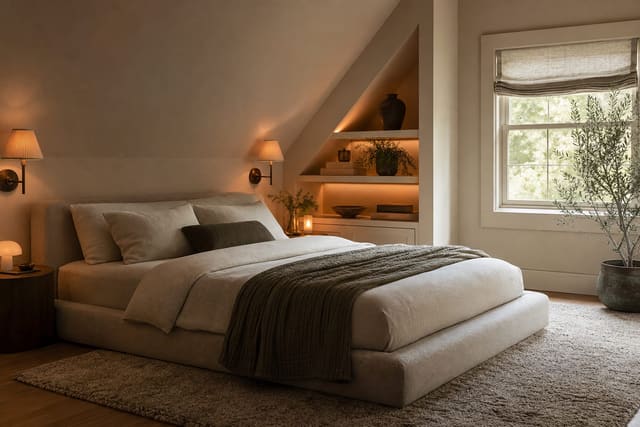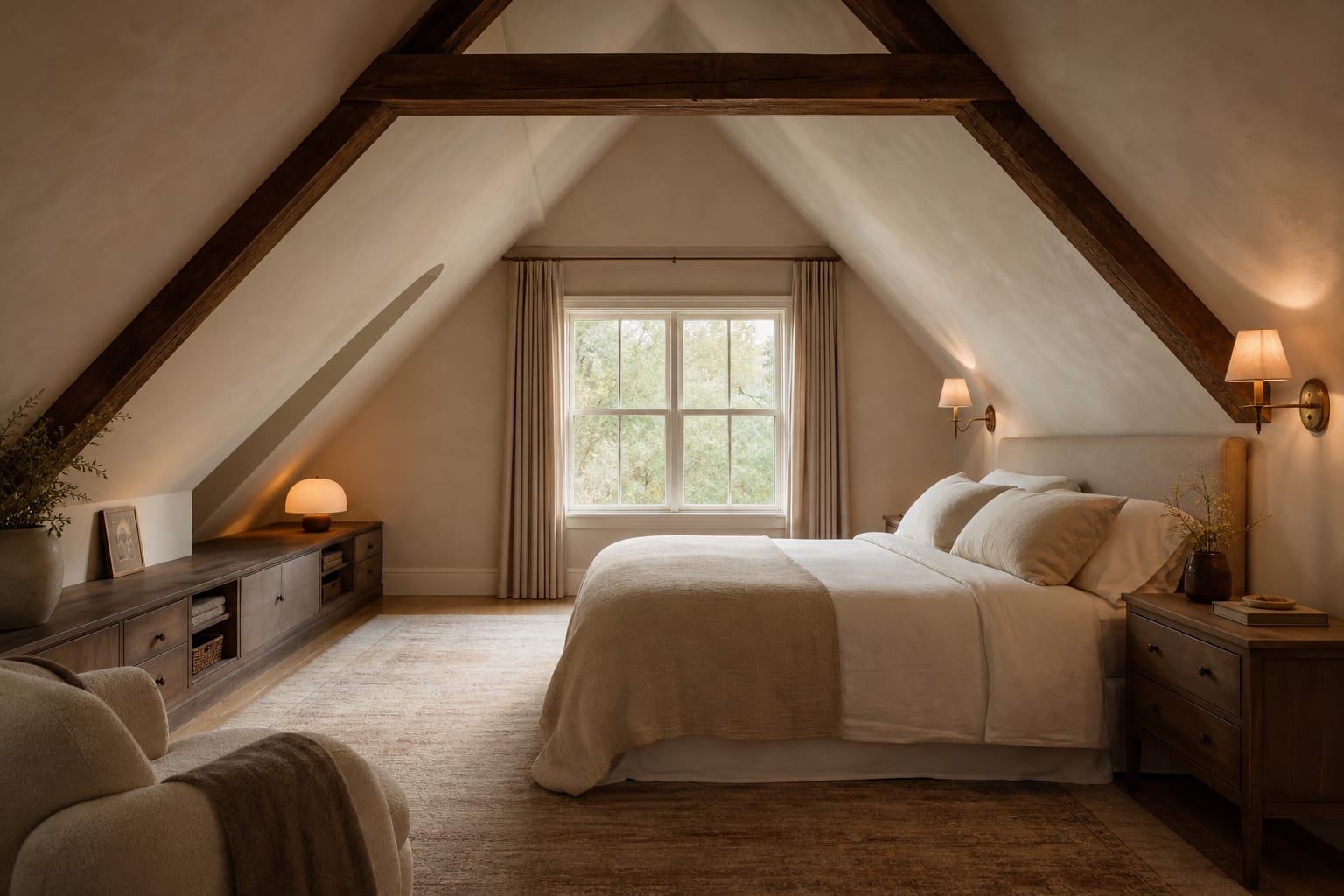
A sloped ceiling bedroom works best when the bed sits where sitting up is comfortable, tall furniture goes on the highest wall, and the low eaves become storage or seating instead of dead space. Layout, not decor, decides whether the room feels cozy or cramped. Get the placement right first, then let color and lighting reinforce it.
How do you design a bedroom with a sloped ceiling?
Start with the height you actually use. Beside the bed you need roughly 36–42 inches of clearance above the mattress at the pillow end, more if you read in bed. Along the main walking path, aim for 30–36 inches of clear width and the tallest ceiling available; reserve any full-height wall for the wardrobe, dresser, mirror, or doorway swing rather than a low headboard.
Treat the lowest wall as useful, not precious. A knee wall 30–48 inches high suits drawers, a bench, a low bookcase, or a built-in ledge. Anything below 30 inches works better for seasonal bins or closed cabinetry than daily clothing. If several planes overlap, the planning issues match odd-shaped bedrooms with slanted ceilings, where the first job is assigning each awkward edge a function.
Before buying furniture, tape the ceiling line on the wall at 24, 36, 48, and 60 inches, then stand where each piece would sit. This tells you whether a drawer can open, whether a nightstand lamp fits, and whether the room wants low horizontal storage instead of another tall piece.
Where should the bed, dresser, and storage go?
In many attic bedrooms, the headboard works best against the lower sloped wall with the foot pointing toward the taller area — as long as the pillow zone still clears comfortably. If the ceiling drops too sharply above the pillows, rotate the bed so one side sits under the slope and the headboard lands on a taller wall. Leave at least 24 inches of access on one side (30 inches for two people).
A king bed (about 76 inches wide) can fit under a slope only if circulation survives — enough clear floor at the sides and foot to avoid crouching. Apply the same discipline as a small bedroom with a king size bed: fewer side pieces, slimmer lighting, nothing blocking the one tall walkway.
Put dressers, wardrobes, and mirrors on the highest wall. A 12–15 inch deep cabinet or long low bench fits a slope better than a bulky 20 inch deep chest, since a deep dresser under eaves becomes an unreachable, dusty shelf. For closets, long clothes need about 60 inches of vertical drop below the rod; shirts need 40–42 inches. If the eave can't give you that, use drawers, shelves, hooks, or vacuum bags instead.
Test this on your own room photo with ReDesign before finalizing the layout — keep the ceiling line and main path visible so the preview solves your actual space.
Which colors, lighting, and textiles calm the slope?
Paint the angled ceiling and upper walls the same color, especially in a small room, so the roofline reads as one shape instead of a set of cuts. Soft warm white, pale putty, muted clay, or greige works better than a high-contrast white ceiling over darker walls, which chops the room visually.
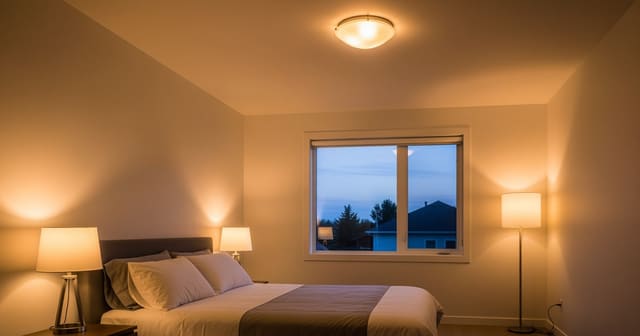
Light where the ceiling allows it: plug-in sconces on taller wall sections, shaded lamps on 20–24 inch nightstands, warm 2700K bulbs at the bed. If daylight is scarce, the strategies in single-window bedroom lighting apply directly, since both problems rely on spreading light sideways rather than one overhead fixture. Avoid a dangling pendant in the lowest part of the room — a shallow flush mount or track lighting aimed down the slope is safer.
Keep headboards around 42–54 inches so they don't crash into the angle. Run curtains from the highest practical mounting point to just above the floor. For rugs, an 8' x 10' works under two-thirds of a queen bed; a king needs a 9' x 12' or two 2'6" x 8' runners if the room is narrow.
Common sloped ceiling bedroom mistakes
- Bed jammed into the lowest corner. If you can't sit up or reach a lamp, rotate the bed or lower the headboard.
- Tall wardrobe under a slope. It blocks light and crowds the entry — reserve tall storage for the highest wall.
- Scattered tiny furniture. One long low cabinet along a knee wall beats five small pieces.
- No bedside lighting. Add two human-height sources near the bed, even plug-in sconces with cord covers, mounted 56–62 inches from the floor.
- Over-theming the angle. Triangle shelves and mountain murals aren't necessary — let the roofline itself be the feature.
Use AI to preview your angled ceiling bedroom before you commit
Sloped ceilings are hard to solve from memory since the problem shifts with every few inches of furniture placement. Upload a photo from the doorway and one from the foot of the bed, then prompt specifics: "attic bedroom with a sloped ceiling, queen bed placed where sitting headroom is comfortable, low drawers under the eaves, 24 inch nightstands, plug-in sconces, warm white walls and ceiling, 8' x 10' rug." Run a second version with the bed rotated and a third with built-in drawers replacing freestanding storage.
Judge headroom and proportion, not fantasy styling. Does the dresser have standing space in front of it? Does the low wall look useful or still like a leftover edge? Renters should preview removable choices — plug-in sconces, no-drill shades, freestanding low cabinets; owners can test built-ins, hardwired sconces, or a custom knee-wall drawer bank before calling a carpenter.
For the broader workflow, use the AI design complete guide as the parent checklist, then return here for scale, light, and layout choices specific to a sloped room.
Frequently Asked Questions
Where should the bed go in a sloped-ceiling bedroom?
Place the bed parallel to the tallest wall with the headboard centered under the peak so head clearance is full when sitting up. Never push the headboard into the low-knee-wall side where sitting up means ducking.
What is the minimum ceiling height for a bedroom code?
Most U.S. codes require at least 7 feet of clear height over 50% of the room and 5 feet at the lowest point in habitable sleeping areas. Check IRC §R305 against your local amendments before finishing the space.
Can I put a closet under the slope?
Yes — under-slope knee-wall closets with 30 to 48 inch depth work well for short-hang clothes, bins, and shoe shelves. Long-hang clothes need a 60 inch tall section near the peak instead, so plan hanging zones accordingly.
How should I light a sloped ceiling?
Use surface-mount or recessed cans aimed at the wall rather than the ceiling slope, plus bedside lamps for reading. Angled track lighting can wash the slope without creating glare onto the bed.
Will paint color make a low ceiling feel taller?
Painting the slope the same color as the walls erases the line and reads taller. A contrasting white ceiling on a steep slope tends to chop the room and emphasize the angle instead.
> Try this: Ready to see this on your own room? Open ReDesign and run the preview before you buy, paint, drill, or move furniture.
Three transformations to try
1. Bed parallel to peak with under-slope built-in storage 2. Reading nook tucked into the knee-wall side with a window seat 3. Slope painted to match the walls with warm sconces near the peak