Most cramped reach-in closets waste roughly half their true capacity because a single rod and shelf leave the space above and below empty. The fastest fix is a second hanging rod set at the right height, paired with vertical shelving, door storage, and slim hangers, which together can make a tight closet hold your entire wardrobe.
How Do I Get More Hanging Space?
Add a second rod. Most reach-in closets have one rod around 66 inches high with a shelf above it, leaving nearly four feet of dead air beneath your shirts. Set the upper rod at about 80 inches and the lower rod at about 40 inches, giving each tier the 38-40 inches of drop that shirts, folded pants, and jackets need.
Double-hanging works best for shorter garments, which make up most wardrobes, so reserve one full-height section elsewhere for dresses and coats that need the full 64 inches of clearance. A tension rod or hang-down extender clips onto the existing rod in minutes with no tools, ideal for renters. If you own the space, a fixed lower rod is sturdier and cleaner-looking.
Be honest about how much you actually hang long. Most people overestimate this and give up capacity to a few coats that could share one dedicated rod. Get this right and a 24-inch-wide closet can hold what once felt impossible.
See also our guide to Walk In Closet Ideas for more small closet strategies.
How Do I Use the Vertical Space Above the Rod?
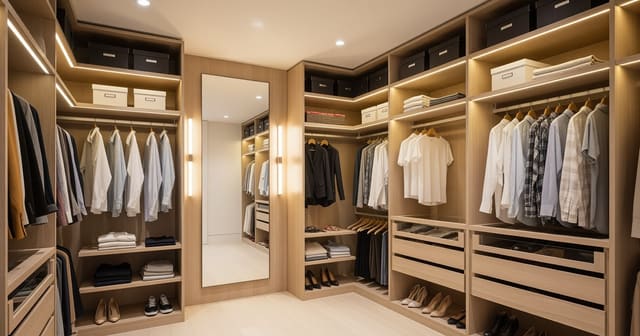
The zone above the top rod sits empty in almost every small closet. An 8-foot ceiling typically wastes the top 18-24 inches, enough for a full row of bins. Add a second shelf or a stack running toward the ceiling to store items you reach less often.
Use a system rather than loose piles:
- Stackable, labeled bins for folded sweaters and seasonal gear
- Clear bins over opaque ones, so you can see contents without pulling everything down
- The topmost space, above 72 inches, for the lightest, least-used items like luggage
- Vertical dividers on shelves so tall stacks don't topple into each other
A hanging shelf organizer clips onto the rod to add cubbies for shoes or folded items with no drilling. If the floor sits empty, low drawers or stacked shoe boxes put that ground level to work too. A small closet has more cubic feet than it looks like it has; the lost space is almost always the column above the rod and the floor below it.
For more ideas, read Closet Lighting Ideas.
What's the Best Way to Use the Door, Walls, and Floor?
The back of the door is the most underused six inches in the house. An over-the-door organizer with pockets holds shoes, accessories, or cleaning supplies, while hooks or an over-door rack handle bags, belts, and scarves.
Walls can work harder too. Adhesive hooks or a slim pegboard on a side wall hold jewelry or hats, and a narrow over-the-rod shelf adds surface for folded items without eating into hanging space.
On the floor, a two-tier shoe rack doubles footwear capacity in the same footprint, and a low cart or 18-inch drawers slide under short hanging clothes to fill that gap. Keep a few inches of clearance so the door still closes. Group like with like: shoes on the door and floor, accessories on the walls, folded items on shelves. Treat these surfaces as storage rather than empty boundaries and the closet gains the equivalent of a second small wardrobe.
How Do I Organize What Actually Stays?
No layout trick rescues a closet that holds too much, so start with an honest edit. Pull everything out and keep only what fits your current life and season; move off-season clothing to under-bed bins or separate storage. A closet holding a curated wardrobe always feels larger than one crammed with everything you own.
Hangers matter more than expected in a tight space. Slim velvet hangers take up far less rod width than plastic or wood and can fit up to 30 percent more garments on the same rod, while their grip stops clothes from sliding off. A single uniform hanger style also makes the closet look calmer.
Organize by category and frequency: daily items at eye level and arm's reach, occasional pieces higher or lower, rare items at the extremes. Clear bins and drawer dividers keep folded items from collapsing into a heap. The maintenance rule that keeps it working: when something new comes in, something old goes out.
Common Mistakes to Avoid
- Cramming long dresses and coats across a whole rod when only a few items need the full drop
- Leaving the airspace above the rod empty instead of adding shelves or bins
- Ignoring the back of the door and its six inches of storage potential
- Using bulky plastic hangers that waste rod width
- Storing off-season clothes in prime space instead of under-bed bins
- Piling folded items in tall stacks with no dividers so they topple
Bring the Look Home with Re-Design
Reorganizing a small closet often means guessing whether a second rod or shelving system will fit. With Re-Design, upload a photo of your closet and preview double-hung rods, vertical shelving, and door organizers in your real space before you buy hardware or drill a hole. Compare a few configurations side by side to find the layout that captures the most usable storage in your footprint.
Frequently Asked Questions
How do I get more hanging space in a small closet?
Add a second rod. Set the upper rod near 80 inches and the lower rod near 40 inches, giving each tier the 38-40 inches of drop that shirts and folded pants need. This nearly doubles hanging capacity for little cost, since most closets otherwise waste four feet of dead air below a single rod.
Are velvet hangers really worth switching to?
Yes, especially in a tight closet. Slim velvet hangers are far thinner than plastic or wood, fitting roughly 30 percent more garments on the same rod. Their flocked surface also grips clothes so nothing slides to the floor, and switching to one uniform style makes the closet look calmer.
What is the most overlooked storage in a small closet?
The back of the door and the vertical space above the rod. An over-the-door organizer reclaims six inches for shoes and accessories, while shelves or bins above the rod capture the 18-24 inches most 8-foot closets waste. The floor below short hanging clothes is a third spot worth filling with drawers or a shoe rack.
How much height does double-hanging actually need?
Each tier needs 38-40 inches of drop for shirts and folded pants, so set the upper rod around 80 inches from the floor and the lower rod around 40 inches. Reserve one separate section with a full 64 inches of clearance for dresses and coats that can't be shortened.