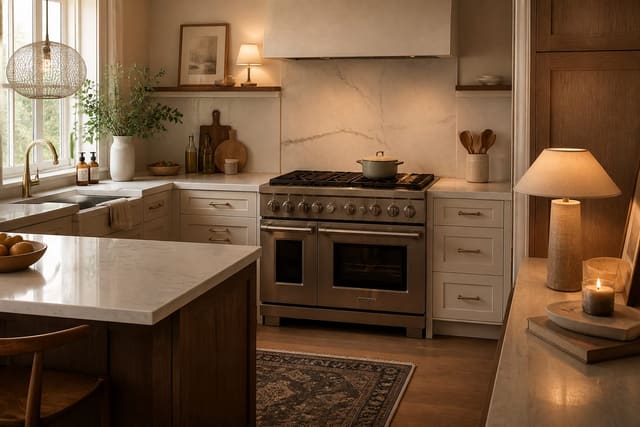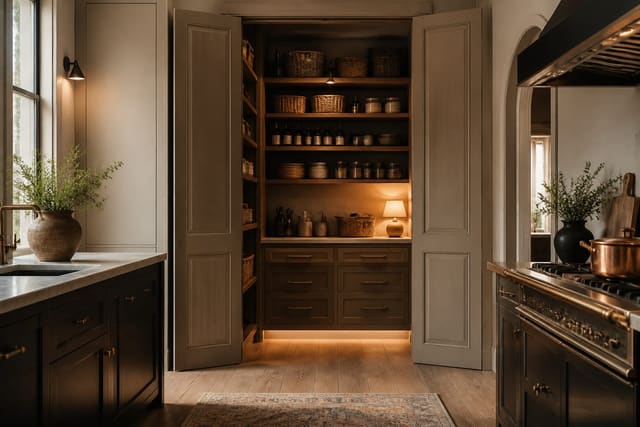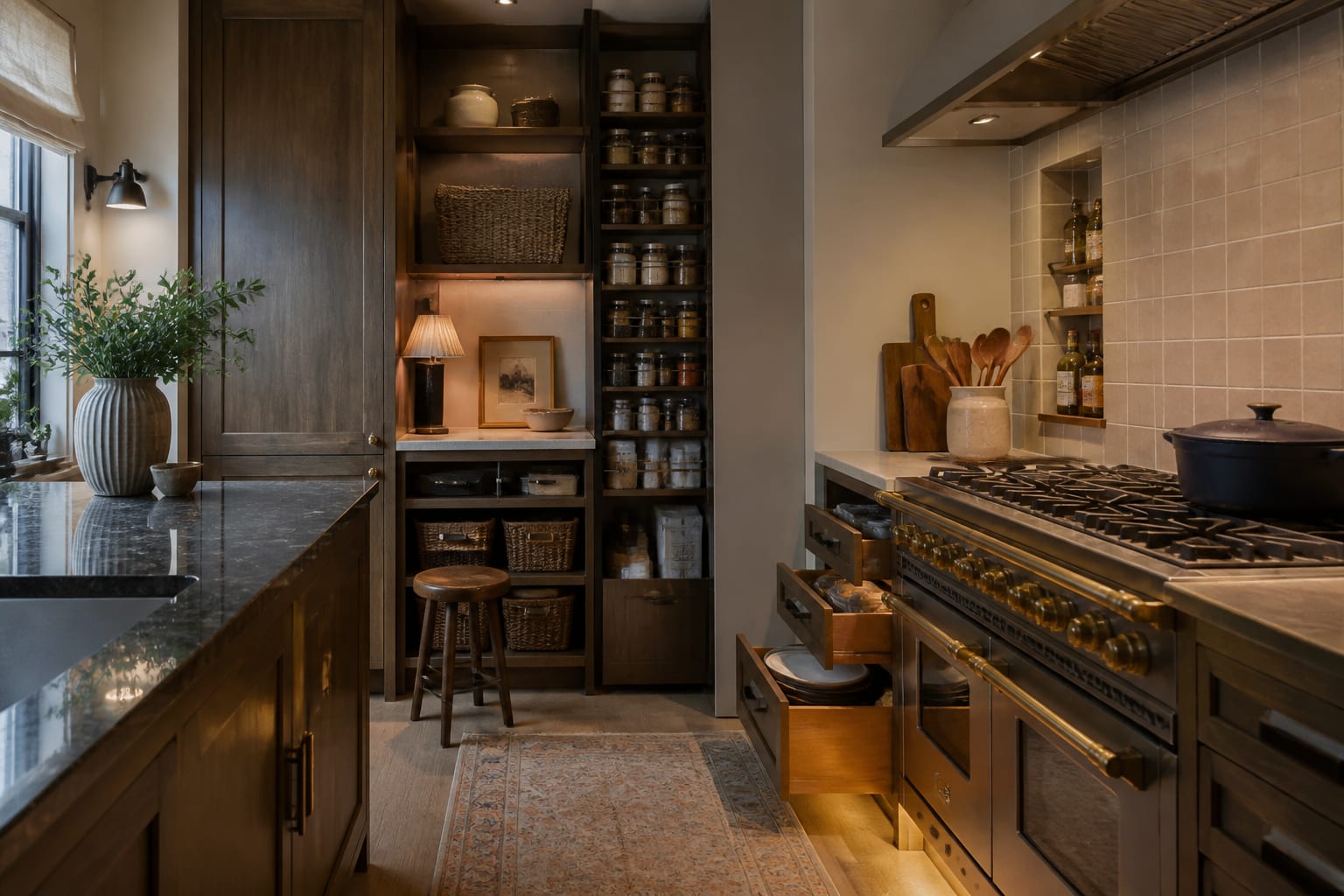
Small kitchens do not need more cabinets; they need cabinets that give back every cubic inch they hold. The classic mistake is leaving fixed shelves and deep dark corners where pots vanish, then blaming the room for being too small. The real opportunity is depth, height, and the overlooked surfaces, the toe-kick, the wall above the sink, the back of a door. Convert base cabinets to pull-outs so nothing hides, divide vertical slots for trays and boards, and carry storage all the way to the ceiling. With the right organizers, a compact kitchen holds far more than its footprint suggests.
Why are pull-out organizers worth it in a small kitchen?
A standard base cabinet is about 24 inches deep, yet a fixed shelf makes the back third nearly useless because you cannot see or reach what sits there. Pull-out organizers fix this by bringing the entire cabinet contents out to you on full-extension slides, so a pot at the very back is as easy to grab as one at the front. In a small kitchen, where every cabinet has to earn its keep, that reclaimed back third is real, usable storage you already paid for.
Deep drawers beat shelves for the same reason. A drawer 30 inches wide stacked with pots lets you look straight down and lift any one out, where a cabinet forces you to crouch and dig. Pull-out wire baskets, tiered cutlery trays, and slide-out pantry towers all apply the principle: motion brings the storage to you instead of you reaching into a black hole. Retrofitting existing cabinets with pull-out hardware is often cheaper than a remodel and can roughly double what a small kitchen comfortably holds.
See also our guide to Save Money Kitchen Remodel for more on small kitchen storage ideas.
How do you store trays, boards, and pots vertically?
Flat items like baking sheets, cutting boards, muffin tins, and serving platters are the enemy of a small kitchen because stacked flat they require you to lift the whole pile to free the bottom one. Vertical dividers solve this by standing each item on edge in its own slot, so you slide out exactly the tray you want. A tall, narrow cabinet beside the oven is the ideal home for these dividers, but you can also retrofit a divider kit into an existing upper.
The same logic applies to lids and pans that otherwise sprawl across a shelf. A vertical lid rack stands pot lids on edge so they stop nesting into an avalanche, and a peg-board drawer system keeps stacked pots from sliding. For a very tight kitchen, even a 6 inch gap at the end of a counter run can take a pull-out vertical rack for trays. Storing on edge rather than in stacks turns wasted vertical air into organized, one-motion access and clears the shelf space those leaning piles used to eat.
For a related angle on small kitchen storage ideas, read Pantry Organization Ideas.
Which overlooked spaces can a small kitchen turn into storage?
The surfaces most small kitchens ignore add up to real capacity once you claim them. The toe-kick, that recessed 4 inch gap under the base cabinets, can hold a shallow drawer perfect for flat trays, pet bowls, or linens that have nowhere else to go. Above the sink, where there is rarely an upper cabinet, a tension rod or a slim shelf holds dish soap and a sponge, and a window-ledge rail keeps herbs within reach.
Doors and walls are the other frontier. The back of a cabinet or pantry door takes a slim rack for spice jars, foil, and cleaning bottles, freeing whole shelves inside. A drawer-over-door layout, where a shallow drawer sits above a standard cabinet door, squeezes a utensil tray into space a plain cabinet wastes. On open wall stretches, a hanging rail with S-hooks or a magnetic strip moves utensils, mugs, and knives off the counter entirely. None of these requires a remodel, and together they can rival the capacity of an extra cabinet you do not have room to install.
How do you take a small kitchen all the way to the ceiling?
Stopping wall cabinets at the usual height leaves a dead zone of one to two feet above them that a small kitchen cannot afford to waste. Carrying cabinets to a 9 or 10 foot ceiling, or adding a stacked upper tier above the standard run, captures that air for the platters, spare appliances, and seasonal items you reach for only a few times a year. A step stool turns the high tier from useless to genuinely usable.
If full upper cabinets feel too heavy in a tight room, open shelving or a row of stacked glass-front cabinets keeps the height without closing the space in. The same height-first thinking applies to the pantry: a tall, narrow pull-out pantry tower stores more in a 9 inch slot than a wide shelf does, because it uses vertical run instead of floor area. The guiding rule in a small kitchen is to build up, not out, since wall and ceiling height is the one dimension a cramped footprint still gives you for free.
Here are the common mistakes to avoid: - Leaving fixed shelves in deep base cabinets so the back third stays a dark, unreachable void. - Stacking baking sheets and boards flat so you must unload the pile to reach the bottom one. - Stopping wall cabinets at standard height and wasting two feet of air below the ceiling. - Ignoring the 4 inch toe-kick gap that could hold a shallow drawer for trays and linens. - Crowding knives and utensils onto scarce counter when a wall rail or magnetic strip would clear it. - Choosing wide shelf pantries over a narrow pull-out tower that uses vertical run far better.
Bring the look home with Re-Design
Storage upgrades are easier to commit to when you can see them in your actual room first. With Re-design you upload a photo of your small kitchen and preview cabinets carried to the ceiling, a wall rail of hanging utensils, or open shelving above the sink against your real walls. Test whether a tall pantry tower or a stacked upper tier reads better in your space before you buy a single organizer. Trying these compact-storage ideas from one upload helps you decide which moves genuinely open the room up and which would only make a tight kitchen feel more crowded.
Frequently Asked Questions
What is the best way to add storage to a small kitchen?
Start by reclaiming depth and height you already own. Convert deep base cabinets to full-extension pull-outs so the back third becomes usable, then carry wall cabinets to the ceiling for rarely-used items. Both moves add real capacity without expanding the footprint, and retrofitting pull-out hardware is far cheaper than a full remodel.
What is toe-kick storage?
Toe-kick storage uses the recessed 4 inch gap beneath your base cabinets, fitting a shallow drawer there for flat items like baking trays, table linens, or pet bowls. It is space that otherwise sits completely empty, so in a small kitchen it adds a full drawer's worth of capacity without taking up any room you actually stand in.
How do I store pots and pans in a tiny kitchen?
Use a deep drawer rather than a shelf so you can look down and lift any pot out without digging. Stand lids on edge in a vertical lid rack to stop them nesting, and hang a few pans from a wall rail with S-hooks. These moves keep pots accessible and free the shelf space stacks would otherwise waste.