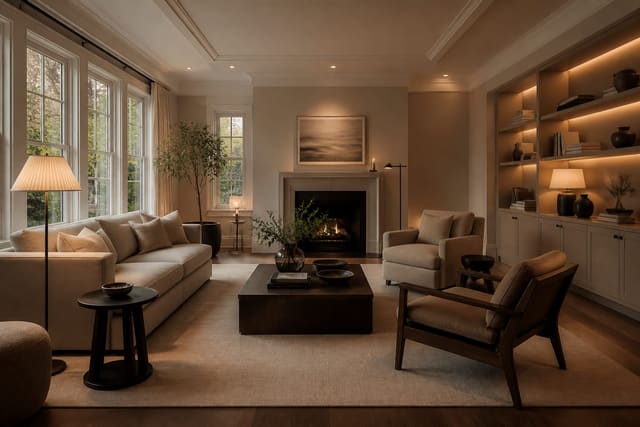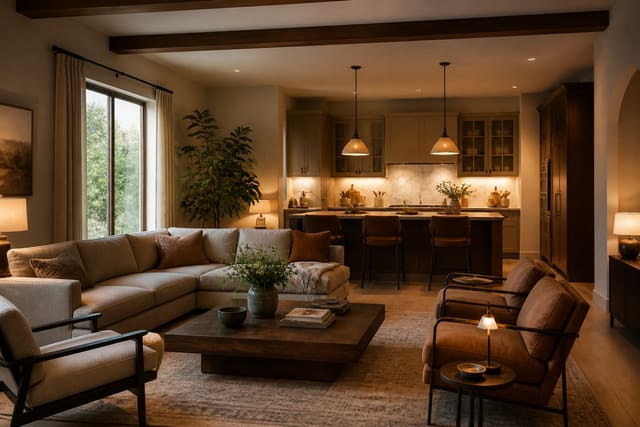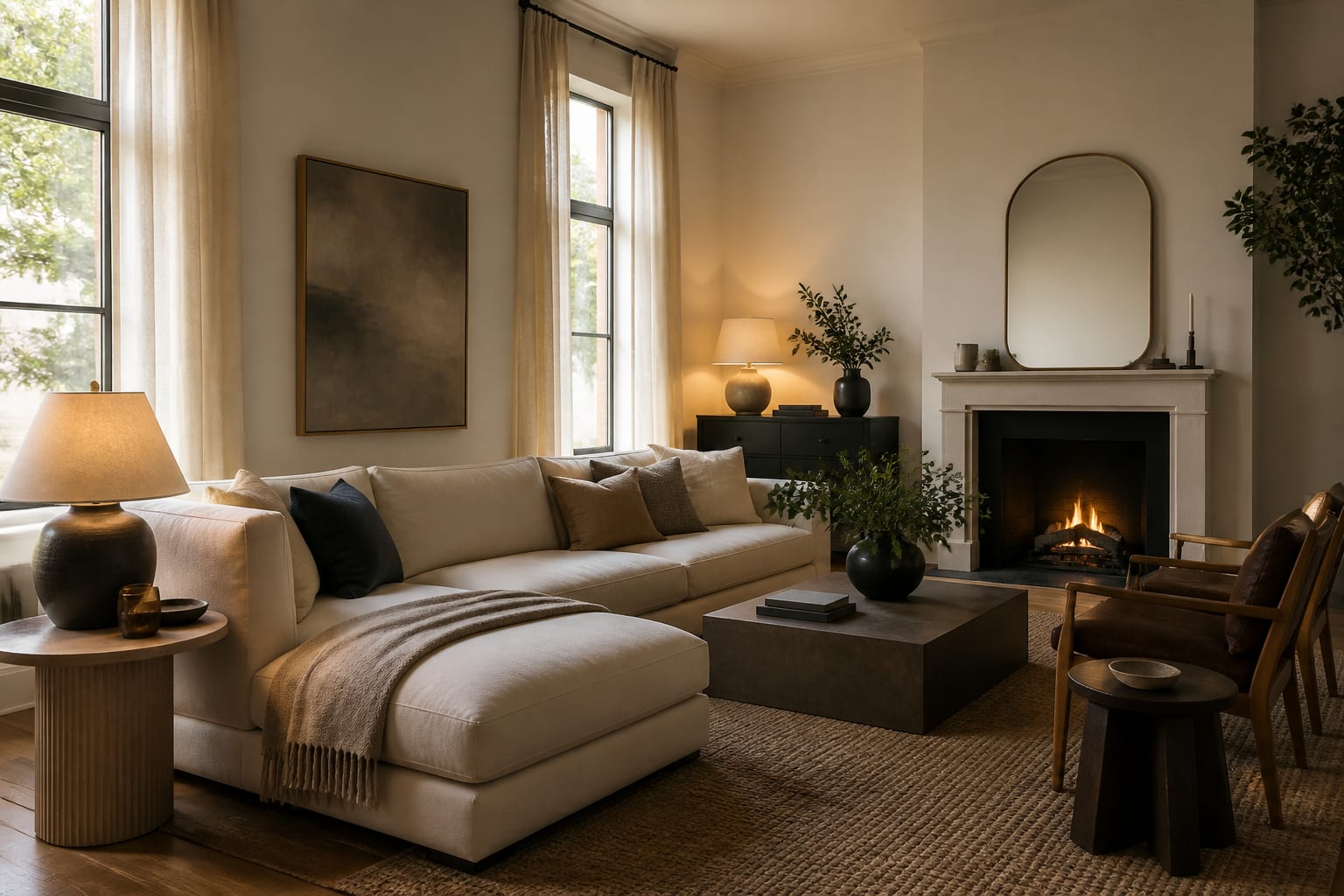
Where should a sofa go? Facing the room's main focal point, with the back of the sofa anchoring one edge of the seating zone, and never shoved blindly against a wall just because the wall is there. That is the short answer. My read is that the against-the-wall instinct is the single most common reason living rooms feel awkward, because it treats the sofa as storage to push aside rather than the anchor of the whole room.
The sofa is the largest object you place, so it sets the rules for everything else. Get it right and the chairs, rug, and table fall into place. Get it wrong and no amount of accessorizing rescues the layout.
Find the focal point before you move anything
Every good layout starts by naming the focal point, because the sofa orients to it. Most rooms have an obvious one: a fireplace, a big window with a view, or the TV wall. Some have two competing focal points, like a fireplace and a TV on different walls, and that is where people freeze. Pick the primary one for the sofa to face, then bring the secondary into the arrangement at an angle rather than forcing the sofa to serve both.
Once the focal point is set, the sofa faces it or sits perpendicular to it, never with its back to it. A sofa that turns its back on the fireplace fights the room's natural center of gravity. If you are working with a tricky footprint or a room doing two jobs at once, the zoning logic in my living room layout approach helps you decide which focal point wins.
There is a height relationship worth checking here too. If the focal point is a TV, mount it so the center of the screen lands about 42 inches off the floor, roughly eye level from a seated position, and set the sofa back about 8 to 10 feet from it for a comfortable viewing distance. If the focal point is a window, do not block the lower 24 inches of the glass with a high sofa back; a sofa back under 34 inches keeps the view and the light intact.
Against the wall or floating: the real rule
The wall-versus-float question has a clean answer based on room size. In a small room under about 12 feet wide, backing the sofa to a wall is usually right, because floating it eats the walkway you cannot spare. In a larger or open-plan room, floating the sofa toward the center and defining the zone behind it is almost always the stronger move.
When you float a sofa, never leave its back bare and exposed to the rest of the room. Back it with something:
- A sofa table or console, ideally 30-36 inches high to sit just below the sofa back.
- A pair of slim accent tables with lamps for symmetry and light.
- A low bookcase that doubles as a divider in an open-plan space.
- A bench or daybed for overflow seating that faces the other direction.
That backing piece turns the sofa's back into a finished edge and creates a natural traffic lane behind it. Keep that lane at 30-36 inches so people can pass without turning sideways. The same trick of using furniture backs to carve zones is central to how I handle open-plan living and kitchen spaces.
Lock in the clearances that make it comfortable
A layout lives or dies on a handful of measurements, and they are non-negotiable. Leave 14-18 inches between the sofa front and the coffee table: closer and you bark your shins, farther and you cannot set a glass down without leaning. Keep the coffee table roughly two-thirds the length of the sofa so the proportions read right.
Conversation distance matters more than people think. Seats that face each other should sit 7 to 10 feet apart; push past 10 feet and people start raising their voices, which kills the cozy feeling a seating group is supposed to create. For the rug, in a standard living room go at least 8 by 10 feet so the sofa's front legs (ideally all the legs) land on it. A rug that floats like an island in the middle, touching nothing, shrinks the whole room. Side tables should land within arm's reach of each seat, roughly level with the sofa arm, usually 24 to 26 inches high.
One more clearance people forget: leave at least 36 inches between the front of the sofa and any major obstacle behind the coffee table, like a media console or a wall, so the main path through the seating group does not pinch. And give the sofa itself room from the wall behind it. Even a sofa pushed back should sit 3 to 4 inches off the wall rather than jammed against it, so the upholstery does not scuff the paint and the piece reads as placed rather than wedged.
Common mistakes to avoid
The most common mistake is automatically pushing the sofa against the wall in a room big enough to float it, which leaves a dead lake of empty floor in the center and seating too far apart to talk.
Another frequent mistake is the too-small rug, an island the sofa cannot even reach, which makes a generous room feel cramped. A third is jamming the coffee table right up against the sofa or stranding it three feet away. Keep it at 14-18 inches. People also ignore the focal point entirely and arrange the sofa to suit the wall outlets instead of the view. And a classic common mistake is blocking a doorway or natural walkway with the sofa or a chair, forcing everyone to detour around the furniture. Map your 30-36 inch paths first, then place seating inside what is left.
Use AI design to test sofa placement before you move a thing
The real problem with sofa placement is that the sofa weighs a hundred pounds and you only learn whether the layout works after you have wrestled it into position. Re-Design removes the guesswork. Upload a photo of your living room and the AI design re-renders it with the sofa floated, backed by a console, or angled toward a different focal point, so you can compare layouts before you strain your back.
Because you upload your actual room, the previews respect your real doorways, your real window placement, and the true dimensions you are working with. Test the sofa against the wall, then floated and backed with a console, and see which version opens up the walkways and aims the seating where you actually want to look, all before you push a single cushion.