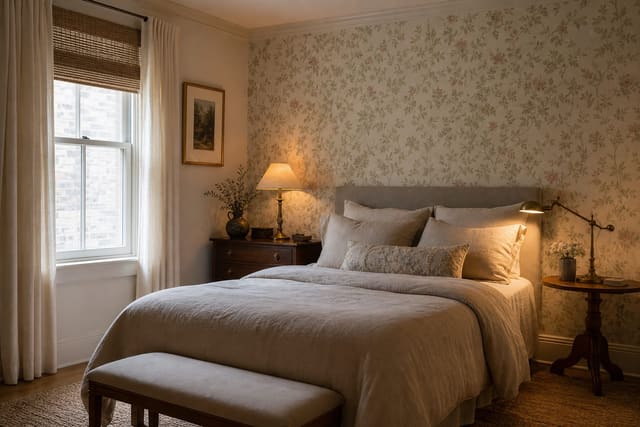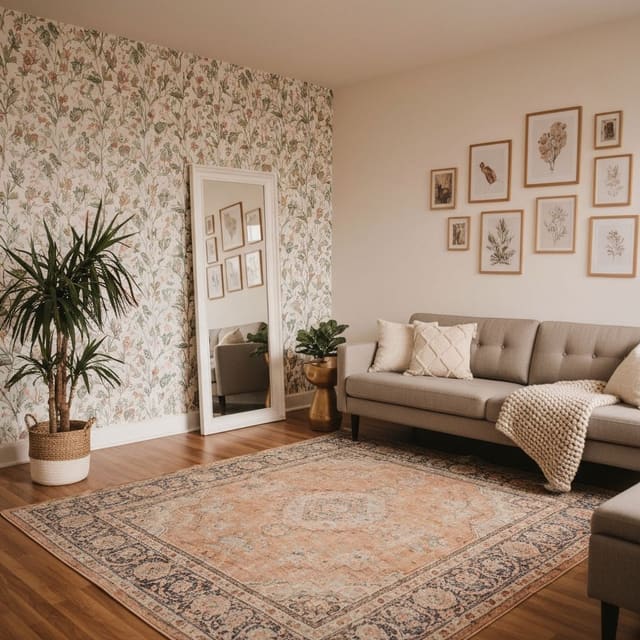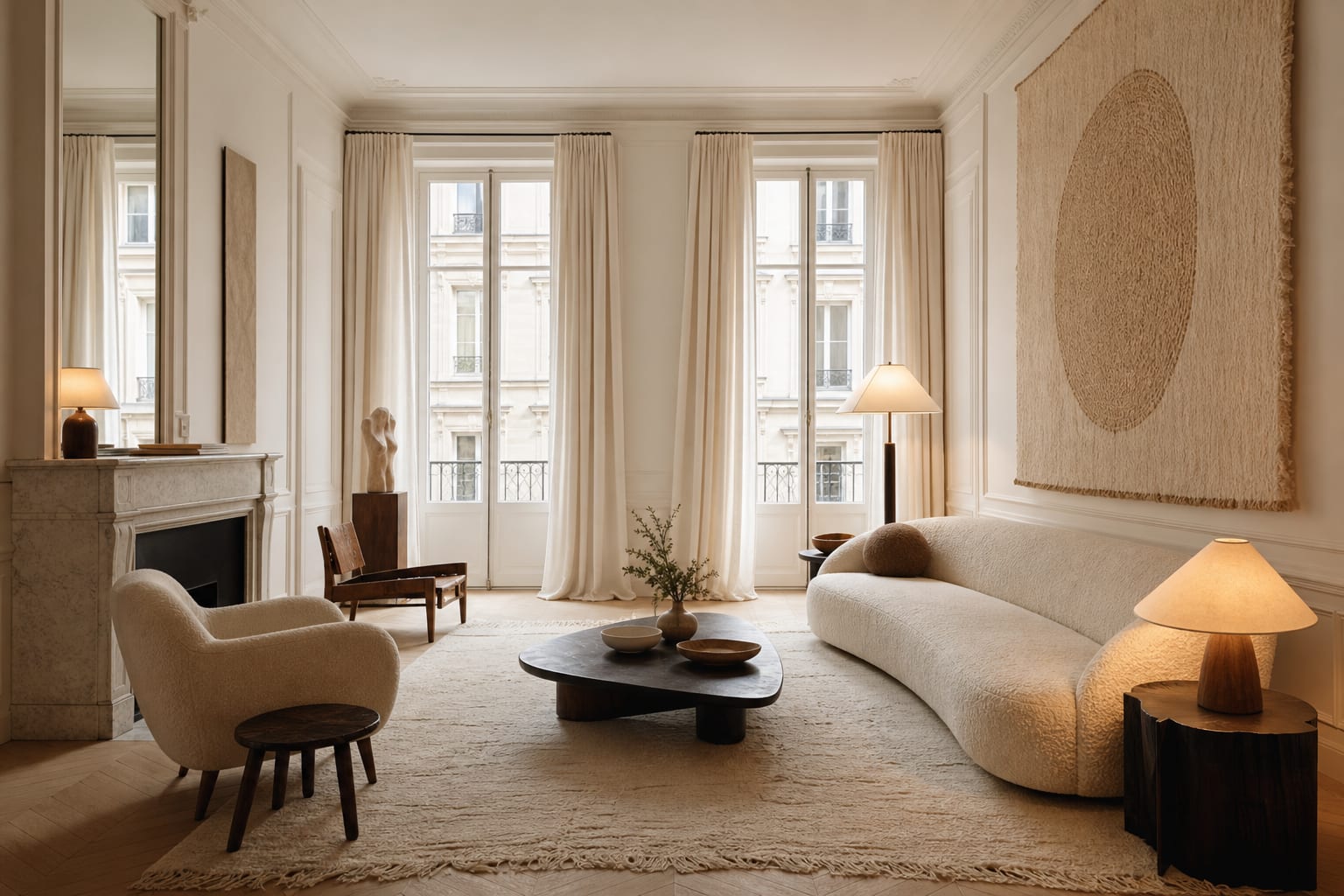
White apartment walls without painting soften fastest with five reversible moves: an oversized art or fabric moment on one wall, every bulb switched to 2700K, two warm-tone floor lamps washing the perimeter, one large textured rug, and furniture that sits proud of the wall instead of flat against it. Blank rental walls need fewer tiny decorations and more scale — the goal is a room that feels chosen, not temporarily occupied.
What makes white apartment walls look better without paint?
You soften white walls by adding scale, shadow, texture, and warmer light — not by covering every inch of drywall. Pieces that sit proud of the wall, hang from existing hardware, or lean against furniture create the same depth paint would.
Start with the largest blank wall, not the easiest corner. One dominant piece should cover roughly 50%–70% of the furniture width below it — over a 78" sofa, that's a 40"–55" art piece or textile, not three small frames in a row.
Hang art with its center around 57"–60" from the floor, or with the bottom edge 6"–10" above a sofa back so wall and furniture read as one composition. For no-damage hanging, see this guide to hang art in a rental without wall damage before trusting adhesive hooks with heavy frames.
Vertical furniture matters too. A 30" console, 42" bookcase, or 60" floor lamp gives the wall rhythm that flat prints can't — add one or two taller silhouettes above waist height and the room stops feeling unfinished.
Which wall treatments add texture without violating the lease?
Fabric is the fastest fix. A woven hanging, quilt, framed scarf, or stretched canvas absorbs echo and adds shadow without committing to adhesive across the room. For a bed or sofa wall, aim for at least 36" x 48" — small scattered textiles look cluttered rather than intentional.
Use removable wallpaper as a finish, not a whole-room solution: one contained zone (behind the bed, a dining nook, a desk niche) works better than a full living room perimeter, which is harder to align and remove cleanly.
Test a sample on the actual wall for 48–72 hours before ordering rolls — rental paint can be chalky, glossy, or freshly touched up, and each condition changes adhesive behavior. If it curls or lifts paint, switch to framed panels or freestanding pieces instead. Read this temporary wallpaper brand review before buying on pattern alone.
For texture with no wall contact, lean a mirror, screen, tall plant, or open bookcase against the wall. A 30"–36" leaning mirror reflects lamp light; a 72" bookcase adds architecture, especially with a darker object every 12"–18" so shelves don't dissolve into pale clutter.
Test this on your own room photo with ReDesign — keep the doorway, windows, furniture, and fixed features visible so the preview solves your actual room.
How should art, curtains, and lighting work together?
White walls look cold without shadow, so plan art, curtains, and lighting as one system rather than separate purchases. Flat drywall needs depth near the ceiling, at eye height, and near the floor.
Curtains are an underrated paint alternative. Mount the rod 6"–10" above the window casing and 8"–12" beyond the frame on each side, and let panels touch or nearly touch the floor — short curtains chop up a white wall.
Lighting decides whether white reads crisp or clinical. Use 2700K–3000K bulbs; cool bulbs turn white paint blue. A 58"–68" floor lamp washes the wall with light, while a small table lamp only brightens its shade. For weak ceiling fixtures, borrow tactics from how to fake natural light in any room: bounce light toward vertical surfaces and place lamps to wash walls, not glare.
For a gallery wall, keep 2"–3" between frames, repeat one frame color, and vary sizes with a clear anchor — one large piece, two medium, a few small beats ten identical 8"x10" frames.
Common mistakes that keep white rental walls looking sterile
- Decorating too small. Tiny art and shelves make a large wall feel emptier; choose one piece that's almost uncomfortably big, then add quieter supporting objects.
- Sticking to white, gray, and acrylic only. Add one visibly warmer material — oak, walnut, rattan, terracotta, rust, or aged brass.
- Pushing every piece against the perimeter. Pull a chair 6"–12" off the wall or float a side table so the room gets layers, not just a ring of furniture around empty space.
- Trusting adhesive without checking paint condition. Clean the spot, let it dry, press strips the full recommended time, and reserve heavy frames for studs or leaning placement.
- Covering every wall at once. One strong wall plus better lighting usually beats four walls of unrelated art — leave some white space on purpose.
Use AI design to preview your white box apartment before you buy
Upload a straight-on photo showing the blank wall, furniture, floor, ceiling line, window trim, and any awkward fixtures like vents or thermostats — don't crop them out if they'll still be visible after decorating.
Preview one category at a time: an oversized textile above the sofa, then a large framed print, then floor-to-ceiling curtains, then a wallpaper panel behind the bed. If the design only works when every surface changes at once, it's probably too fragile — and expensive — for the actual problem.
Use the preview as a shopping brief: note whether art wants to be 36", 48", or 60" wide, whether curtains should be ivory or warm gray, and whether a lamp needs a drum shade or arched arm. Compare a removal-minded version (framed fabric, leaning mirror, curtain wall) against the prettiest version, and pick whichever softens the white box while respecting the lease.
Frequently Asked Questions
How do I add warmth to white apartment walls without painting?
Swap every bulb to 2700K, add wool or jute rugs, layer warm-toned throws and pillows (cream, oat, terracotta, rust), and hang one large piece of warm-toned art. Together these make the white walls read as a backdrop rather than the dominant color.
What single move warms up a white-box apartment fastest?
Replace cool overhead bulbs (3000K and above) with warm 2700K dimmable LEDs. This single low-cost swap shifts the room's entire color temperature so the white walls read warm immediately.
Can I use temporary wallpaper in a white-box rental?
Yes — one accent wall in textured peel-and-stick wallpaper or a fabric wall hanging adds warmth and visual interest. Full-room temporary wallpaper rarely earns the install effort for a 12- to 24-month stay.
How do I add color to white walls without painting?
Use art, textiles, and books instead of paint. A 30" x 40" warm-toned print, two thrown blankets in muted colors, and an open bookcase of warm-spine books all read as color on the walls without any paint.
Why does a white apartment feel cold even with warm furniture?
Cool overhead bulbs and bare floors transmit cold from above and below regardless of furniture warmth. Pair 2700K bulbs with at least one large textured rug per room to break that cold sandwich effect.
> Try this: Ready to see this on your own room? Open ReDesign and run the preview.
Three transformations to try
1. Oversized warm-toned art on one wall 2. 2700K floor lamps washing white walls 3. Textured rug and throws in cream and rust