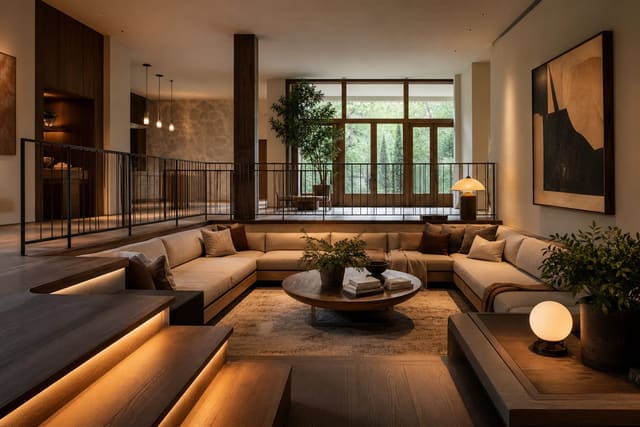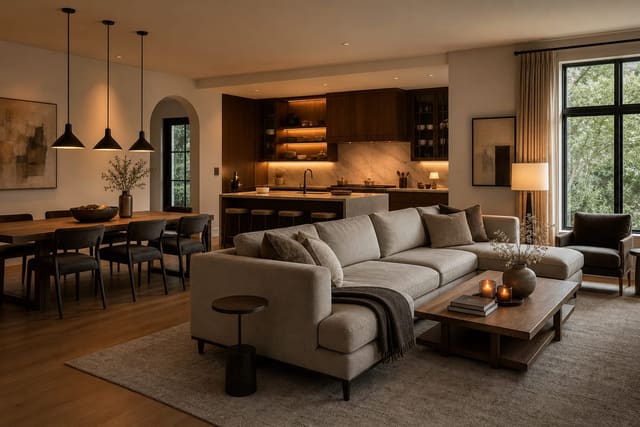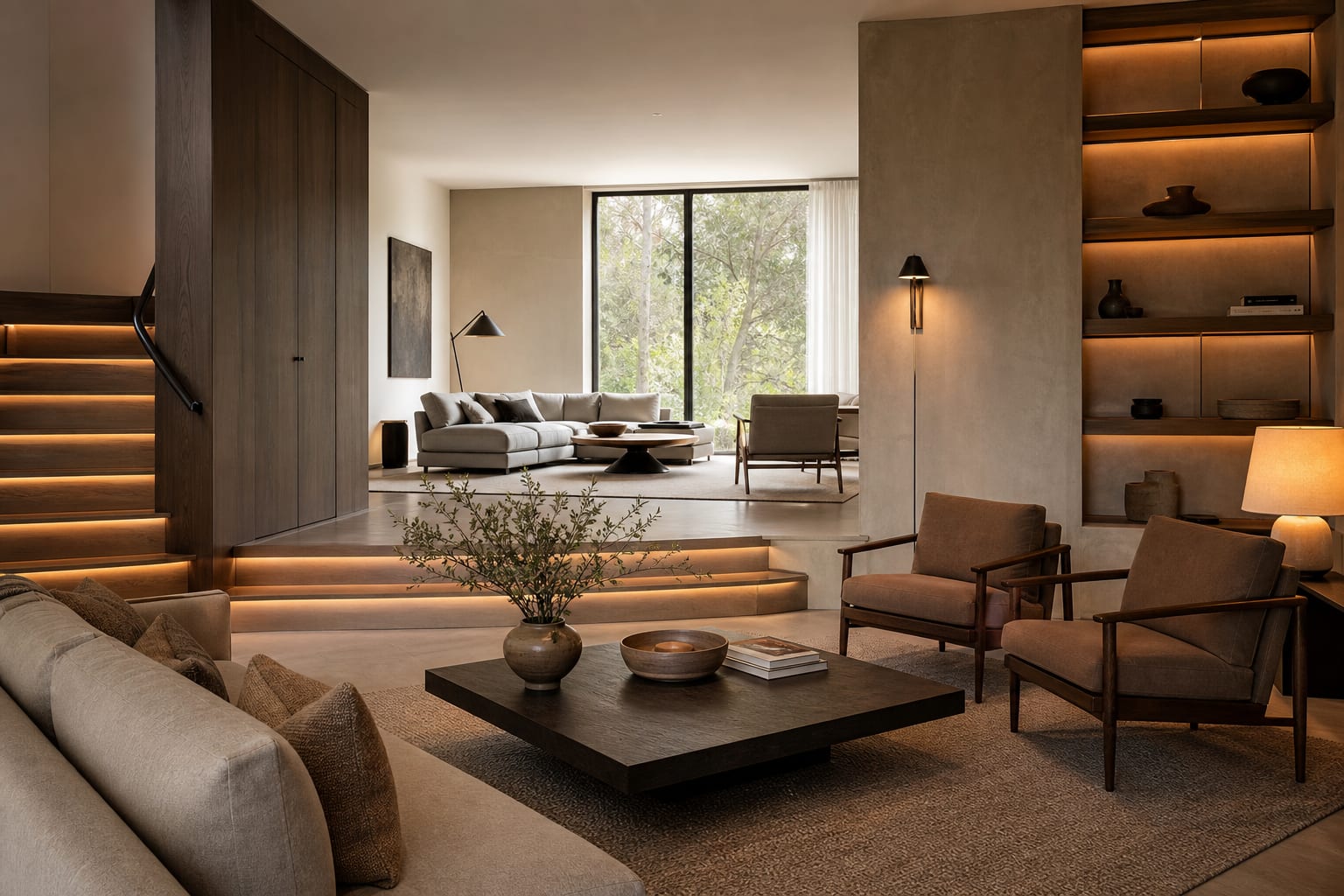
A split-level living room reads as unified when the rug on each level shares a color family but differs in texture, wall color runs continuous across both heights, one lighting scheme spans both planes, and seating on each level faces a shared focal point like a fireplace or window wall. The level change isn't the problem; treating the two areas like unrelated rooms is. Make the stair edge, lighting, materials, and furniture acknowledge each other, and the split starts to feel architectural instead of accidental.
What makes a split-level living room feel unified?
Unify a split-level living room by connecting the two levels with consistent sightlines, repeated materials, layered lighting, properly scaled rugs, and furniture that faces across the height change rather than away from it. You're not hiding the split; you're making it feel intentional.
Treat the stair edge as a design element, not a construction seam: a continuous railing, a low plinth, a repeated wood tread, or a lighting detail all work. A 2-inch to 4-inch nosing contrast helps the steps read clearly, especially with kids, guests, or aging parents in the house.
Repeat one major material across both levels — the same oak tone in stair treads and coffee table, the same black metal in railing and lamps, or one warm white on both walls. Mismatched flooring, rug color, and metal finish between levels reads as two separate rooms sharing air.
Light both planes with one ambient layer, one stair/wall layer, and one task layer. Sconces flanking the lower seating wall, a floor lamp on the upper landing, and low-glare stair lights around 2700K–3000K make the height change feel deliberate at night. If your lower area is sunken, the safety and edge principles from sunken living room design apply directly.
Where should furniture and rugs go in a bi-level living room?
The biggest decision is whether the two zones face each other, share a focal point, or perform separate jobs. Most split-level rooms fail because every seat points at its own wall, turning the upper level into a pass-through and the lower level into the only room anyone uses.
Keep the main sofa low — a back around 30 to 34 inches — so it doesn't block the view from the upper level. Leave at least 36 inches of clearance behind any sofa near the stair edge for safe circulation.
A sectional works only if it respects the step line: keep the long side parallel to the main view and the chaise away from the stair opening. In narrow bi-level rooms, two sofas facing each other across the lower zone often feel calmer than one large L-shape.
Swivel chairs on the upper level can rotate conversation across elevations, especially if that level also sees a fireplace or window. Choose arms around 24 to 28 inches high so seating doesn't wall off the stair edge.
Size rugs to define zones without isolating them:
- Lower level: 8x10 ft for standard seating, 9x12 ft for a large sunken area; get at least the front legs of every seat on the rug.
- Upper level: skip a competing rug unless the space has its own job (reading chair, game table, piano).
For more ways to separate functions without walls, see zoning an open-plan room without walls.
Test this on your own room photo with ReDesign — keep the doorway, windows, main furniture, and awkward fixed features visible so the preview solves the room you actually have.
Which colors and materials should connect both zones?
Use one continuous palette with the same undertone on both levels; a creamy white upstairs and cool gray downstairs will make the split feel harsher before furniture even enters the room.
Pick three repeats and use them with discipline: a wood tone, a metal finish, and a textile color. White oak stair treads, a white oak console, and a white oak side table paired with aged brass lamps and two rust or olive textile accents will read as related without matching perfectly.
Run paint floor-to-ceiling on shared walls, and hang drapery 6 to 10 inches above the window casing to the floor — this reads the full room height and makes the split feel more spacious.
If the fireplace or TV lives on the lower level, give the upper level a job too: a console, bench, or reading chair facing the lower focal point keeps it from feeling like an empty balcony. In shaded or north-facing rooms, avoid stark contrast between levels — sample paint at the stair edge, sofa, and main window first, using the approach in north-facing living room color and lighting.
What mistakes make a split-level living room feel disconnected?
- Decorating the lower level like a separate basement. Pull at least two finishes upward, even if the upper zone is just a landing with chairs.
- Ignoring the step approach. Keep 30 inches clear at the base of the steps, 36 inches if it's a main route to a hallway or kitchen.
- Choosing a railing for code only. A bulky half wall isolates the upper level; a spindly rail looks flimsy beside large furniture. Match the railing to furniture scale.
- Letting one level have all the light. A chandelier over the upper volume won't light a sunken seating area — add lower-level lamps or sconces aimed at seating.
- Overfilling the upper level to compensate for looking empty. A quieter upper plane often lets the architecture breathe better than a second sofa group.
How can AI design help preview a split-level layout?
AI preview tools are useful here because the hard part is judging sightlines between elevations. Upload one photo from the upper level looking down, one from the lower seating area looking up, and one wide shot showing the stair edge and focal wall — these angles reveal blocked views, heavy railings, or mismatched colors.
Use a specific prompt: "split-level living room with lower conversation seating, 9x12 neutral rug, warm oak stair treads, slim black railing, swivel chairs on upper landing, layered 3000K lighting, cohesive warm neutral palette." Then run a second version testing a lighter railing or different sofa orientation.
Check each preview for a 36-inch upper path, a rug that connects all seats, and whether contrast at the stair edge feels safer or matching wood feels calmer. AI can't verify building code or railing height, but it can show whether the room should lean into contrast or soften the height change before you spend on furniture.
Tape the sofa, rug, console, and chair footprints on both levels before ordering. Stand at the top step, bottom step, front door, and main seat — if you can walk, talk, and see the focal point clearly, the layout is ready.
Frequently Asked Questions
How do I make a split-level living room feel like one room?
Run the wall color continuously across both levels, pair rugs in the same color family but different texture (wool above, jute below), and orient seating on each level toward a shared focal point so the eye connects the two halves.
Where should the main seating go in a split-level living room?
Put main seating on the larger level, facing the focal point (fireplace, window wall, or TV). Secondary seating on the smaller level becomes a conversational nook that extends the room rather than competing with it.
How do I light a split-level living room?
Use a tall floor lamp (60–72 inches) at the step edge to anchor the level change, plus matching pendants or sconces at equal elevation on each level. The visual rhyme ties the two halves together.
What rug strategy works for two-level living rooms?
Use two rugs in the same color family but different texture — warm wool above, warm jute below. Identical rugs on both levels look accidental, and completely different rugs split the room in two.
Should a split-level living room have a railing at the step?
An open step edge works for a single 8-inch drop; a railing is needed for two or more steps (16 inches or more). Where required, use a low horizontal cable or rod design (30–36 inches) that doesn't visually wall off the spaces.
> Try this: Ready to see this on your own room? Open ReDesign and run the preview.
Three transformations to try
1. Continuous wall color across both levels with anchor art 2. Floor lamp at step edge anchoring level change 3. Matched-tone different-texture rugs on each level