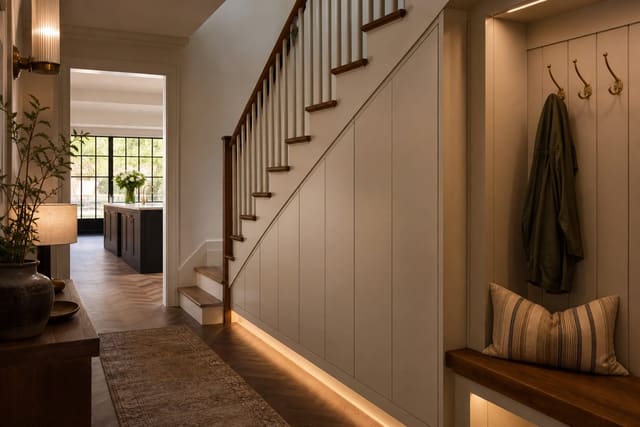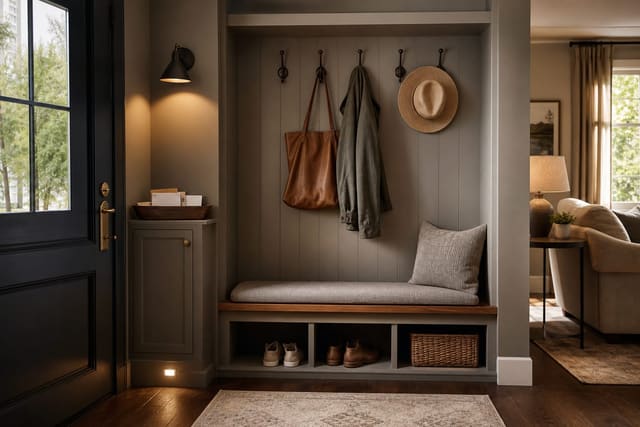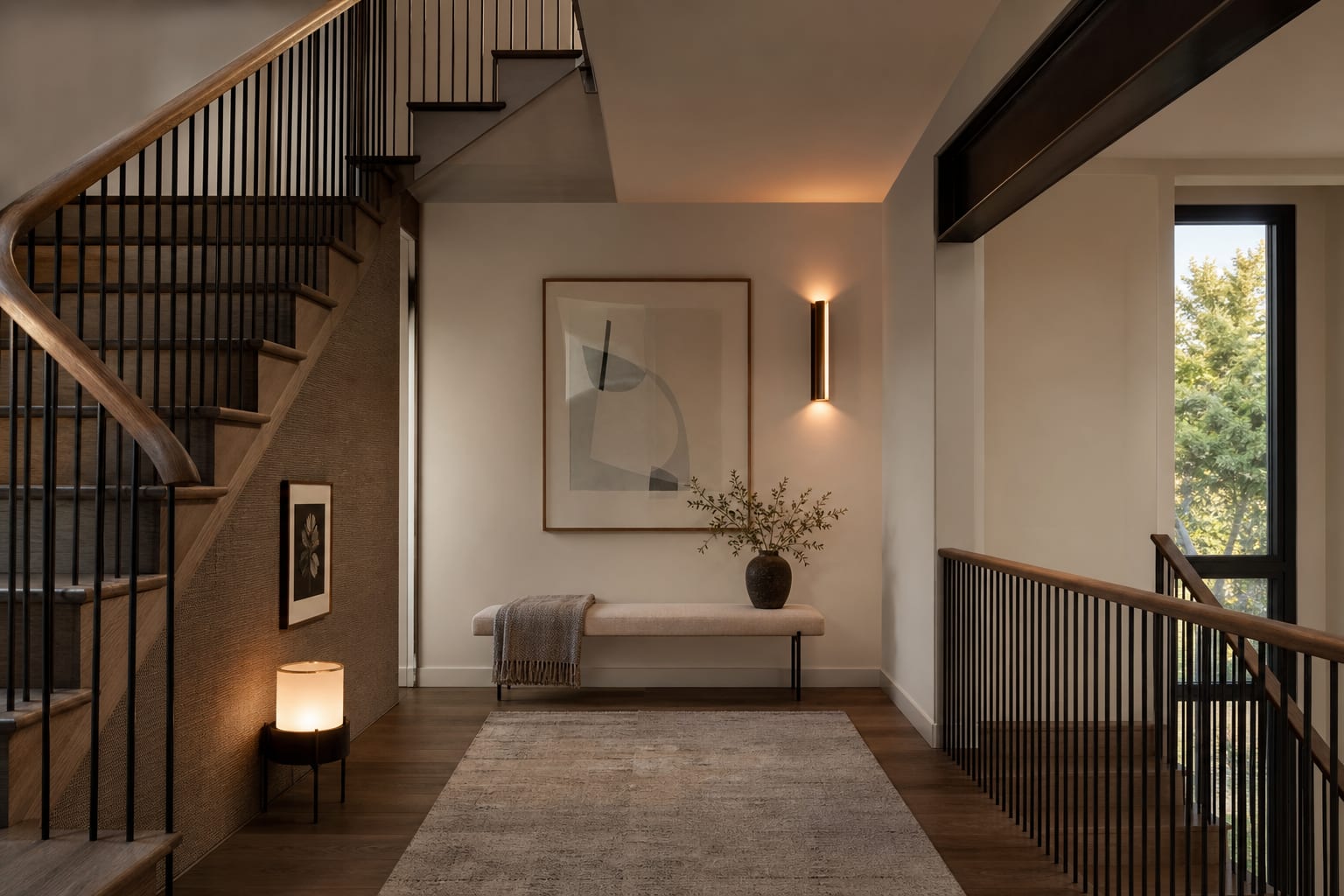
Staircase landing ideas work when one anchor piece — oversized art, a tall plant, an accent chair, or a built-in window seat — gives the landing a purpose, lighting drops to landing height, and the wall becomes a gallery zone tied to that anchor. A landing is a pause, not a room, so keep the walking path clear before adding decor.
What do you do with a staircase landing area?
Assign the landing one job before adding decor, and protect the stair circulation first. Keep at least 36 inches of open walking width where feet naturally land; anything deeper than 15 to 18 inches needs to earn its place.
The landing is seen from below, above, and often a hallway, so the back of a chair or underside of a shelf all matter. Borrow the continuity thinking in staircase design ideas that connect the whole house: repeated wood tones, one metal finish, and rail-related lighting make the landing feel built in rather than perched on.
Lighting is the quickest win. A single sconce at 60 to 66 inches with a warm 2700K to 3000K bulb makes a blank wall feel intentional. No wiring? A plug-in picture light or rechargeable sconce still works after dark.
Can the landing hold furniture, or should it stay vertical?
A square landing at least 5x5 feet can usually support a small bench, low bookcase, or chair. A narrow turn landing may only support art, lighting, or a 6 to 10 inch ledge — that's not a failure, it can look more expensive than a cramped vignette.
- Benches: 12 to 16 inches deep, open legs, tight to the wall. Leave knee room if it's a shoe-tying spot.
- Storage: cabinets should run 10 to 14 inches deep unless the landing is unusually generous.
- Rugs: must sit flat with a proper pad and stop short of stair nosings — a curling corner here is a trip hazard.
If the landing connects to a hallway, the logic in hallway design ideas for tight passages applies directly: shallow pieces, clear path, let the wall do the work.
Test this on your own room photo with ReDesign before choosing — keep the doorway, walls, windows, and fixed features visible so the preview solves the room you actually have.
Which landing ideas earn the square footage?
The best ideas improve light, create a destination, or solve a small storage problem without crowding the stairs.
| Idea | Best when | Key spec |
|---|---|---|
| Reading perch | Landing has a window or calm wall | Chair back under 34", table under 16" wide |
| Gallery wall | Floor can't spare depth | Lowest frame ~48" from floor |
| Plant ledge | Landing gets real daylight | One large plant or three small, related pots |
| Shallow book wall | Landing is wide and quiet | Shelves 8 to 10" deep |
| Work ledge | Not the main stair turn | Shelf 18" deep, ~29" high, chair tucks fully clear |
Angle a reading chair 15 to 30 degrees toward the stair opening so it feels connected rather than abandoned. For homes with dead space below the stairs too, pair this plan with an under-stair storage guide for awkward voids — closed cabinets below may suit bulk storage better than the landing itself.
What mistakes make landing dead space worse?
- Adding a console "because the wall is blank." A 16-inch console can clip elbows carrying bedding down the stairs; use a picture ledge or sconce instead on narrow landings.
- Turning it into a dumping station. Baskets for returns, laundry, and school bags train the household to abandon things mid-stair. If storage belongs there, make it closed and category-specific.
- Fighting the rail's finish. Black rail, oak treads, brass light, chrome plant stand reads like leftovers — repeat one finish from the stairs on the landing.
- Ignoring echo. Stairwells have hard walls and bare treads; a flatwoven runner, fabric hanging, or cushioned bench softens sound without filling the floor.
- Styling only one direction. A landing that looks great from the bottom stair may show an ugly cabinet side from above — walk both ways before placing anything.
How do you preview a landing design with AI before committing?
Upload a photo from the bottom of the stairs looking up, one from the top looking down, and one straight across the landing. These views reveal whether a bench blocks the turn, a gallery wall feels too busy, or a dark paint tightens the stairwell.
Request specific tests instead of a vague makeover: try "narrow staircase landing, 14 inch deep oak bench, warm wall sconce, framed black and white art, clear stair path" against "stair landing gallery wall, no furniture, picture light, pale runner, one tall plant by the window." Keep the rail, treads, and window positions consistent so the comparison tests the landing, not a different house.
Check that the bench sits outside the footpath, the plant doesn't block the handrail, and the lighting lands on the wall rather than glaring at someone climbing. AI can't verify code, handrail clearance, or shelf anchors — but it can show whether the landing wants furniture, vertical decor, or one disciplined focal point before you buy anything.
After the preview, tape the proposed bench depth, shelf projection, and rug edge in the real landing. Walk the stairs carrying a laundry basket, then again at night with only the planned light on — the idea is ready when the pause feels safer and more intentional than before.
Frequently Asked Questions
What goes on a staircase landing?
Pick one anchor — large art (60+ inches), a tall plant, an accent chair, or a built-in window seat. One strong piece reads designed while three small pieces read cluttered.
Should the landing have its own lighting?
Yes. A sconce, pendant, or table lamp at landing height, not just the staircase pendant up high, treats the landing as a room instead of a passthrough.
Can a staircase landing have a rug?
Yes, a small rug (4x6 or runner) anchors a seating piece. It should stop at the top stair and never overlap the riser, since a loose edge there is a trip hazard.
What window treatment works on a landing?
A floor-length curtain or a roman shade works best; short shades read cheap on landing windows. If the window sits high, treat it as architecture rather than a treatment opportunity.
Does AI preview landing designs?
Yes. Upload the landing photo and AI previews anchor pieces, lighting placement, and gallery wall additions before you commit to any purchase.
> Try this: Ready to see this on your own room? Open ReDesign and run the preview.
Three transformations to try
1. Oversized art on staircase landing 2. Window seat on landing with curtain 3. Tall plant + sconce on landing