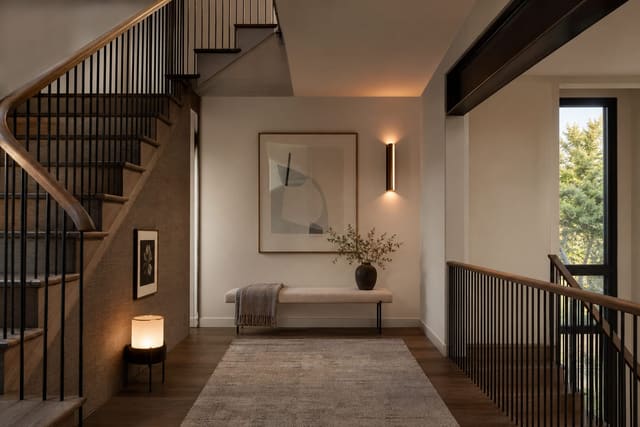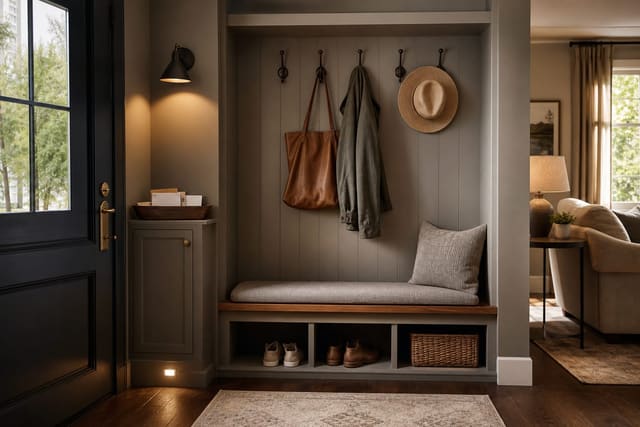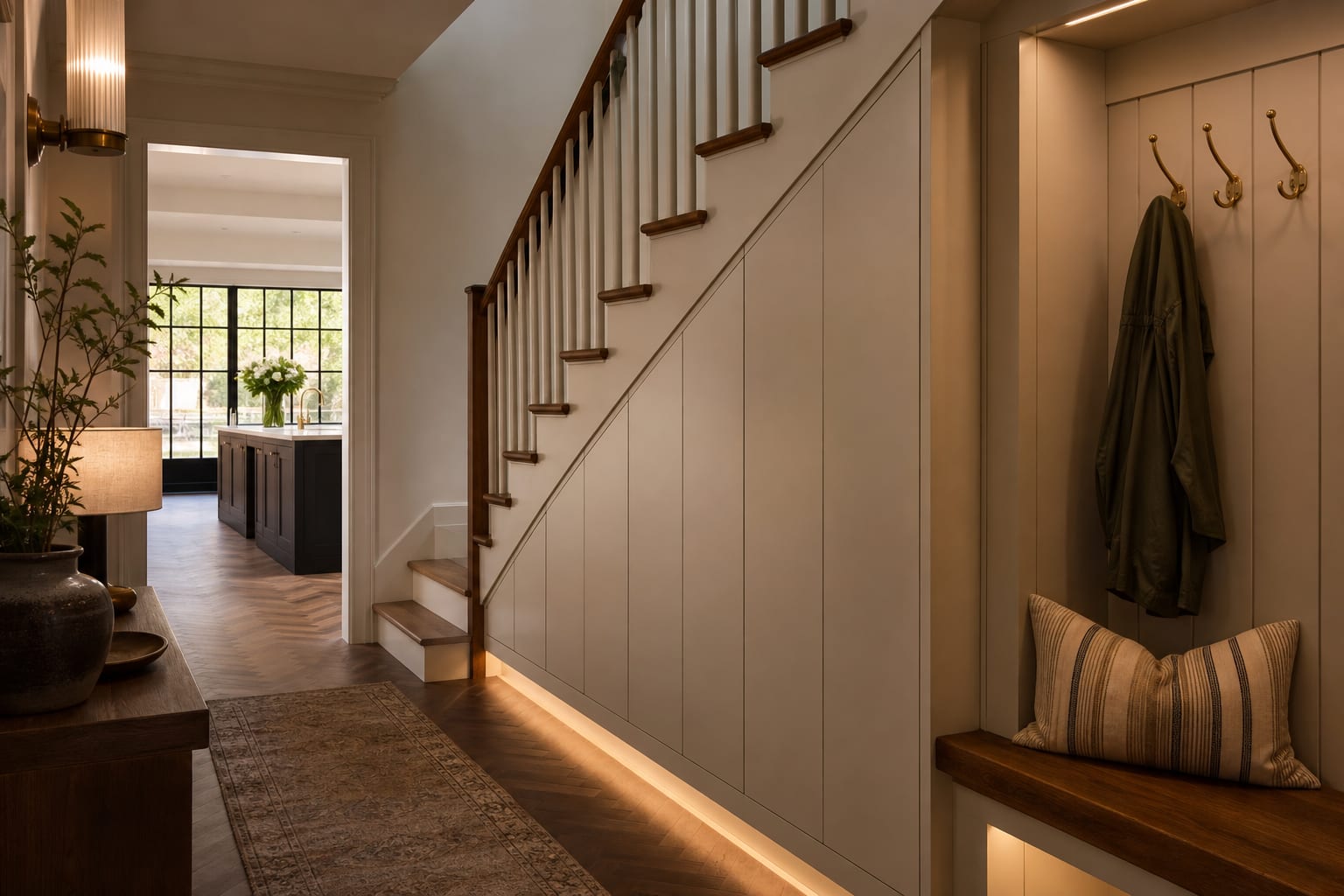
Under-stair storage works as a coat closet, pull-out drawer system, built-in bookshelves, a small powder room, or a wine and bar zone, and the right pick depends on stair geometry, adjacent room function, and budget. The best under stair storage ideas are usually the quietest ones, not the cleverest ones: a staircase already creates a strong diagonal line, so anything built beneath it has to look intentional from the hallway. The right configuration depends on depth, head height, traffic, and what your home is genuinely short on.
What can you do with the space under stairs?
The void can become closed cabinets, pull-out drawers, coat and shoe storage, a compact pantry, a reading bench, a workstation, a wine or coffee bar, pet storage, or a small utility zone when plumbing and clearances allow it. The deciding question is not "what fits?" but "what problem sits closest to the stairs?"
Near a front door, treat the space as entry infrastructure. Coats need hanging depth around 22"-24", shoes need shelves around 10"-12" deep, and a 16"-18" high bench needs at least 30" of clear floor in front or it becomes an obstacle.
Near a kitchen, pantry storage may beat another bench. Use shallow shelves (8"-10" deep) for cans and jars, and deeper lower cabinets for appliances or paper goods; deep triangular shelves are where boxes disappear.
If the staircase is visually dominant, match rail color, tread stain, or wall trim so the storage feels built in. See these staircase design ideas for real homes to decide whether storage should blend in or become the feature.
Which configuration fits your staircase and hallway?
A straight stair with a solid wall below is the easiest candidate for cabinets, drawers, or a closet door. An open stringer stair is harder because storage can make it feel heavy; use low drawers, a bench, or freestanding pieces that preserve the tread rhythm.
Pull-out drawers suit shoes, sports gear, toys, pet supplies, and seasonal accessories. Keep each drawer to about 30"-36" wide and leave a clear pull zone equal to the drawer depth (a 24" deep drawer needs roughly 24" in front, plus room for your body).
Hinged cabinet doors look calmer in a formal hallway but need swing clearance; if a door opens into the walking path, use sliding panels, touch-latch doors, or smaller bays. Flat slab fronts suit modern homes; shaker fronts suit older houses with existing trim profile.
Open cubbies only work when contents stay visually consistent - use them for baskets, books, or display, and put daily-use items behind doors instead.
A desk nook can work if head height is honest: aim for at least 30" of knee width, a 24"-30" deep surface, and enough height that the seated person is not leaning away from the slope. Busy routes favor a closed cabinet over a desk that gets brushed by every passerby.
Test this on your own room photo with ReDesign before you choose the final direction; keep the doorway, walls, windows, main furniture, lighting, and fixed features visible.
The storage details that make under-stair cabinets work
The diagonal cut line should follow the staircase cleanly, with reveals around 1/8"-3/16" on cabinet fronts, avoiding a filler strip that advertises a bad measurement.
Depth should change by category: shoes need less depth than coats, coats less than vacuum storage, and a pantry needs better visibility than a utility closet. I like shallow side cubbies, deeper lower drawers, and one full-height bay for brooms or a cordless vacuum, with an outlet inside only if it can be installed safely.
Lighting matters because the underside of a stair can become a cave. A recessed puck, LED strip, or door-triggered light around 2700K-3000K, placed toward the front third of the cabinet, keeps the storage usable.
Ventilation matters for coats, shoes, dog gear, or a litter zone: add grille cuts, cane panels, louvered doors, or a toe-kick gap so damp items do not go stale.
Study the sightline from the landing before choosing handles or paint. These staircase landing design ideas help since the cabinet is often seen with the landing, rail, and floor at once. Choose small knobs, recessed pulls, or push latches so hardware does not fight the slope, and avoid pulls that catch backpack straps at hip height.
Common under-stair storage mistakes
- Copying a wide-foyer built-in into a narrow hall. If it leaves less than 36" of passage, use shallower storage or a bench with closed storage below instead.
- Making the deepest corner an everyday spot. Reserve the lowest, deepest point for rarely used luggage or holiday decor, and keep daily items near the tallest opening.
- Ignoring the stair structure. Under-stair walls may hide stringers, wiring, plumbing, or fire-blocking; confirm what is structural and code-required before cutting in.
- Defaulting to open shelving. It collects odd shoes, mail, helmets, and tote bags; near an entry, use doors and drawers first and save one niche for styling.
- Forgetting the rest of the hallway. New storage can make a narrow passage feel tighter if wall color, flooring, and lighting do not support it — see these hallway design ideas for narrow spaces.
Use AI to preview your under-stair storage before you build
AI design suits under-stair storage because the shape is unforgiving; a cabinet that looks clever in plan can look bulky from the doorway. Upload a straight-on photo of the staircase plus a second from the hallway approach, keeping rail, tread color, trim, floor, and existing clutter visible so the preview tests storage against the real mess.
Preview separate versions before combining features: full-height closed cabinets, pull-out shoe drawers, a mudroom bench, a pantry wall, and a desk niche if the location works. Try cabinet fronts matching the wall in one version and the stair trim in another, since a subtle color difference decides whether storage feels integrated or pasted on.
Check where doors open, whether a bench blocks the path, whether the diagonal line feels clean, and whether the darkest corner needs a light. Then translate the winning preview into real dimensions - cabinet depth, drawer width, bench height, hook height, shelf depth, lighting location, clear walkway - before ordering.
Renters can go freestanding: a low cabinet, narrow shoe bench, tension-mounted coat rail, or modular cube unit uses the space without cutting the wall. Owners can use the preview to decide whether custom millwork earns its cost or a clean closet door solves it with less visual noise.
Frequently Asked Questions
Which under-stair use returns the most value?
A coat closet returns the most value in homes without an entry closet, pull-out drawers return the most everyday usability, and a powder room returns the most at resale in homes without a main-floor half-bath.
How much does an under-stair build cost?
Open shelving or drawers run $500-2000 DIY or $2000-5000 with a finish carpenter; a built-in powder room runs $8000-15000 due to plumbing; a wine bar zone runs $2000-4000 depending on millwork.
Can I install a closet rod under the stair slope?
Only for short coats and bags, since the slope cuts hanging height near the bottom; pull-out drawers or open shelving make better use of the angled space.
Should under-stair storage match the staircase finish?
Yes. Matching the wood or paint finish makes the storage read as built-in rather than added on, while a contrasting finish makes it look like a retrofit.
Does AI preview under-stair builds?
Yes. Upload the under-stair photo and AI previews closet, drawer, shelving, and powder-room layouts before any build commitment.
> Try this: Ready to see this on your own room? Open ReDesign and run the preview.
Three transformations to try
1. Under-stair coat closet with hooks 2. Pull-out drawers under stair slope 3. Built-in bookshelves matching stair finish