A sunken living room is one of the few architectural features that physically defines a space without a single wall. The step down creates a boundary that feels both grand and intimate — you know exactly where the conversation pit begins, and stepping into it feels like a deliberate arrival.
The look fell out of fashion in the 1990s, but it is back with a sharper edge. Contemporary versions use clean-lined built-in seating, restrained material palettes, and lower ceiling treatments to make the pit feel considered rather than retro. These sunken living room ideas work whether you are building from scratch or adapting an existing recessed area into something worth keeping.
Defining the Pit: Dimensions and the Step Down
The structural decision you make first is how far the floor drops. A 12-inch step is the practical minimum — enough for visual separation without requiring a handrail under most building codes, though always verify locally. An 18-inch drop reads more dramatically and allows for built-in seating with storage underneath, which is worth the additional structural work if you are renovating.
Plan the pit footprint before finalizing seating. A square or rectangular pit that measures at least 10 by 12 feet gives you room for a sofa, a coffee table, and two chairs without crowding. Smaller pits work better with continuous built-in benches around three walls and a low table at the center — less floor area is needed because the seating is integrated into the structure.
The perimeter ledge — the flat area at upper-floor level surrounding the pit — should be at least 18 inches wide if you want people to sit on its edge casually. Narrower ledges read as purely architectural trim rather than usable surface, which is also a valid choice if you prefer a cleaner boundary.
See also our guide to Mid Century Modern Living Room Ideas for more on sunken living room ideas.
Built-In Seating and the Conversation Pit Configuration
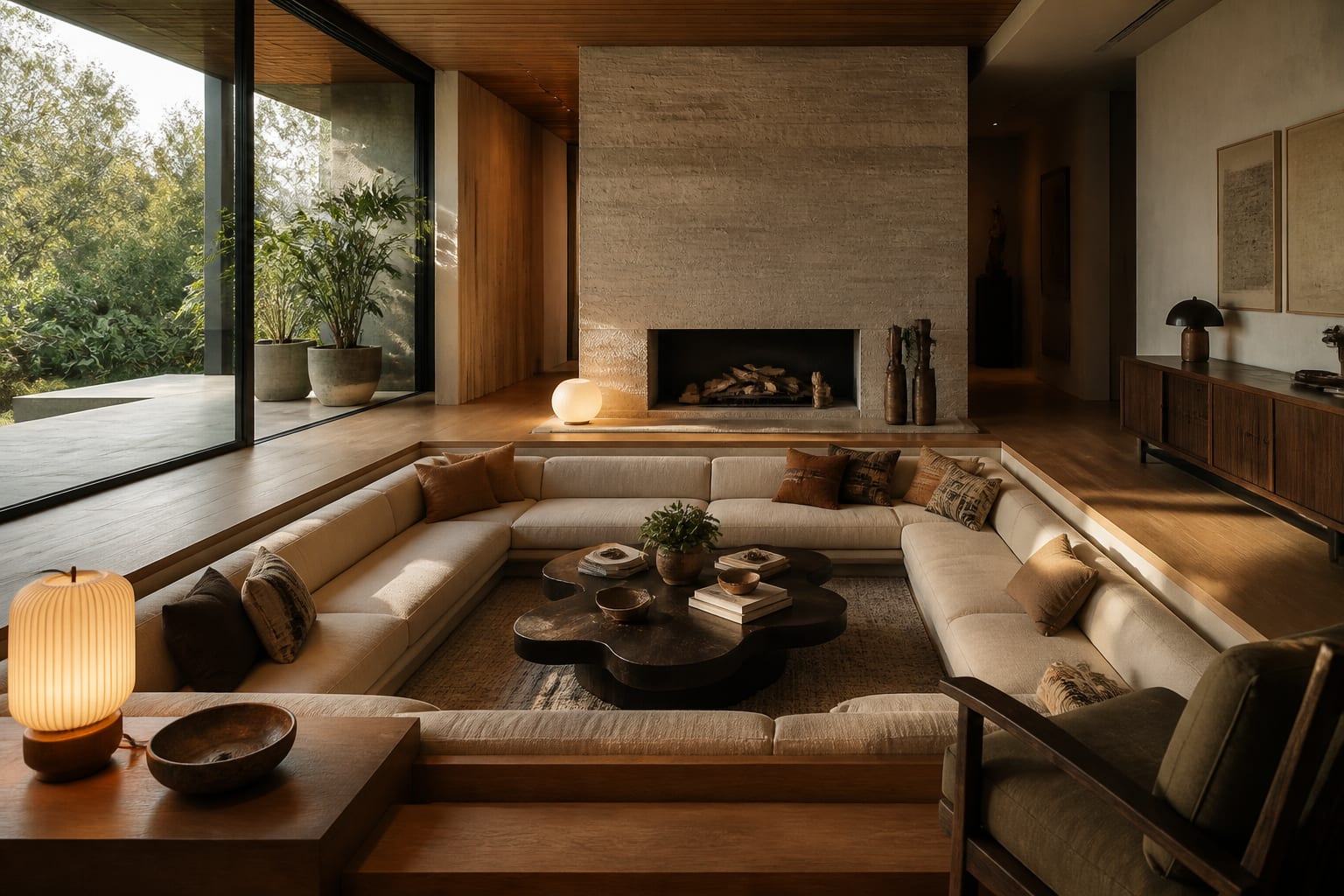
The conversation pit format — seating arranged on all four sides facing inward around a central coffee table — is the defining feature of a sunken living room done well. Built-in benches make this possible in tight spaces where freestanding sofas would eat every square inch of floor. Upholstered bench cushions in a performance fabric keep the look soft while standing up to daily use.
For a more flexible layout, use a large sectional sofa along two or three walls of the pit and leave one side open as the entry point. This reads as a modern living room that happens to be lower, rather than a pure conversation pit. Low-profile sectionals with a seat height under 15 inches are proportionally correct in a sunken space — standard-height sofas make the pit look shallower than it is.
Corner seating positions are the most coveted spots in any pit layout. Build in extra cushion depth at corners — 24 inches rather than the standard 20 — so two people can share the corner comfortably. This small dimensional upgrade makes the space genuinely inviting rather than just visually interesting.
For a related angle on sunken living room ideas, read Cottagecore Living Room Ideas.
Materials and Finishes for a Step-Down Floor
The material contrast between the pit floor and the surrounding room floor is one of the strongest design tools available. Polished concrete or large-format stone tile in the pit against wide-plank hardwood at the upper level creates an immediate, legible boundary that reads as intentional architecture rather than accident.
For warmer results, a cut-pile or low-pile rug covering the entire pit floor — fitted to the exact dimensions — makes the space feel like a furnished room within a room. This works especially well in open-plan homes where the pit needs acoustic separation as much as visual separation. Choose a rug with a tight, dense weave: high-pile rugs look ungainly against built-in seating and collect debris at the step edge.
Step risers deserve material attention too. Clad them in the same stone or tile as the pit floor so they read as part of the lower zone rather than as raw construction. Alternatively, a contrasting material on the riser face — brass, dark wood, or painted plaster — draws the eye to the transition and makes the step itself a design feature.
Lighting a Sunken Living Room
Overhead lighting becomes complicated in a sunken space because the ceiling is now farther from the seated eye level than in a standard room. Recessed downlights positioned directly over the pit can create a spotlight effect that feels harsh and institutional. A better approach is to light the pit from below and from the sides rather than from above.
Step riser lighting is the most functional option: LED strip lights recessed into the riser face illuminate the tread of each step without spilling upward. They serve a safety purpose at night and give the pit a defined, warm glow that reads as architectural detail from across the room. Keep the color temperature at 2700K to 3000K — cooler temperatures make the recessed effect feel clinical.
Floor lamps positioned at the corners of the pit provide the uplighting and ambient fill that overhead fixtures cannot deliver at the right angle. Because the pit sits lower, a floor lamp at pit-floor level brings the light source closer to seated eye level, which is exactly where it should be. Pendant lights hung from the ceiling above the pit work well if they drop low enough — aim for a bottom clearance of 5 feet from the pit floor.
- Drop the pit floor exactly 18 inches to allow built-in bench storage underneath the seating platform.
- Tile only the pit floor in large-format stone and leave the surrounding level in hardwood for clear visual contrast.
- Fit built-in bench cushions at three walls with a 24-inch corner depth for comfortable shared seating.
- Recess LED strip lights into each step riser at 2700K for safe, dramatic accent lighting.
- Use a custom-cut low-pile rug fitted to the pit footprint to add warmth and acoustic separation.
- Select a sectional with a seat height under 15 inches so it stays proportional in the lowered space.
- Hang a pendant light above the pit center, dropping the fixture to 5 feet above the pit floor for correct scale.
Bring the look home with Re-Design
Wondering whether a sunken living room will actually work in your space before you break any concrete? Re-Design lets you upload a photo of your current room and preview the step-down look with AI, including different seating configurations, flooring contrasts, and lighting setups. Seeing the result in your own room removes most of the uncertainty that comes with a structural change like this.
Frequently Asked Questions
How much does it cost to build a sunken living room?
Costs vary widely based on structural complexity, but a single-step drop with a concrete subfloor modification typically runs between $10,000 and $25,000 including materials and labor in most US markets. Built-in seating and custom flooring add to that baseline. Always consult a structural engineer before removing or altering the subfloor.
Are sunken living rooms a safety hazard?
A single step of 12 to 18 inches is manageable for most people and generally does not require a railing under residential building codes, but local codes vary. Riser lighting, a contrasting material at the step edge, and a clear entry point on one side reduce trip risk significantly. Households with young children or mobility concerns should evaluate carefully.
Can you add a sunken living room to an existing house?
Yes, but it requires a structural assessment first. The subfloor and joists must support the modification, and you need to confirm there are no utilities running through the area you plan to lower. In slab-on-grade construction, a sunken pit means cutting and re-pouring concrete, which is feasible but adds cost and complexity compared to a wood-frame floor system.