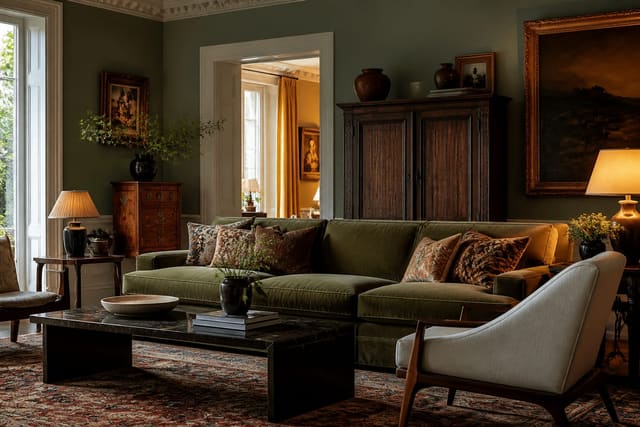
Designers shop thrift stores constantly, and not to save a few dollars. They go because the bones of older furniture are often better than anything at a big-box store, and because a room full of pieces with history reads as collected rather than ordered off a single page. The trick is knowing what is worth carrying home and what is someone else's problem dressed up as a bargain. A solid oak dresser for $40 is a win; a sagging particleboard bookcase for $10 is a slow-motion mistake. Learn the few checks below and you will walk past the junk and grab the gems.
Where thrift stores beat the furniture store
The reason secondhand works is simple: a lot of older furniture was built from solid hardwood with dovetailed joints, and that construction outlasts the stapled particleboard that fills most stores today. A 1970s teak credenza or a maple dresser from the 1950s has already survived 50 years and will easily do another 50. You are buying engineering that is no longer cheap to manufacture, often for less than the cost of a flat-pack version that will wobble within two years.
The second advantage is character. Thrifted pieces carry patina, odd proportions, and finishes you cannot order new, and that variety is what keeps a room from looking like a showroom. If your space already reads dim or flat, a heavy vintage mirror or a brass lamp can add reflectivity and warmth a catalog piece never will. Rooms starved of natural light especially benefit from secondhand mirrors and metallics, and our guide to brightening a dark room shows how reflective surfaces multiply what little light you have. Thrifting is also how you mix eras without buying a matched set, which is exactly the texture a layered room needs.
There is a budget argument too, and it is bigger than people expect. A solid-wood dresser that retails for $700 to $1,200 new turns up secondhand for $30 to $90, and a quality table lamp that costs $120 in a store sits on a thrift shelf for $10 to $20. Over a full room, sourcing the structural and accent pieces used rather than new routinely cuts the spend by 60 to 80 percent. That saving is what lets you pair high-quality bones with a few new splurges, and the mismatched-era look that results is precisely what designers chase when they mix design styles on purpose. A single space can also stretch further when secondhand finds do double duty, which is the whole premise behind dual-purpose room ideas where one thrifted piece serves two jobs.
What to buy and what to leave behind
Not every category is a smart secondhand bet. The winners are pieces where construction or material quality matters more than newness, and the losers are anything where hidden wear or non-repairable materials hide the real cost. Use this split as your shopping filter:
- Buy solid-wood dressers, desks, and nightstands, since a $30 sand-and-paint job makes them look like a $600 piece.
- Grab real wood or gilt frames and original art, because framing alone often costs more than the whole secondhand find.
- Take lamps with intact cords and brass or ceramic bases, then add a fresh shade for $20 to $35.
- Snap up mirrors with solid frames and clean silvering, which run $80 to $300 new for the same size.
- Skip upholstered sofas and chairs unless the frame is hardwood and you plan to reupholster, since stains and odors hide inside the padding.
- Walk away from laminate or melamine furniture, which cannot be sanded or refinished once the surface chips.
The categories to grab share a trait: they are structurally sound and cosmetically fixable. The ones to skip share the opposite, where the damage is internal or the material refuses repair. Lamps, frames, and mirrors are the lowest-risk buys because what you see is what you get, and a $12 lamp with a $25 shade looks identical to a $90 store version.
Common mistakes to avoid
Most thrifting regrets come from buying with your eyes instead of your hands. Run through these before anything goes in the cart:
- Trusting a pretty finish without knocking on the wood, then discovering at home that the dresser is hollow veneer that chips the moment you sand it.
- Buying an upholstered chair for the fabric, ignoring a cracked frame or a musty smell that no cleaning will ever fully remove.
- Overpaying because a tag says vintage, when the same mass-produced lamp sits at three other shops for half the price.
- Skipping the drawer test, so you get home to find runners that bind and a top drawer that will not close flush.
- Ignoring mirror damage, since black spots where the silvering has failed only spread and cannot be repaired affordably.
- Falling for a project you will never start, leaving a half-stripped table in the garage for a year instead of a finished piece in the room.
The drawer-and-joint check takes ten seconds and saves the most grief. Pull every drawer fully out, wiggle the legs, and press on any joint that looks loose. A solid piece feels tight and heavy; a doomed one rattles, racks, or smells.
Preview your thrift finds in Re-Design
Frequently Asked Questions
How can I tell if thrifted furniture is solid wood?
Knock on the side or a drawer front: solid wood sounds dense and dull, while veneer over particleboard sounds hollow and light. Check the bottom and back for a uniform grain that wraps around edges, since real wood shows continuous grain and laminate shows a printed pattern that stops at the seam. Lift one corner, too, because solid hardwood is noticeably heavier than its particleboard lookalike.
What should I never buy secondhand?
Avoid upholstered sofas and chairs unless the frame is hardwood and you intend to reupholster, since stains, odors, and pests hide in the padding. Skip laminate or melamine furniture, which cannot be sanded or refinished once it chips. Pass on mirrors with failing silvering, mattresses, and anything with structural sag, because those flaws are either unsanitary or not worth the cost to fix.
Is it worth painting or refinishing thrift finds?
Yes, when the piece is solid wood. A $15 to $40 budget for primer, paint, and new hardware turns a dated but sturdy dresser into something that looks custom. Stick to refinishing solid-wood pieces only, since laminate will not hold paint or take a sand, and choose drawer pulls that update the proportions rather than just the color.