Under about 150 sq ft, a U-shaped kitchen without an island beats an island layout on counter and storage every time; past 180 sq ft, an island starts to earn its keep. In the 150-180 sq ft gray zone, skip the forced island and pair the U-shape with a peninsula, banquette, or tall pantry wall instead.
How does a U-shape compare to an island layout?
A U-shape delivers more counter per sq ft than an island layout because three walls do the work two walls plus an island normally split. The tradeoff is aisle width: a U-shape needs one 48 in. clear aisle, while an island needs that same 48 in. on both sides — which is why islands fail in rooms under 12 ft wide.
Full-height uppers on all three walls give roughly 25-35% more cabinet volume than a galley-plus-island layout, since islands usually trade uppers for a seating overhang. Confirm the work triangle stays under 26 ft of total path with a tested kitchen layout guide before locking cabinets.
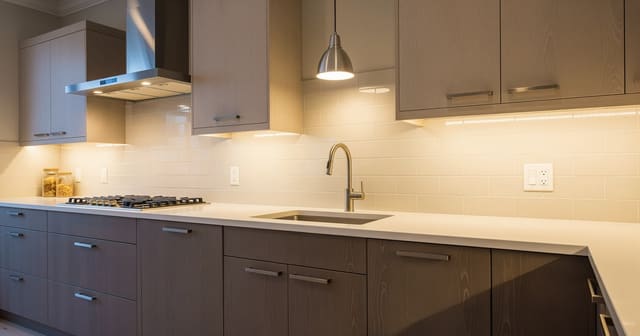
A U-shape can read darker than an island kitchen since cabinetry wraps three walls. Plan a 36 in. window over the sink, match upper-cabinet paint to the wall color, and run 200-300 lumens per linear foot of counter at 2700-3000K throughout.
The decision matrix: when a U-shape beats an island
Most island-versus-U debates skip the room math. Check the matrix before drawing a single cabinet line.
| Kitchen size | Better layout | Why | Spec to respect |
|---|---|---|---|
| Under 120 sq ft | U-shape, no peninsula | Island steals the work triangle | 42-48 in. center aisle minimum |
| 120-150 sq ft | U-shape with peninsula | Adds seating without a second 48 in. aisle | 24 in. seating overhang for two stools |
| 150-180 sq ft | U-shape with banquette | Seats 4-6 without taking any counter | 36-42 in. bench, 30 in. table height |
| 180-220 sq ft | U-shape OR small island | Either works; island only wins with 48 in. on all sides | 48 in. clear on all sides of any island |
| Over 220 sq ft | Island layout pulls ahead | Second prep zone earns its footprint | 60 in. clear on the cleanup-side aisle |
The most common error is treating an island as a status object rather than a tool. An island under 4 ft by 2 ft rarely out-performs a peninsula of the same footprint. If the room can't fit a 4 ft by 4 ft island with 48 in. clear on all sides, a U-shape with a peninsula will out-cook and out-store it.
Preview a U-shape layout on your kitchen photo before ordering cabinets.
What to put in the open end of the U
The open end of a U-shaped kitchen is the most wasted space in most plans. Pick one of these five moves:
- Banquette: seats 4-6 in 36-42 in. of wall width; stores linens under the bench.
- Tall pantry wall: 84-96 in. of stacked storage in 24 in. of depth.
- Peninsula: 24-30 in. deep, 48-72 in. long; seats 2-3 and adds a second prep surface with no second aisle.
- Landing zone: 36-48 in. of open counter for groceries or a coffee station.
- Tall cabinet bank: hides a full-size fridge and wall ovens in 36 in. of run, freeing the back wall for prep.
The banquette is the most under-used option. A 42 in. by 60 in. nook seats four adults comfortably and beats a 4 ft island for real family dinners. Pair it with a 30 in. round table and a 2700K pendant hung 32-36 in. above it.
Common U-shape kitchen mistakes to avoid
- Forcing an island without 48 in. clear on every side. The result is two pinched aisles and a weak prep counter — choose a peninsula or banquette instead.
- Treating all three walls the same. Sink handles cleanup, cooktop handles heat, fridge handles grocery flow; scattering the dishwasher or trash across the room breaks the flow even when aisle math is fine.
- Dark cabinets without enough light. Walnut or charcoal uppers absorb 30-40% more light than white ones. Run a dark kitchen feel bright audit if the room already feels dim.
- Mixing light temperatures. Cool 4000K LED strip under warm 2700K pendants reads as a defect — pick one temperature and match every fixture using a task lighting kitchen placement plan.
- Forgetting the trash. Keep a pull-out trash cabinet within 24 in. of the sink and 36 in. of prep; a floor can almost always ends up blocking traffic.
Use AI design to preview a U-shape before you commit
Layout decisions are the costliest to reverse in a kitchen. Upload one photo from the entry doorway showing both side walls and the back wall, then test a U-shape with a peninsula, one with a banquette, and one with a tall pantry wall from the same angle.
Be specific in the prompt: painted lower cabinets, walnut uppers on one wall, a 60 in. peninsula with two stools, a 36 in. window over the sink. If the preview reads narrow, that's a warning before the cabinet bid lands; if the banquette version suddenly feels like real eating space, that's likely the right call.
Frequently Asked Questions
What is the minimum kitchen size for an island instead of a U-shape?
About 180-200 sq ft of clear floor with both aisles at 48 in. is the practical minimum for an island that out-performs a U-shape with a peninsula. Below that, the island either steals an aisle or shrinks below the 4 ft by 4 ft size where it stops being a real prep surface. In rooms 12 ft wide or less, a U-shape almost always wins.
Does a U-shape kitchen feel cramped?
Only when the center aisle drops below 42 in. or all three walls run dark cabinets without enough task lighting. A 48 in. center aisle, upper cabinets matched to the wall color, and 200-300 lumens per linear foot at 2700K keep a U-shape feeling open even in 100-120 sq ft kitchens.
Where do you put the trash in a U-shaped kitchen?
In a pull-out cabinet within 24 in. of the sink and 36 in. of the main prep counter. A 15 in. wide double-bin pull-out fits between the sink base and dishwasher in most U-shapes. Avoid a floor can; it always ends up in the one traffic path the U-shape needs clear.
Is a peninsula a real substitute for an island?
Yes, when the open end of the U-shape backs onto a dining or living room. A 60-72 in. peninsula at 24-30 in. deep gives the same seating and prep value as a similarly sized island while needing only one aisle instead of two. It loses to an island only in true open-plan rooms where 360-degree access matters.
What is the best appliance layout in a U-shape?
Sink on one wall under a window, cooktop on the opposite wall with the range hood, and fridge on the connecting wall nearest the entry. This keeps the work triangle under 26 ft of total path, isolates the heat-and-exhaust zone, and lets groceries land within 36 in. of the fridge without crossing the cooking zone.
Can you fit a banquette in a small U-shape?
Yes, in 36-42 in. of wall width at the open end of the U. A 30 in. round table with a 42 in. wide bench seats four adults and frees the entire back wall for prep. Keep the bench seat 18-19 in. deep and 18 in. high; deeper benches eat the aisle and shallower ones feel like a hallway perch.