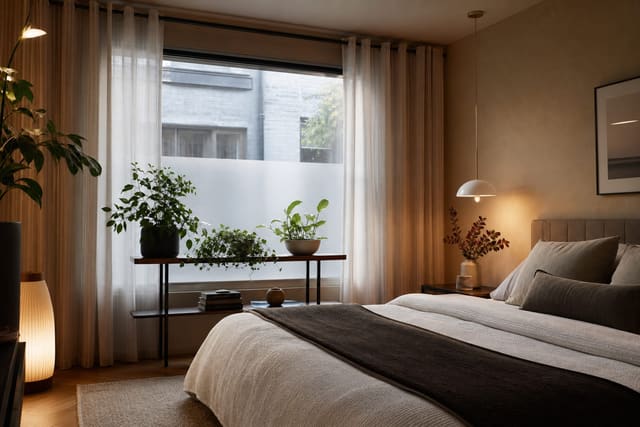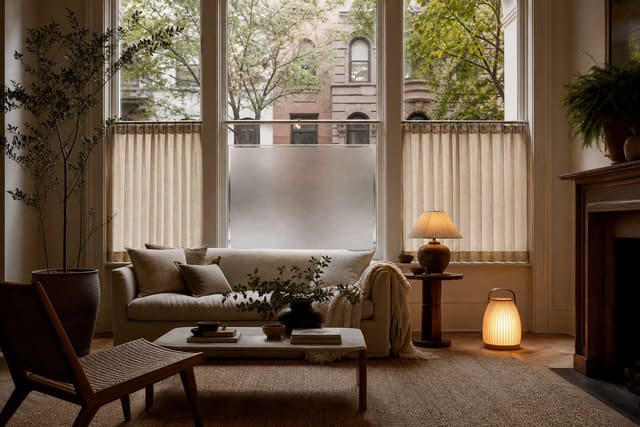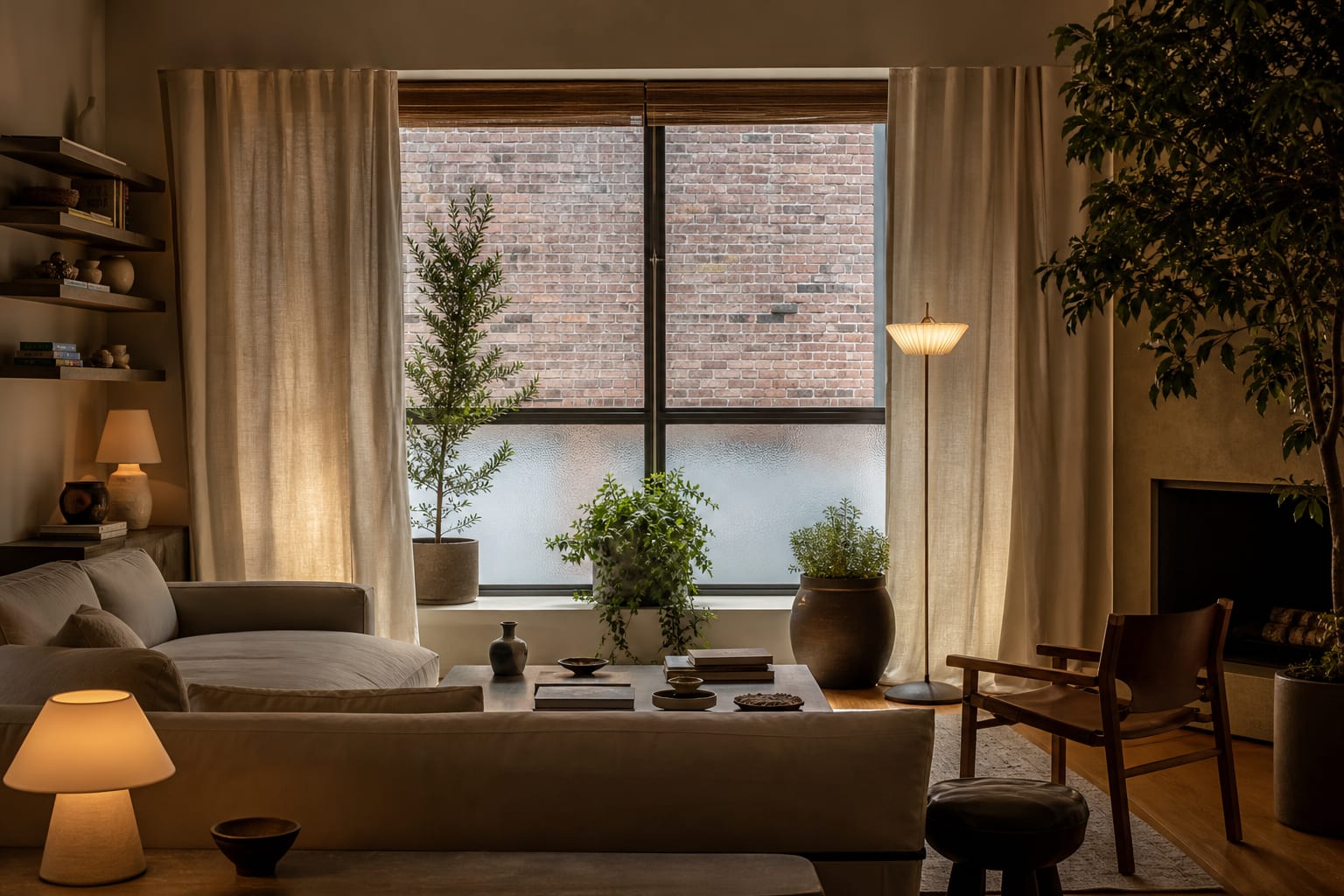
The best window facing brick wall treatment layers privacy film or sheers to soften the glass, adds a warm lamp to replace lost daylight, and treats the sill as a vignette with plants or art so the brick reads as backdrop, not obstruction. Skip heavy blackout drapes — there's no view to block, only light to protect.
What do you do with a window that looks at a brick wall?
Control privacy first, then soften the glass, add depth in front of it, and replace the missing view with light, texture, or greenery. Don't cover the window completely unless the room already gets plenty of daylight elsewhere.
Decide how much brick you actually need to hide. If the wall is close, dark, or pipe-covered, frosted film on the lower two-thirds of the glass keeps daylight moving while blurring the eyesore. If the brick is warm and textural, frame it instead of erasing it.
For renters, static-cling film in plain frosted, reeded, or rice-paper patterns is the least dramatic first move — skip faux stained glass. Cut it with a sharp blade and leave a small margin so water doesn't lift the corners. If the real issue is a close neighbor rather than an ugly wall, the same blur-the-sightline logic applies in street-level window privacy ideas.
Then add a soft interior layer — curtains, Roman shades, woven shades, or café panels — so the window has thickness and shadow even though the outside view is flat.
Which treatment should hide the wall, and which should frame it?
- Hide it if the brick is grimy, too close, or visually noisy. Hang drapery 4-6 inches above the casing, extending the rod 6-10 inches past each side so fabric rests on the wall when open. Use tension rods or adhesive brackets in rentals; see no-damage curtain mounting before drilling old plaster.
- Use a Roman shade over a radiator, desk, or narrow passage where long drapery is impractical. Mount it outside the frame for better coverage, in linen or cotton in warm white, oatmeal, clay, or muted green — pure white can make a dirty wall look dirtier.
- Frame it if the brick has character. Use sheers, a roller shade, or a café curtain covering only the lower half. Add a 6-8 inch sill shelf with a few backlit objects: translucent glass, a trailing plant, a ceramic lamp.
- Add plants if the room gets reflected light, especially south- or west-facing. Pothos, philodendron, ZZ plant, snake plant, or a small fern tolerate lower light. Keep taller plants 12-24 inches off the glass so leaves don't flatten into a neglected-greenhouse look.
Test these options on your own room photo with ReDesign — keep the doorway, walls, windows, and main furniture visible so the preview solves the room you actually have.
How can lighting make a no-view window feel intentional?
Brick bounces color into a room: red brick warms it, gray brick chills it, dirty beige drains it. Interior lighting should correct that mood rather than compete with it.
Mount a warm plug-in sconce 48-60 inches up beside the casing, or use a table lamp with a fabric shade to spread light across the curtain. Use 2700K bulbs for bedrooms and living rooms, 3000K for kitchens and offices.
If the room stays dark all day, don't rely on one ceiling fixture. Layer a window-adjacent lamp, a task light where you sit, and a mirror on a side wall — a mirror directly facing the brick just doubles the bad view, while one perpendicular to the window catches light without centering the wall.
For rooms with almost no usable daylight, borrow techniques from fake natural light for any room, especially warm diffusion and concealed LED sources placed where a window would naturally brighten a surface.
Common mistakes to avoid
- Blackout curtains all day. This solves the wall and creates a cave. Keep at least one daytime layer — sheer fabric, frosted film, or a top-down bottom-up shade.
- Busy patterned film. It looks charming online and cheap at full window scale. Use quieter frosted, ribbed, or matte glass instead.
- A cluttered sill. Random candles and mail signal a problem zone. Edit to three to five objects with at least 4 inches of height variation.
- Furniture facing the window head-on. Angle a desk 30-45 degrees or place a chair beside the window so brick sits in your peripheral view, not dead ahead.
- Stark white trim. It sharpens the contrast with the brick. A slightly warmer wall color often calms the whole opening.
Use AI design to preview the window before you commit
Film, fabric, plants, lamps, and furniture angle all change how a brick-facing window feels, and a subtle-looking product can turn out too flat once it's next to your actual sofa or cabinets. Photograph the room from a corner in daylight so the window, adjacent wall, and main furniture are all visible — don't crop tight around the glass.
Request a few controlled versions: frosted lower glass with linen curtains, a woven Roman shade with a sill shelf, café curtains with plants, and a warmer lamp beside the casing. Keep furniture and wall color steady so you're judging the treatment, not a full makeover. If the best-looking version only works in an unrealistically empty room, keep testing — the winning design should hold up on an ordinary weekday.
Frequently Asked Questions
Should I block a brick-wall window?
Usually no. The brick is the view, and a heavy treatment that blocks it entirely just loses the window and makes the wall read as dead space. Soften instead of block.
What is the best treatment for a brick-facing window?
A sheer linen curtain or a thin cellular shade filters the muted brick view without blocking light. Reserve full blackout fabric for bedrooms or media rooms that need it for sleep or screens.
How do I add light to a brick-facing window room?
Layer two to three lamps — table, floor, and accent — since brick-facing rooms get noticeably less reflected light than rooms with an open-sky view, so the interior lighting layer carries more of the work.
Can I make the brick view a feature?
Yes. A window seat, a row of plants, or a small art grouping at the sill turns the brick into a backdrop for a designed vignette instead of an eyesore you're trying to hide.
Does AI preview brick-window rooms?
Yes. Upload a room photo and preview sheer treatments, window-seat vignettes, and lamp placement directly against your existing brick-facing window before buying anything.
> Try this: Ready to see this on your own room? Open ReDesign and run the preview.
Three transformations to try
1. Sheer linen against brick-wall view 2. Window seat with brick-wall backdrop 3. Plant collection at brick-facing sill