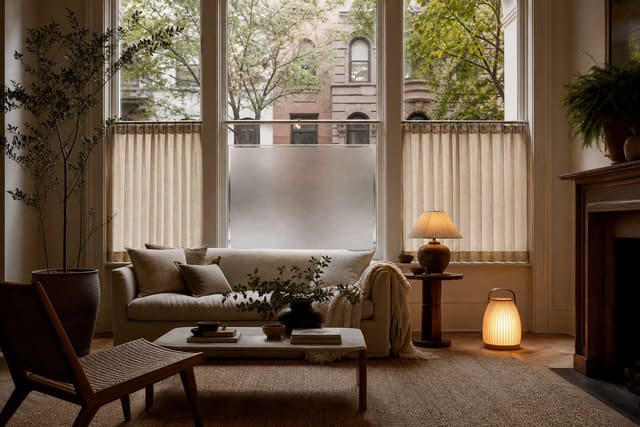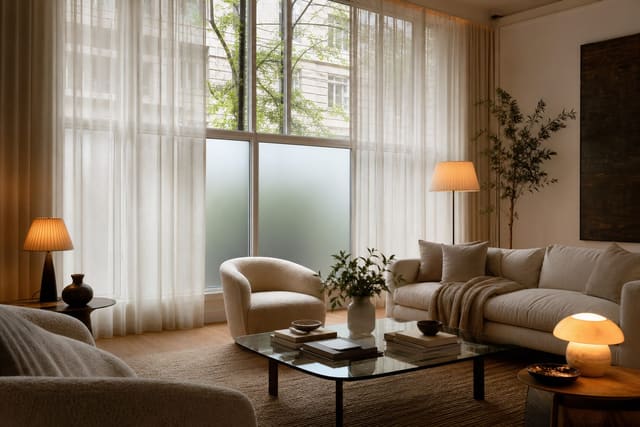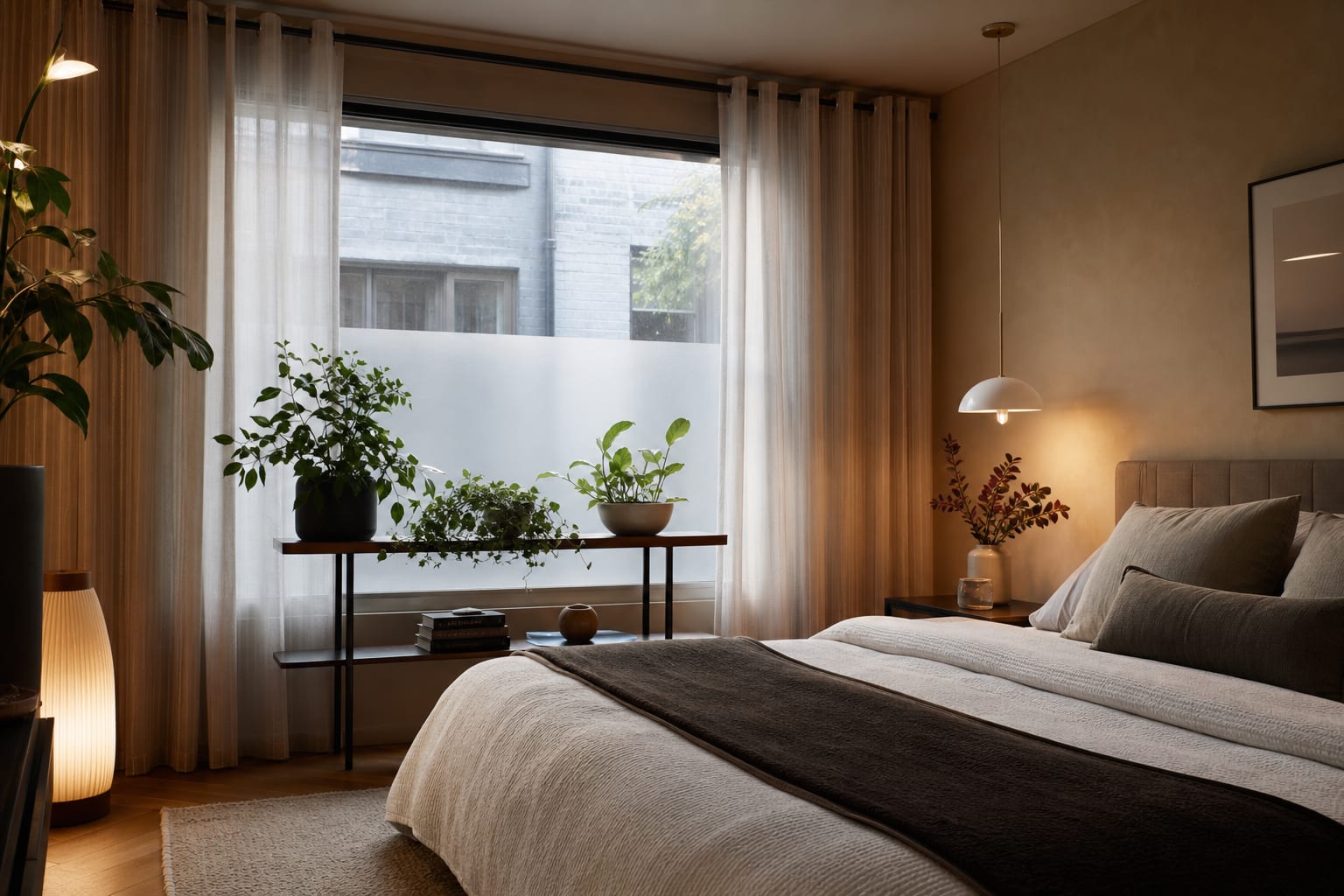
A window facing neighbors gets solved by blocking the exact eye-level sightline first, then layering light-filtering treatments — frosted film low, sheers or top-down/bottom-up shades above — so the room keeps daylight instead of going dark all day. The goal is a calm, usable window, not the thickest blackout shade you can buy.
How do you handle a window that faces your neighbor's house?
Stand where you actually use the room: beside the bed, at the desk, on the sofa, or at the sink. Mark the band of glass where your eye meets the neighbor's window; that 36–60 inch zone from the floor usually matters more than the top of the window.
Full blackout is often the wrong first move — it solves privacy by making the room feel like a cave any time you want to feel unobserved. For bedrooms, bathrooms, and street-facing rooms, layer instead: translucent film on the lower glass, fabric at the sides, and a shade for night.
If the window is tall, cover the bottom third or half with frosted film and leave the upper glass clear; shift the film upward if the neighbor's view sits higher. Renters can use static-cling film, tension rods, and inside-mount shades that need no new holes. Owners can add custom top-down/bottom-up cellular shades or exterior planting. The rule stays the same: hide the body, keep the daylight.
Which privacy layer should you choose first?
Privacy film is the cleanest first layer for direct glass-to-glass exposure. Use frosted, reeded, rice-paper, or linen-look film rather than mirrored film unless the exterior can handle a sharper look, leaving about 1/8 inch of clear glass at each edge so it doesn't buckle.
For a bedroom or office, pair film on the lower 24–36 inches with soft curtains you close at night, when interior light would otherwise turn the window into a display case. The same logic applies to ground-floor exposure in street-level window privacy ideas: block the human-height view first, then decide how open the top should be.
Hang sheers generously — rod 4–6 inches above the casing (or near the ceiling on tall windows), extended 6–10 inches past each side so panels stack off the glass by day. Linen, voile, or slubbed polyester wash easily and read better against a neighbor's siding than shiny sheers.
Top-down/bottom-up shades are the most precise interior fix: lower the top for daylight, raise the bottom for privacy. Cellular versions add softness and insulation; woven versions add texture but can gap slightly at night. A folding screen 48–60 inches high, or a narrow bookcase, can also interrupt a diagonal view — keep it shallow (10–12 inches) so it doesn't steal floor space.
Test this on your own room photo with ReDesign before buying anything, keeping the window, walls, and main furniture visible so the preview solves the room you actually have.
Common privacy mistakes to avoid
Choosing the darkest product first is the top mistake. Blackout curtains help with sleep, but closed all day they shrink a bedroom or office more than they protect it — use blackout as the nighttime layer, not the whole strategy.
Covering the wrong part of the glass is another. If the neighbor's window lines up with your torso, a shade pulled from the top may still expose the uncomfortable zone; mark the sightline with tape and treat that band specifically.
Sparse plants don't work — a single fiddle-leaf fig won't screen a lit room at 9 p.m. Use a dense plant, a matched pair, or a trellis outside instead, and keep pots below the latch if you still need to open the sash.
Avoid curtains that stop exactly at the sill unless the room is intentionally tailored; leave about 1/2 inch above the floor. And don't treat every window in a room the same — a neighbor-facing window may need film and sheers while another only needs fabric, following the layered thinking in rooms with too many windows and not enough privacy.
How does AI design help you see the fix?
Neighbor-facing windows are hard to solve in your head because the problem barely shows up in product photos. Upload a straight-on photo of the window wall and test several privacy layers before ordering anything custom.
Try one version with lower frosted film, ceiling-height linen sheers, and a warm bedside lamp with nothing bulky blocking the sash. Test a second with top-down/bottom-up shades, slim side panels, and a 10 inch plant shelf. For an office, try a woven shade, a desk turned 90 degrees from the glass, and a matte wall that won't reflect your silhouette at night.
The preview shows proportion: whether the treatment calms the room, overwhelms the trim, or crowds a corner. If it reads dim, pair the privacy layer with the tactics in faking natural light in any room — warmer bulbs, pale matte surfaces, and mirrors angled to catch real window light rather than glare.
What final checks keep the room private but bright?
Check the window twice: once in daylight, once after dark with the lights on, since the brighter side becomes the visible side at night. Stand outside or have someone check from the shared drive, alley, or sidewalk while you move normally inside.
Use bulbs around 2700K in bedrooms and living rooms, 3000K in kitchens or workrooms, and keep lamps away from the glass — a bright lamp beside a bare window makes the interior easy to read from outside.
Measure before buying: inside width at top, middle, and bottom; full height; sill depth; latch clearance; and casing-to-ceiling distance. A short rod blocks the glass even when open; a shallow frame may need an outside mount or slimmer shade.
The result should feel normal, not defensive — open in the morning without performing for the house next door, closed at night without killing all the softness.
Frequently Asked Questions
What is the best privacy treatment for a neighbor-facing window?
Top-down/bottom-up cellular shades work best — they cover the lower zone where the neighbor's sightline sits while leaving the upper glass open for sky and light, all from one product.
Should I use frosted film on neighbor-facing windows?
Yes for bathrooms and other high-privacy zones, since film gives 24/7 coverage without daily operation. In living spaces, top-down shades offer more flexibility between day and night use.
How do I keep light when neighbors are close?
Layer the window: sheers diffuse daylight while a blackout shade handles night privacy, or use a top-down cellular shade to keep the upper half clear at all times regardless of hour.
Can plants give privacy at a window?
Yes — a dense row of tall plants such as snake plant, fiddle-leaf fig, or dracaena on the sill or floor creates a soft privacy screen, especially when paired with a sheer treatment.
Does AI preview neighbor-window designs?
Yes. Upload a photo of the room and the AI previews shade systems, frosted film placement, and plant arrangements against your existing window before you buy anything.
> Try this: Ready to see this on your own room? Open ReDesign and run the preview.
Three transformations to try
1. Top-down shade with neighbor view blocked 2. Frosted privacy film on neighbor window 3. Plant privacy layer at neighbor window